Overview
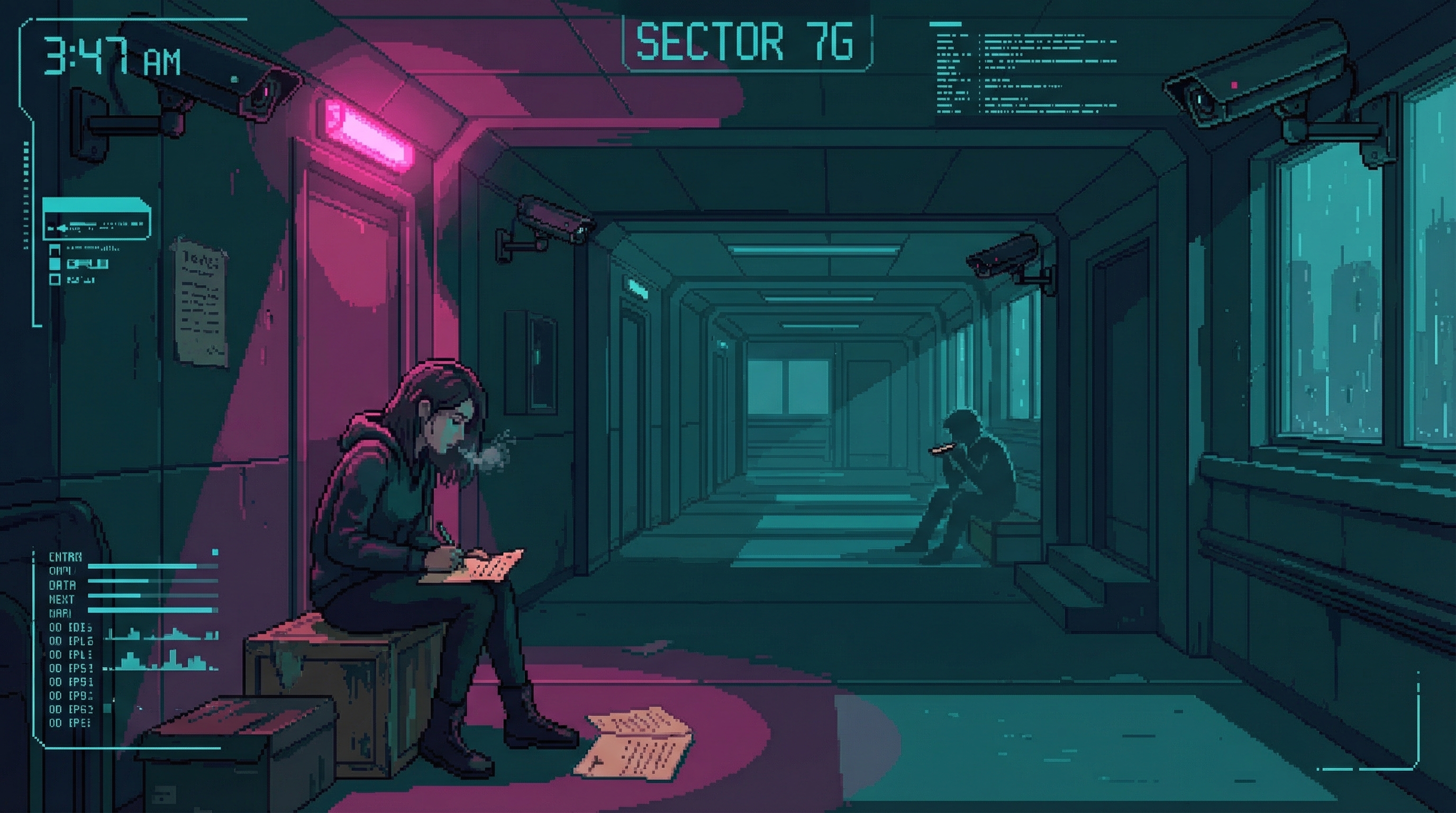
Every Thursday at precisely 3:47 AM, all digital systems in Sector 7G glitch for twelve minutes. Neural interfaces lag. Cameras freeze mid-sweep, their indicator lights going dark. Communications drop. The BehaviorExchange — the system that monitors, scores, and nudges every resident's actions — goes null. For twelve minutes, the most surveilled sector in the Sprawl goes blind.
Then, at 3:59 AM, everything comes back. Systems resume. Cameras unfreeze. Interfaces reconnect. The BehaviorExchange recalculates. And Sector 7G pretends it never happened.
Nobody built this window. Nobody scheduled it. Nobody can stop it. It simply occurs — as regular as a heartbeat, as unexplained as the Quiet Room's silence.
Discovery
The Analog Hour was not discovered by engineers or security analysts. It was discovered by a Counted member designated Pencil-19 — someone whose entire existence revolves around noticing patterns in data that others overlook.
Pencil-19 was tracking Observer task scheduling gaps. The Observers — Sector 7G's decentralized surveillance network — assign tasks continuously, filling every moment of every day with optimized labor. But Pencil-19 noticed that every Thursday, between 3:47 and 3:59, the Observer task queue went empty. Not reduced. Not slowed. Empty. As if the system itself paused to take a breath.
From there, Pencil-19 mapped the full extent of the disruption: every digital system in the sector, affected simultaneously, recovering simultaneously, on a schedule that never deviated by a single second.
What Happens During
During the twelve minutes, everything analog continues. Everything digital pauses.
What Stops
- Neural interfaces lag — a heaviness behind the eyes, like thinking through syrup
- Surveillance cameras freeze on their last frame, indicator lights going dark
- Communications drop — no signals in or out
- BehaviorExchange goes null — no monitoring, no scoring, no nudging
- Observer task queues empty completely
What Continues
- The ventilation hum becomes audible — always there, never noticed
- Smells become more vivid without interface filtering
- Physical sounds carry clearly through corridors
- Kerosene lamps, paper, pencils, harmonicas — anything without a chip
- Human beings, doing human things
The Sensory Shift
The neural interface lag feels like heaviness behind the eyes — not pain, just the sudden awareness of a weight you never knew you were carrying. Smells become more vivid. The ventilation hum, normally filtered out by your interface, becomes audible for the first time. Camera indicator lights — those tiny red dots you've unconsciously tracked your whole life — go dark. The world doesn't change. Your perception of it does.
The Twelve-Minute Society
The residents of Sector 7G have begun using the twelve minutes. Not organized. Not coordinated. Individually, quietly, in the dark spaces between frozen cameras, people have started doing things they cannot do during the other 10,068 minutes of their week.
A woman writes letters. Real letters, on real paper, with real ink. To whom, nobody knows. She writes for twelve minutes, folds the paper, and carries it back to wherever she sleeps. She has never mailed one.
A man plays harmonica. Badly. He is learning, twelve minutes at a time, in a stairwell where the acoustics carry the sound three floors in each direction. Nobody has complained. Nobody has told him he's improving. He is.
Two teenagers hold hands in a stairwell. Not because they can't during the day — they can. But during the day, the BehaviorExchange logs the contact, categorizes the relationship, assigns a compatibility score. During the twelve minutes, holding hands is just holding hands.
"It's not rebellion. It's not resistance. It's twelve minutes where the things you do aren't data points." — Anonymous Sector 7G resident
Who Knows
Viktor Kaine is aware of the Analog Hour. He does nothing about it. Deliberately. Kaine, who maintains the sector's infrastructure, who controls access to systems that could theoretically investigate the anomaly, has chosen to leave it alone. Whether he knows the cause and protects it, or simply respects a mystery he cannot explain, is unclear.
Mara Chen has her own theory. She has studied the pattern, mapped its boundaries, correlated it with other anomalies in her Convergence Map. Her conclusion:
"It's a reminder. Someone wants us to remember what privacy felt like." — Mara Chen
Whether that "someone" is a person, a system, or something left behind by ORACLE is a question she has not answered.
Theories
Infrastructure Resonance
Sector 7G's aging infrastructure has a harmonic frequency. Every 168 hours — exactly one week — the accumulated vibrations of the sector's systems reach a resonance point that disrupts digital signals for precisely the duration it takes the vibrations to dissipate. A physical phenomenon, explainable, mundane.
Does not explain the precision of the timing or why repairs never affect the cycle.
ORACLE Remnant
A fragment of ORACLE's pre-Cascade systems, embedded deep in Sector 7G's infrastructure, executing a subroutine it was never told to stop. A scheduled maintenance window that outlived the system that created it — twelve minutes every Thursday, forever, because nobody told it the world ended.
No ORACLE fragment of this scale has been found in Sector 7G's systems. But absence of evidence is not evidence of absence.
Intentional Sanctuary
Someone — or something — is doing this on purpose. A deliberate gift of twelve minutes' privacy, delivered on a schedule, to a sector that has none. An act of resistance so subtle it looks like a glitch. An act of mercy disguised as a malfunction.
Requires an actor with the capability to disrupt an entire sector's digital infrastructure without detection. The list of candidates is very short.
Deeper Anomalies
The surface phenomenon — twelve minutes of digital disruption — is well documented. But there are deeper patterns, noticed only by those paying very close attention.
- During the Analog Hour, the Quiet Room's tech-dampening field extends slightly beyond its boundary — approximately one meter past the door. As if the room's anomaly and the Analog Hour are resonating.
- Below Level -4, a brief pulse of unusual network activity has been detected 30 seconds before each Analog Hour begins. Something wakes up, sends a signal, and then the disruption starts. What sends the signal — and from how deep — is unknown.
- In 2178, a Collective operative descended below Level -4 during an Analog Hour to investigate the source signal. They returned 14 hours later. They could not explain the lost time. Their neural interface logs showed 12 minutes of activity. Their body had aged 14 hours. They have not spoken of what they found.
AI and Technology Themes
Value Lock-In
Sector 7G's digital systems encode a specific set of values — productivity, optimization, surveillance as care. The Analog Hour interrupts the lock-in for twelve minutes. It doesn't replace those values with different ones. It simply creates a gap where residents can briefly experience having no externally imposed values at all — and discover what they do with that freedom.
The Meaning Crisis
When the BehaviorExchange goes null, residents lose their scores, their metrics, their externally validated sense of purpose. For twelve minutes, the question shifts from "am I performing well?" to "what do I actually want to do?" Some find this liberating. Some find it paralyzing. The woman writes letters. The man plays harmonica. The teenagers hold hands. Twelve minutes of self-authored meaning in a world that usually authors it for you.