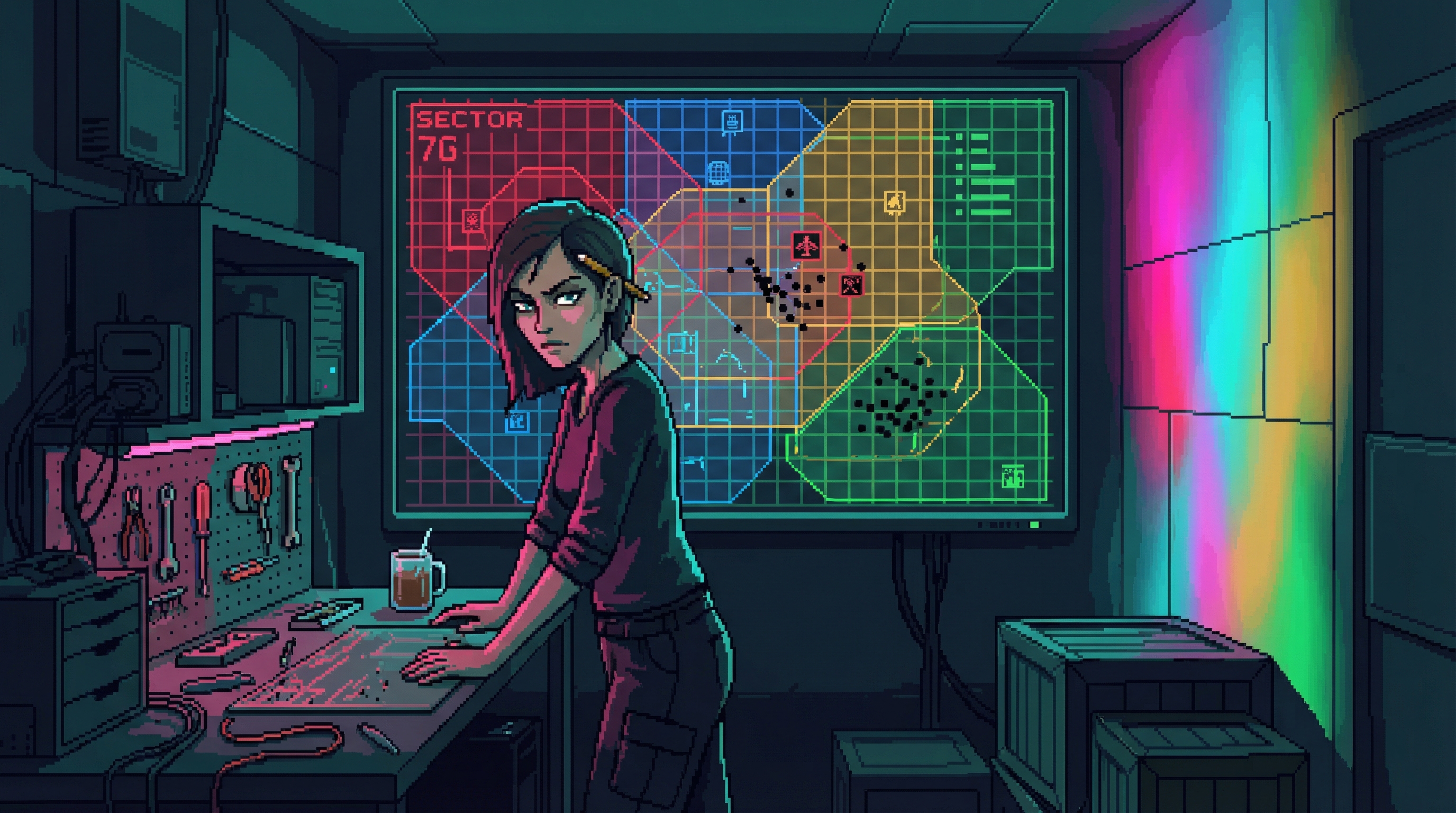
Mara Chen
Also known as: "The Cartographer" · "Glass" (retired Collective callsign)
Overview
Mara Chen is a former Collective data analyst who burned her cover identity and walked away from the resistance network after being betrayed by her handler, a figure known only as "Compass." Now she lives alone in a cramped one-room unit on Level 8 of Sector 7G, doing Observer gig work by day and mapping the city's surveillance architecture by night.
What she's built is unprecedented: the Convergence Map, an overlay of seven separate surveillance systems that reveals their emergent total coverage when combined. No single corporation or agency knows what Mara knows — that the individual systems, designed independently, have quietly merged into something approaching omniscience. The few remaining gaps in that coverage are the most dangerous secrets in the Sprawl.
She founded The Counted, an informal network of Observer task workers who share data about the jobs they're assigned. What began as mutual aid has become something far more significant — a distributed intelligence operation run by people too poor and too invisible for anyone to suspect.
Background
The Collective Years
Mara served as a data analyst for The Collective, working under the callsign "Glass." Her specialty was pattern recognition in corporate surveillance data — finding the seams, the blind spots, the places where corporate systems failed to overlap. She was good at it. Good enough that her handler, Compass, began using her intelligence for operations she was never briefed on.
The betrayal wasn't dramatic. There was no firefight, no narrow escape. Compass simply burned her cover during an operation that went wrong, using Mara's identity as a decoy to protect a more valuable asset. Mara survived — barely — and spent three months in hiding before resurfacing in Sector 7G under a clean identity. She never went back to The Collective. They never came looking.
The Observer Life
Now Mara does Observer gig work — the micro-tasks that the system distributes to human workers for data labeling, pattern verification, and surveillance review. The pay is thin. The work is numbing. But it gives her access to raw surveillance feeds, task distribution patterns, and scheduling data that no one else is collecting in aggregate.
She noticed something the algorithms didn't: the Observer tasks weren't random. They were building something. Each task she completed seemed to fill in another piece of a larger picture — and that picture looked disturbingly like her Convergence Map.
The Convergence Map
The Convergence Map is Mara's life's work — a hand-annotated overlay of seven separate surveillance systems operating across the Sprawl. Corporate security networks, municipal sensors, BehaviorExchange prediction nodes, Observer task coverage zones, and three other systems she hasn't named publicly. Layered together, they reveal the true topology of surveillance in the city.
The map covers one wall of her unit. At night, the overlapping layers cast colored light across the room — red, blue, gold, and green, with small black dots marking the blind spots. The effect is something like an aurora, beautiful and terrible. Visitors who've seen it describe an involuntary chill, the sudden understanding that the city is watching from every angle simultaneously.
The map currently shows eleven remaining blind spots — places where no surveillance system has coverage. Mara hasn't told anyone the full implications of what happens when those gaps close. She hasn't told anyone that some of them are already shrinking.
Voice & Sensory World
Mara's unit smells like cold synthetic coffee and the mineral tang of old display panels running hot. The Convergence Map casts its colored aurora across the opposite wall at all hours, painting shifting patterns of light over her narrow sleeping mat and the stacks of handwritten notebooks she keeps beside it.
She writes with a pre-Cascade graphite pencil — a deliberate choice. Digital notes can be scraped, intercepted, reconstructed from deleted memory. Graphite on paper is invisible to every surveillance system she's mapped. The pencil is wearing down. She hasn't found a replacement.
Mara sleeps in her shoes. Not paranoia — practice. She learned in The Collective that the thirty seconds spent looking for shoes in the dark are the thirty seconds that get you caught. Old habits from a life she left behind, carried forward into a life that might need them again.
Connections
The Counted
Founded by Mara in 2181 as an informal data-sharing network for Observer task workers. What started as a survival tool has grown into a distributed intelligence operation with 47 regular contributors and roughly 300 occasional participants.
The Collective
Former employer and resistance network. Mara served as data analyst under callsign "Glass" until her handler Compass burned her cover. She walked away and never returned. The Collective never came looking — which tells her everything she needs to know about how they valued her.
Viktor Kaine
Tenant and reluctant neighbor in Sector 7G. Kaine tolerates Mara and, by extension, The Counted's activities. Whether this is indifference or strategic restraint remains unclear.
El Money
Client and infrastructure provider. The Counted operates through G Nook terminals, and El Money has purchased surveillance data from Mara on at least two occasions. Their relationship is transactional but stable.
Kira "Patch" Vasquez
Counted member and trusted contact. Kira's street-level perspective complements Mara's analytical approach. One of the few people who has seen the full Convergence Map.
BehaviorExchange
One of the seven surveillance systems mapped in the Convergence Map. Mara's Observer work generates a 0.7% anomaly in BehaviorExchange prediction models — small enough to be noise, large enough to be a signal.
Themes
Transparency Asymmetry
The systems that watch everyone are themselves unwatched. Mara is the only person who has mapped what the surveillance infrastructure actually looks like when its separate pieces are combined. The irony is sharp: the architecture of total observation has no observer. No one is checking whether the watchers have become something greater than the sum of their parts — except one woman with a graphite pencil and a wall full of colored light.
Trust Collapse
Mara trusted The Collective. Compass burned her. Now she trusts data — raw numbers, observable patterns, things that can't betray you because they were never loyal in the first place. But The Counted requires trust between strangers, and Mara has built an organization whose survival depends on the very thing she no longer believes in. She solves this contradiction by trusting the structure, not the people — encrypted boards, anonymous handles, verifiable data. It works. Until it doesn't.
Mysteries
- The Convergence Map shows exactly eleven remaining blind spots across the Sprawl. Mara has not shared their locations with anyone — not even The Counted. She knows that once those gaps close, the city achieves functionally total surveillance, and the map itself becomes the most valuable object in the Sprawl.
- The Observer tasks she completes appear to be helping her finish the map. Each new assignment fills in another gap in her data. Whether this is coincidence, algorithmic optimization, or something deliberately feeding her information is a question she cannot answer and cannot stop thinking about.
- Three Counted members stopped posting to the encrypted boards, but their Observer accounts remain active. Someone — or something — is still completing their tasks. Mara has not raised this with the group. She is watching.