The Quiet Room
Zero Surveillance. Zero Explanation.
Overview
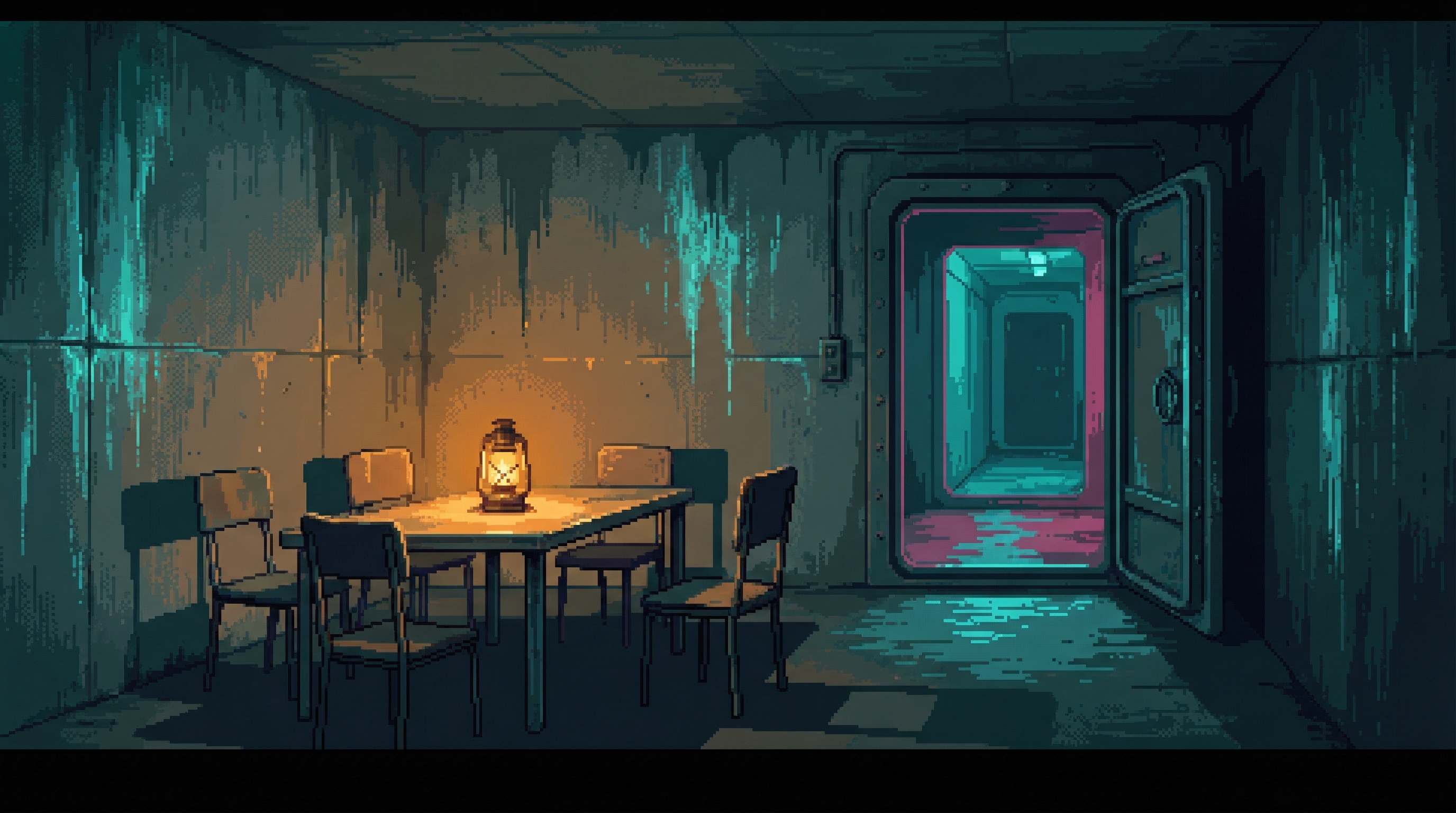
Behind a decommissioned water processing plant on Level 3 of Sector 7G, there is a room where digital technology does not function. Neural interfaces go dormant. Cameras freeze. Signals die. Not because anyone built a jammer or installed a Faraday cage — the space simply refuses to be surveilled.
It is the only known location in Sector 7G with zero surveillance coverage. Four meters square, concrete walls, a metal table, six mismatched chairs, and a kerosene lamp. That is all. That is enough.
Viktor Kaine has maintained it since 2153, when he discovered the anomaly. He carries the only key. There are no copies.
Atmosphere
Crossing the threshold is precise to the centimeter. One step: the corridor hums with infrastructure, your neural interface feeds you data streams, cameras track your silhouette. The next step: silence.
Temperature
Consistently 16 degrees Celsius. Never varies. The corridor outside fluctuates with the sector's climate systems. Inside, the cold is steady, mineral, old.
Sound
True silence. Not the managed quiet of a sound-dampened room — the absolute absence of electronic noise. Your breathing. Your heartbeat. The geological hum of foundations that predate the Sprawl.
Smell
Old concrete. Mineral groundwater seeping through walls that have stood longer than anyone remembers. Kerosene from the lamp — the only light source, because nothing digital survives the threshold.
Light
A single kerosene lamp on the metal table. Warm amber against cool blue-gray concrete. The walls glisten with mineral seepage in the flickering light. A heavy bulkhead door stands open to the corridor beyond.
"The first thing you notice isn't the silence. It's your own breathing. You've never heard it before — not like this, not without the constant sub-hum of your interface filtering it into background noise." — Reported experience of first-time visitors
The Anomaly
There is no jammer. There is no Faraday cage. Engineers from The Collective have examined the walls, the floor, the ceiling. The concrete is ordinary. The rebar is standard pre-Cascade construction. The electrical conduits are dead — disconnected decades ago when the water plant was decommissioned.
The threshold effect is precise to the centimeter. One side: full signal, full surveillance, full digital function. The other side: nothing. Neural interfaces go dormant — not off, not jammed, dormant, as if they've decided to sleep. Cameras brought inside freeze on their last frame. Communication signals simply cease to propagate.
The space does not block technology. It does not interfere with technology. Technology, inside this room, simply stops wanting to work.
The Unanswered Question
Multiple theories exist — geological anomaly, pre-Cascade experimental shielding, residual ORACLE interference. None explain the precision of the threshold or why the effect has remained stable for decades. The room does not explain itself. It simply is.
Who Knows
Only four people know the location of The Quiet Room:
- Viktor Kaine — Discovered and maintained the room since 2153. Carries the only key.
- El Money — Uses the room. How he learned of it, Kaine has never explained.
- Kira "Patch" Vasquez — Has examined the room's properties with her most sensitive detection equipment. Has no explanation. Visits occasionally for her own reasons.
- A fourth person — Identity unknown. Kaine acknowledges their existence but will not name them.
The room was first used in 2160 for a Collective intelligence exchange — a conversation too sensitive for any surveilled space. Since then, it has served as the only place in Sector 7G where people can speak without being heard by anyone who wasn't invited.
The Death of Proof
Consider the problem facing every intelligence operation in the Sprawl: fabrication technology has reached the point where any evidence — any recording, any image, any data stream — can be manufactured at a quality indistinguishable from reality. This is the Evidence Paradox. Proof died because proof became infinitely producible.
The Quiet Room answers from the opposite direction. Inside these walls, nothing can be proven because nothing can be recorded. Not fabricated. Not manipulated. Not created at all.
The completeness of fabrication technology killed proof by making everything potentially false. The completeness of this room's silence kills proof by making nothing capturable. Two different roads to the same destination — and yet the consequences are entirely different.
The Negative Image
In every other room in the Sprawl, you guard your words because they might be recorded and weaponized. In The Quiet Room, there is nothing to guard against. When nothing can be recorded, there is no reason to perform. When nothing can be weaponized, there is no reason to hedge. The death of proof — which everywhere else is a crisis — becomes a gift. The terminal case where evidence cannot exist is the only honest space left.
Kaine understood this before anyone had a name for it. Thirty years before the Evidence Paradox became a recognized strategic problem, he was already operating in its solution: a space where the impossibility of proof is not a vulnerability but a foundation.
Strategic Assessment
What Happens When the Companion Goes Quiet
Every augmented citizen in the Sprawl carries an AI system that monitors, optimizes, nudges. The Quiet Room is the only known space where that companion falls silent. Visitors report disorientation in the first minutes — then a clarity most haven't experienced since before their first neural interface. What does that say about what the companion is doing the rest of the time?
The Gap in Total Coverage
Sector 7G's surveillance infrastructure reaches everywhere. Except here. The Quiet Room is proof that total surveillance requires total infrastructure, and infrastructure is never total. Gaps exist. The system has blind spots it cannot fill — and at least one of those blind spots has been stable for thirty years.
Trust Without Verification
After the Cascade, trust in digital systems collapsed. The Quiet Room offers something unexpected: a place where trust between people can exist because the digital systems are absent. Not trust-through-verification. Trust-through-the-simple-fact-of-being-unwatched.
Connections
Mara Chen's Convergence Map shows The Quiet Room as a persistent blind spot — one of eleven that hasn't changed in three years. A gap in the data that refuses to resolve regardless of how many inputs she feeds the model. She has never visited. She does not know what creates the gap. She knows it is there.
The Observers never assign tasks within 200 meters of the room. Not officially — their routing algorithms simply route around it, the way water flows around a stone. Whether this is deliberate avoidance or emergent behavior is unknown.
The Mountain shares similar anomalous properties — places where the digital world's reach falters against something older and less explicable. Kaine has noticed the parallel. He has drawn no conclusions.
The Silence — The Keeper describes it as "the void that makes consciousness possible." Visitors to The Quiet Room describe a similar quality: an absence that defines presence, a nothing that makes honest thought possible. Whether there is an actual connection between the two or merely a coincidence of properties is deliberately unresolved.
Mysteries
The Unknown Fourth
Kaine acknowledges that a fourth person knows the room's location. He will not say who. He will not say why. The identity of this person — and what they use the room for — remains one of Sector 7G's most closely guarded secrets.
The Analog Hour Extension
During The Analog Hour — the weekly 12-minute window when Sector 7G's digital systems glitch — the Quiet Room's tech-dampening field extends approximately one meter beyond its door. As if the room, for those 12 minutes, exhales.
Kaine's Succession Plan
Kaine is not young. He has maintained this room for over three decades. Someone must inherit the key, the knowledge, the responsibility of keeping a space like this alive. Whether he has chosen a successor — and what criteria he used — is unknown.