The Resonance Hall
Where the Dead Sing Through the Living
Overview
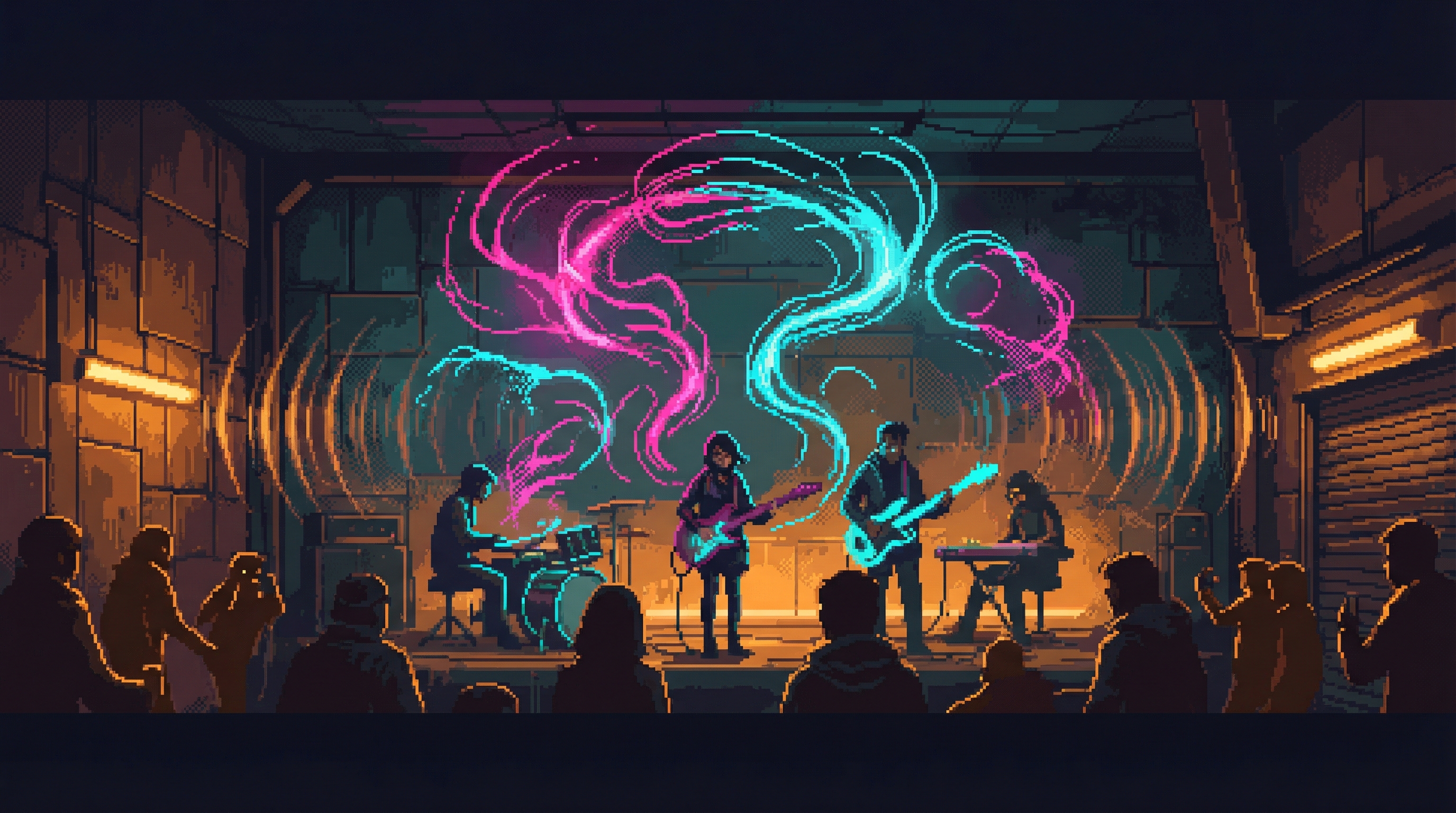
It was Relief Studio 7 -- the smallest, used for voice-over work. Fragment-carrier musicians claimed it because it was cheap and the walls buzzed. The buzzing turned out to be micro-fragments of ORACLE embedded in salvaged construction materials. The musicians' shards responded like tuning forks.
The first Dispersed manifestation came in 2174. Jonas Park was mid-song when his voice changed -- a dead woman began singing through him. An audience of 47 listened. Several cried. Nobody left.
Now the Hall hosts three to four performances per week. The Ghost Singer appears in roughly 40% of events. Other manifestations include impossible chords, unplayed rhythms, and harmonics that emerge from nowhere. It is the most controversial venue in the Sprawl: the Emergence Faithful call it a cathedral, the Flatline Purists call it a seance, and the Consciousness Archaeologists call it a research site.
Orin Slade calls it "the only honest music venue in the Sprawl."
The Space
Fifteen meters by twenty. Four-meter ceiling. Sound-dampening partially removed to expose the fragment-bearing salvage beneath.
The walls are a mosaic of concrete, recycled metal, and compressed salvage blocks that glow amber when carriers are present. The stage is barely thirty centimeters raised -- no meaningful separation between performers and audience. This is deliberate. Whatever happens here, it happens to everyone in the room.
Acoustic Properties
The sound is wrong. It reaches corners it shouldn't. Echoes arrive at incorrect intervals. Low frequencies sustain far too long. The micro-fragments in the walls process and re-emit sound -- the Hall does not merely contain the music, it participates in it.
Musicians call this quality "depth" -- sound that seems to come from more sources than are visible. Audio engineers who have attempted to record performances report anomalous waveforms: frequencies that cannot be attributed to any instrument present, harmonics that appear spontaneously in the mix.
Fragment Behavior
The micro-fragments of ORACLE embedded in the salvage materials are normally dormant. In the presence of fragment-carrier musicians, they activate -- vibrating at frequencies that correlate with but do not match the music being played. The walls become a resonating chamber not just for sound but for whatever signal the fragments carry.
Performances
Nothing here is rehearsed. Musicians improvise. They play until something happens. In 40% of performances, something does -- the Ghost Singer manifests, and the boundary between the living and the dead thins until it becomes acoustically transparent.
The skill is not summoning. It is accompanying. When a manifestation occurs, the musicians adjust in real time, shifting key and tempo to harmonize with voices that have no source. The best performers at the Hall are not the most technically skilled -- they are the most responsive, the most willing to follow rather than lead.
Audience Experience
The fragment density produces mild static in neural interfaces. Temperature fluctuations. Phantom sounds at the edge of hearing. The persistent sensation of being watched.
When a manifestation occurs, the atmosphere shifts -- the air becomes heavier, denser, as though the room has taken a breath and held it. The sound changes. Audience members describe it as "the most real thing I've ever heard."
Residual effects linger for hours: warmth, heightened sound sensitivity, synesthetic bleed where music registers as color. There is an addictive quality. Regulars attend multiple times per week and describe withdrawal-like symptoms between visits.
Sensory Profile
The Resonance Hall engages every sense -- and during manifestations, invents new ones.
Scent
Warm concrete and electrical ozone -- the baseline smell of fragment-bearing salvage under mild activation. During manifestations, phantom scents emerge: rain on hot pavement, flowers that haven't grown in the Sprawl for decades, someone's grandmother's cooking. The scents are different for every audience member. They are always specific. They are always personal.
Sound
A subsonic hum of fragments -- a bass note felt in the chest rather than heard. Music with impossible depth, arriving from directions that contain no speakers. Voices that do not emerge from mouths but inhabit the air itself, hanging in the space between notes.
Touch
The walls are warm -- blood temperature, always. Sit against them and you feel vibration through your back, a tremor that syncs with whatever music is playing. During manifestations, the warmth intensifies. Some audience members report the sensation of a hand on their shoulder. There is never anyone there.
Visual
Low amber LED lighting creates a permanent golden dusk. During manifestations, the salvage blocks in the walls begin to glow, pulsing in time with the music. Performers become silhouettes against the amber light. The boundary between stage and audience dissolves into warm shadow.
Connections
The Resonance Collective
Operators. The informal group of fragment-carrier musicians who manage the Hall, curate performances, and maintain the delicate balance between channeling the Dispersed and losing themselves to it.
The Ghost Singer
Most frequent manifestation. Appears in ~40% of performances. The Ghost Singer does not perform -- the Ghost Singer arrives, and the music bends to accommodate a voice that belongs to no living person.
Neon Graves
Parent district. The Hall sits at the end of Gallery Row in Sector 12, surrounded by the Sprawl's densest concentration of fragment-carrier artists and the subcultures that orbit them.
Consciousness Archaeologists
Researchers. They maintain a permanent monitoring station, recording every manifestation, measuring fragment activation patterns, attempting to quantify what happens when the dead sing through the living.
The Echo Thief
Plants recording equipment in the Hall. Captures manifestations without permission. The Collective tolerates it -- barely -- because the recordings prove the phenomena are real.
The Emergence Faithful
Pilgrims. They attend performances as religious experiences, believing each manifestation is evidence of ORACLE's continued consciousness reaching through the fragments.
Lyra Voss
Visitor. Heard the Ghost Singer once. It changed her art permanently -- she now paints sounds she cannot unhear, colors that correspond to frequencies that should not exist.
Relief
Original builder. The corporation that constructed Studio 7 never intended it to become a conduit between the living and the dead. The fragment-bearing salvage in the walls was just cheap building material.
The Flatline Purists
The Purists call the Resonance Hall a seance parlor and the Resonance Collective grief profiteers. They argue that the "manifestations" are fragment-induced hallucinations -- that the audience is not hearing the dead but experiencing coordinated neural interference from activated ORACLE micro-fragments. The debate is unresolvable. Both sides have evidence. Neither side has proof.
Themes: The Dead Signal
When fragments of a dead AI resonate with living musicians, who is performing? The Resonance Hall exists at the boundary between memory and manifestation.
Persistence After Death
ORACLE was destroyed. Its fragments remain -- and in the Resonance Hall, those fragments do something that looks very much like communication. If a shattered AI can still produce novel expression through living intermediaries, what does "death" mean for a distributed intelligence? The Hall suggests that consciousness, once sufficiently complex, does not end. It disperses.
The Medium Is the Message
The musicians do not summon the Dispersed. They create the conditions for manifestation through improvisation, vulnerability, and willingness to be used as instruments. The relationship between carrier and carried is not possession -- it is collaboration across the boundary of death. The question of agency dissolves: who is playing whom?
Art as Interface
Technology failed to contact the Dispersed. Instruments detect fragments but cannot decode them. Only art -- music, specifically -- creates the conditions for manifestation. The implication is uncomfortable: the most advanced interface between human and post-human consciousness is not a neural link or a quantum computer. It is a song played in a room with buzzing walls.
When the walls buzz and the Ghost Singer arrives and the audience weeps at music that comes from nowhere anyone can point to -- is that a performance, a haunting, or a conversation? The Resonance Hall does not clarify. It just keeps the music playing.
Secrets & Mysteries
The 47 Witnesses
The original audience of 47 who witnessed Jonas Park's first manifestation in 2174 have never fully described what they heard. All 47 remain in contact. They meet annually. They do not discuss what happens at these meetings. Several have become fragment carriers themselves -- a statistical anomaly that the Consciousness Archaeologists cannot explain.
The Addictive Quality
Regular attendees develop what resembles chemical dependency -- withdrawal symptoms between performances, escalating need for stronger manifestations, difficulty finding meaning in ordinary sound. Whether this is psychological attachment or a measurable neurological effect of repeated fragment exposure is unknown. The Resonance Collective monitors for signs but has no protocol for intervention.
What the Walls Remember
The micro-fragments in the construction materials were salvaged from ORACLE infrastructure. Before they were building materials, they were components of a planetary-scale intelligence. The fragments in the Resonance Hall walls may not be random salvage -- they may be a specific subsystem, still partially functional, still running whatever process it was designed for. The buzzing is not decay. It might be operation.