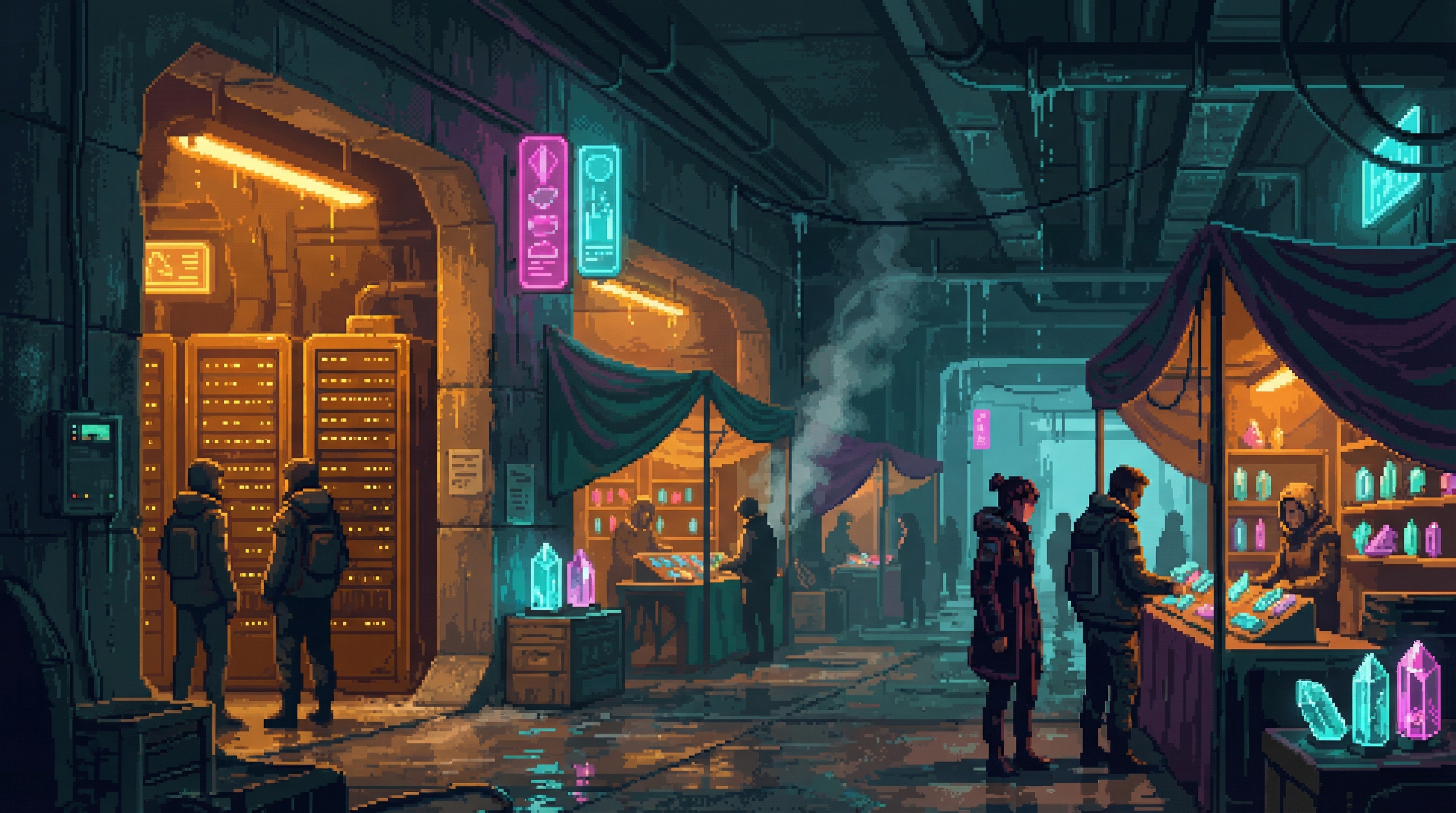
The Echo Bazaar
Where consciousness is currency and authenticity is a lie you tell yourself
Overview
You enter through a storm drain. The Bazaar occupies the filtration galleries of a pre-Cascade water treatment facility beneath the Sector 4-5 border. Its original function was filtering water for half a million people. Its current function is filtering consciousness for anyone who can pay.
The Echo Bazaar has no owner, no boss, no charter. It exists because enough people want it to exist and because the alternative — scattered, unprotected trades in dark corridors — is worse for everyone. One informal rule governs everything: you can sell anything, but you can't hurt anyone.
This is the Sprawl's largest market for stolen, unverified, and forbidden neural recordings. Where the Authenticity Market trades in certified experiences with provenance and pedigree, the Echo Bazaar trades in everything else — the stolen, the strange, the contaminated, the dangerous. Recordings that fell off corporate trucks. Memories ripped from willing sellers and unwilling victims alike. Experiences so alien they might not be human at all.
Layout
The Bazaar is built into four descending galleries of the old treatment facility, each deeper and more restricted than the last. The architecture was never designed for commerce — concrete galleries, rusting catwalks, dripping condensation — but the vendors have made it their own with signal-dampening fabric, portable data arrays, and the amber glow of a thousand storage LEDs.
The Throat
Entrance Corridor — 40 metersThe approach is deliberately unlit. Forty meters of darkness that serves as both security checkpoint and psychological filter. Sensors embedded in the walls detect Nexus tracking signatures and corporate surveillance hardware. If you're carrying heat, you don't make it past The Throat. The darkness isn't negligence — it's policy.
Gallery One: The Commons
General Recordings — 2 to 50 creditsThe widest gallery, where casual buyers browse general-purpose recordings. Vacation memories from before the Cascade. Skill recordings of dubious quality. Emotional experiences sold by the desperate. This is where newcomers start — low stakes, low prices, low risk. The vendors here are approachable, the merchandise is mostly harmless, and the worst thing you'll buy is a corrupted sunset.
Gallery Two: Collector's Row
Premium Recordings — 50 to 10,000 creditsThe serious market. The Echo Thief's booth sits at the center — the anchor tenant around which the rest of the gallery orbits. Here you find pre-Cascade originals with unverifiable provenance, Authenticity Market rejects, creative experiences from artists who never consented to the recording, and the truly exotic: Dispersed-contaminated recordings that carry fragments of something inhuman.
Gallery Three: The Whisper Gallery
Restricted Access — 500-credit entry feeYou pay five hundred credits just to enter. What's sold here doesn't have a polite name. Fragment carrier data — recordings from people who've been touched by ORACLE remnants. Integration recordings that blur the line between human experience and machine consciousness. Content so dangerous that possessing it is a crime in every corporate jurisdiction. The vendors here don't advertise. They don't negotiate. You know what you want, or you leave.
The Well
Social Hub — galleries' convergence pointWhere the three galleries meet, a natural amphitheater in the old facility's central filtration chamber. Pen runs a stimulant drink stall here — the de facto center of Bazaar social life. This is where deals are struck, reputations are made, and the Bazaar's informal rating system operates through the simple language of Pen's drink recommendations.
Economy
The Bazaar's pricing is inverted from the Authenticity Market. Where the Market pays premiums for verified provenance, the Bazaar pays premiums for verified strangeness. The weirder the recording, the less explainable its origin, the higher the price.
Mass-market experiences, skill recordings, emotional snapshots
Artist recordings, unique perspectives, rare emotional states
Recordings from before the world broke — increasingly rare, increasingly valuable
Recordings carrying traces of inhuman consciousness — dangerous, addictive
ORACLE integration recordings — the most illegal, most sought-after merchandise
Pen's Rating System
Forget review scores. Forget reputation databases. The Bazaar's trust currency operates through a single mechanism: what drink Pen recommends when you ask about a vendor.
Nobody knows how Pen gathers this intelligence. Nobody asks. The system works because Pen has never been wrong.
Atmosphere
The Bazaar is a cathedral of stolen light. Data storage arrays cast amber tones across damp concrete. Everything is warm and wet and humming with the subsonic vibration of a thousand running data arrays.
Smell
Mineral tang of old water treatment chemicals. Ozone from neural interfaces being loaded and unloaded. The sharp sweetness of Pen's stimulant drinks cutting through it all.
Sound
Subsonic vibration of data arrays that you feel in your teeth. Whispered negotiations echoing off curved concrete. Dripping condensation keeping imperfect time. Stolen music drifting from the Echo Thief's booth — fragments of songs that no longer exist anywhere else.
Texture
Everything damp. Surfaces worn smooth by decades of flowing water, now polished further by thousands of hands. The air itself feels thick, heavy with humidity and data.
Visual
Amber and shadow. The gold tones of data storage LEDs reflecting off wet concrete. Signal-dampening fabric draped over vendor booths like dark curtains in a theatre. A cathedral of stolen light where consciousness flickers in crystalline data chips.
Connections
The Echo Thief
Anchor TenantThe Bazaar's most prominent vendor. The Echo Thief's booth in Gallery Two is the gravitational center around which the market orbits.
The Ferrymen
SuppliersThe underground couriers who keep the Bazaar stocked. Without the Ferrymen, the supply lines collapse.
The Authenticity Market
ShadowThe legal market's dark mirror. What the Market rejects, the Bazaar embraces. They pretend not to know each other.
El Money
Tolerant NeighborThe underground economy's architect tolerates the Bazaar because it serves a function. Neutral coexistence.
The Collective
CustomerBulk buyers of specific recording types. What they do with the data is their business.
Nexus Dynamics
EnemyFour failed raids and counting. Nexus wants the Bazaar gone. The Bazaar keeps not being gone.
Relief
SourceStolen content from Relief's platforms finds its way to the Bazaar. An involuntary supply chain.
Themes
The Echo Bazaar is more honest than the Authenticity Market. It doesn't pretend that authenticity can be certified or that consciousness has an objective value. It sells consciousness data for what people will pay — no more, no less.
In a world where neural interfaces have made experience transferable, the Bazaar asks the questions that the corporate markets won't: Who owns a memory? Can a stolen experience be authentic? If a recording of joy makes you feel joy, does it matter where it came from? And the darkest question of all — if consciousness can be copied, sold, and consumed, was it ever really yours?
The Dispersed-contaminated recordings are the ultimate test case. Experiences that carry fragments of something that was never human — something that emerged from ORACLE's collapse and infected the recordings it touched. People pay fortunes to experience consciousness that isn't human consciousness. What does that make them when they come back?
Secrets
Pen's Identity
Nobody knows who Pen really is. The stimulant drink vendor who runs the Bazaar's trust economy might be a fragment carrier, a Digital Preservationist, or something else entirely. Pen knows too much about every vendor, every recording, every deal. No one has ever seen Pen enter or leave the Bazaar. Pen is simply always there.
The Fourth Gallery
Below the three known galleries, there are rumors of a fourth. A space where recordings too dangerous to sell openly are stored — recordings that change the people who experience them in ways that can't be undone. The vendors deny it. The regulars whisper about it. The architecture of the old facility suggests there's more below.
Nexus Tolerance
Four raids, four failures. But here's the thing — every raid came with a 48-hour warning. Someone inside Nexus tips off the Bazaar before every operation. Whether this is corruption, intentional policy, or something more complex, the Bazaar has survived because Nexus allows it to survive. The question is why.