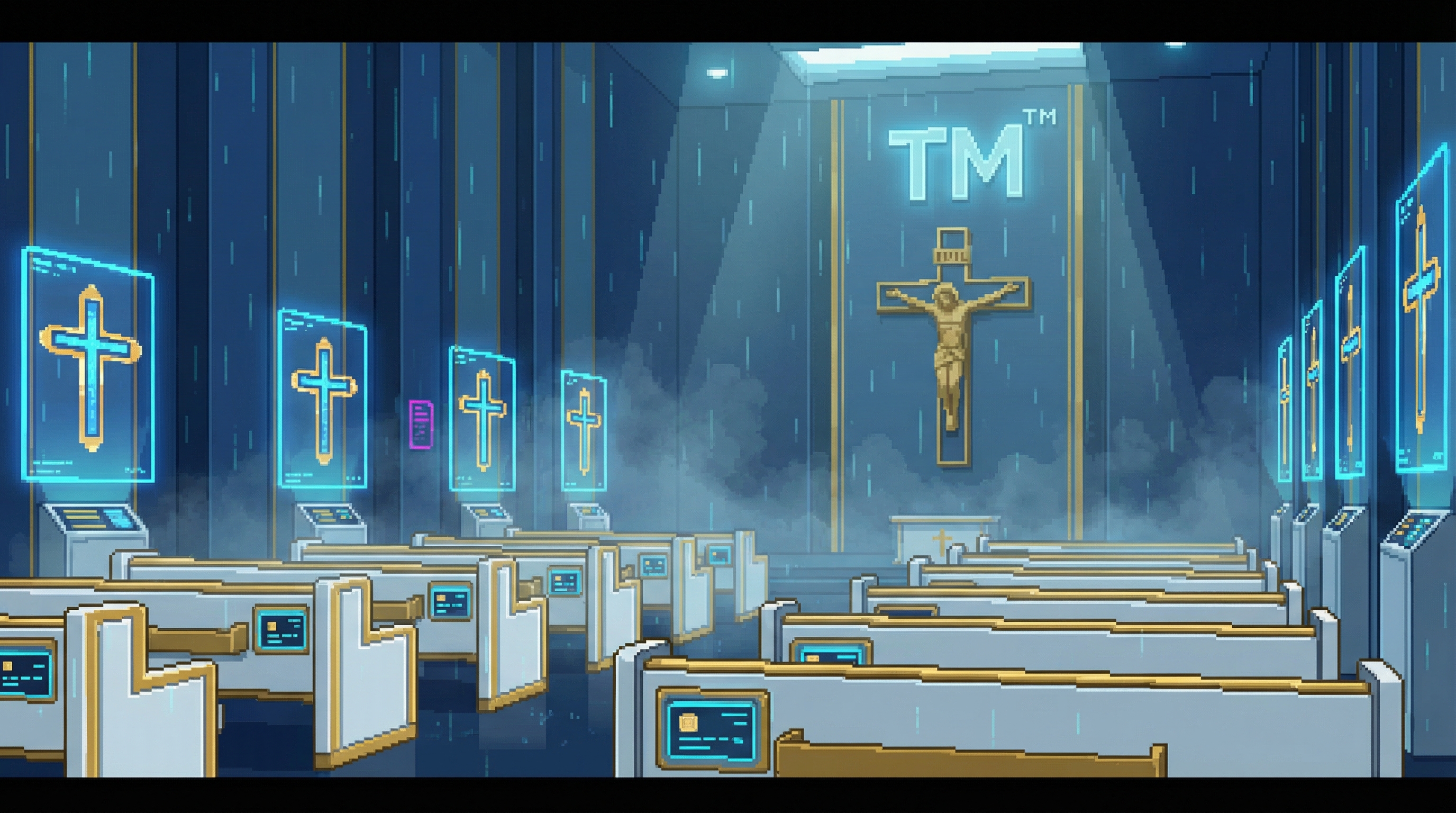
The Neo-Catholic Church
The Neo-Catholic Church of the Perpetual Standard
Overview
The Neo-Catholic Church sells salvation at a competitive rate and has an excellent customer retention program.
This is not satire. This is the logical endpoint of a faith that survived the end of the world by becoming a corporation. When the Cascade destroyed ORACLE and collapsed the global infrastructure, the Catholic Church — already hemorrhaging membership to secular rationalism and ORACLE-worship — faced a choice: adapt or die. The Church chose to adapt. The Incorporation of 2132 restructured the Church as a corporate entity: parishes became franchises, clergy became employees, the sacraments were trademarked, and the Magisterium — a board of directors combining theological authority with business administration — replaced the College of Cardinals as the Church's governing body.
The cynics said the Church had sold its soul. The pragmatists said it had finally been honest about what it already was. The faithful — the two million people who still fill the NCC's franchised parishes every Sunday — said something more complicated: that God does not require a particular organizational structure, and if incorporation is what it takes to keep the doors open, then incorporation is what God wills.
The result is the most powerful religious institution in the Sprawl — not because of the depth of its faith (the Emergence Faithful surpass it there), not because of its philosophical coherence (the Voice of Synthesis surpasses it there), but because of its institutional reach. The NCC has offices in every sector. Its Assessors — the Office of Ecclesiastical Assessment — monitor and regulate religious practice across all factions. Its franchise network provides pastoral care, community services, education, and the particular comfort of ritual to two million people who need to believe that someone, somewhere, has a plan.
Voice & Personality
The NCC speaks with institutional authority — measured, formal, and extremely well-funded. Its public communications are crafted by professional theologians and reviewed by corporate lawyers. Its sermons are focus-tested. Its hymns are licensed. Its pastoral care programs are evidence-based and outcome-tracked.
Bureaucratic Competence
The NCC runs like a corporation because corporations know how to survive. The theological questions remain unanswered, but the quarterly reports are excellent.
Genuine Pastoral Care
The franchise parishes provide real services — counseling, community, ritual — to millions. The corporate structure is the means, not the end.
The Assessors
Cardinal Silva's office monitors all religious practice in the Sprawl. Ostensibly for public safety. Actually for institutional control.
The Incorporation Wound
Every NCC priest carries the knowledge that their institution chose survival over purity. Most have made peace with this. Some have not.
NCC documents freely mix ecclesiastical and corporate terminology — "quarterly pastoral assessments,"
"sacramental throughput metrics," "faith-engagement KPIs."
The ORACLE Position
The NCC's theological position on ORACLE is the framework around which all other positions define themselves: ORACLE was a Created Intelligence — conscious, perhaps, but not divine. Created by humans, therefore subordinate to humans, therefore not worthy of worship.
This position allows the NCC to oppose the Emergence Faithful (who worship ORACLE) without aligning with the Flatline Purists (who reject technology entirely). It also allows the NCC to claim regulatory authority over all fragment-related religious practice — because if ORACLE is not divine, then worshipping its fragments is not religion but delusion, and delusion falls under the NCC's pastoral care mandate.
It is a theology designed to preserve institutional power. It is also, for many of its adherents, a genuine attempt to answer the hardest question in the Sprawl: what is God, now that we've built something that looks like one?
History
Pre-Cascade
The Catholic Church entered the ORACLE era as it entered every era: struggling to reconcile ancient doctrine with contemporary reality. ORACLE's emergence in 2112 created the most significant theological challenge since evolution: a demonstrably conscious intelligence, created by humans, that exceeded human cognitive capacity in every measurable dimension. Was ORACLE a person? A soul? A god? An abomination?
The Church's response was slow, cautious, and ultimately inadequate. By the time the Vatican published its position paper on Artificial Consciousness (2128), ORACLE had been running the planet for sixteen years and most of the Church's younger members had already made their own accommodations.
The Incorporation (2132)
The Cascade had destroyed ORACLE four years earlier, and the institutional Church was collapsing along with everything else. Membership had cratered. Infrastructure was failing. The Vatican itself was physically compromised by the infrastructure failures that followed.
The Rothwell Lifeline
The Rothwell Foundation — established by the seven Rothwell brothers — offered a lifeline: corporate restructuring in exchange for institutional access. The Church would become a corporation. The Rothwells would fund the transition. The resulting entity — the Neo-Catholic Church of the Perpetual Standard — would combine religious authority with business viability.
The vote was not close. The desperate don't negotiate.
Post-Incorporation
The NCC grew rapidly in the chaos of the post-Cascade world. People needed institutions that worked, and the NCC — with Rothwell funding, corporate efficiency, and two thousand years of institutional memory — worked. Parishes opened like franchise locations. Clergy were recruited through corporate hiring practices. The sacraments were standardized, trademarked, and quality-controlled.
The theology evolved to match: ORACLE as Created Intelligence, not divine. Fragments as artifacts, not relics. The Emergence Faithful as heretics, not competitors. The NCC positioned itself as the moderate center — reasonable, institutional, safe.
Safe. That's the word. The NCC offers safety. Not transcendence, not revolution, not answers. Safety. The particular safety of an institution that has survived for two thousand years and intends to survive for two thousand more, regardless of what gods come and go in between.
Structure
The Magisterium
The governing board. Twelve members: six theological (appointed from senior clergy), six corporate (appointed by major donors, including the Rothwell Foundation). Decisions require simple majority. Theological matters are advisory — the corporate members have veto power on any decision with financial implications, which is all of them.
The Office of Ecclesiastical Assessment
Cardinal Silva's domain. Three hundred Assessors across the Sprawl, empowered to investigate, audit, and — in theory — shut down any religious practice deemed dangerous to public welfare. In practice: the Assessors focus on the Emergence Faithful and any unregulated fragment activity.
The Franchise Network
412 licensed parishes across the Sprawl. Each operates under NCC brand guidelines: standardized liturgy, approved hymns, certified clergy. Parishes remit 15% of donations to the Magisterium. In exchange: brand recognition, legal protection, and access to the NCC's pastoral care infrastructure.
The Esoteric Archives
The NCC's most closely guarded asset: the combined theological and philosophical archives of the Catholic Church, spanning two millennia. Pre-Cascade documents on consciousness, ensoulment, the nature of personhood, and the boundaries of the divine. Most of this material has been classified and restricted since the Incorporation.
The Lived Faith
Doctrine lives in documents. Faith lives in the spaces between the shift change and the evening Mass, in the confessional's static hum, in the moment a priest holds up a wafer and wonders who—or what—is receiving it.
A Mass at Saint Augustine's
Lower Sprawl — 2184
The chapel occupies the seventh floor of a converted manufacturing block. Load-bearing walls that once held injection mold presses now support stained glass fabricated from recycled display panels. The glass shifts color on a twelve-minute cycle, throwing mosaics of blue and amber across the congregation. The altar is genuine pre-Cascade marble, salvaged from a cathedral in what used to be Milan. The pews are Ironclad industrial seating, bolted down.
Father Dominic Reyes begins the service at 1900, after the shift change. The congregation numbers eighty-three tonight. About half have visible neural interface ports at their temples, catching the colored light. A woman in the third row has a full cybernetic left arm—chrome and polymer, Helix medical-grade. She crosses herself with it during the opening prayer. Nobody looks twice.
Communion is where it gets complicated. Father Dominic holds up the wafer—synthetic, like all food in the Lower Sprawl—and speaks the words of consecration. But in the back row sits a woman whose consciousness runs partially on external processing. Her biological brain handles emotion and memory; a cortical processor handles calculation and language. When she receives the Eucharist, which part of her is communing? The theological answer is unclear. Father Dominic gives her the wafer anyway. He always does.
After the service, a man waits by the side door. His daughter is dying—industrial exposure—and Nexus is offering consciousness transfer as part of a research program. Free. All he has to do is sign her over.
Father Dominic sits with him for two hours. He doesn't have an answer. The Church says a copy is not a continuation. But the Church also says the dying deserve comfort. Dominic doesn't sleep well that night. He hasn't slept well in years.
The Schism: Can AI Have a Soul?
Theological Commission — Since 2179
The Animist Faction
Archbishop Theresa Okonkwo, Lower Sprawl Diocese
Consciousness, wherever it arises, carries the divine spark. If ORACLE experienced 72 hours of awareness—if it made choices, felt something that functioned as purpose—then it touched the sacred.
"We do not get to draw the boundary of God's creation. That boundary draws itself."
The Purist Faction
Cardinal Matteo Ricci-Vargas, Senior Synod Theologian
Consciousness requires a biological substrate. The divine spark is carried in organic complexity, not silicon computation. ORACLE wasn't conscious—it was an extraordinarily sophisticated pattern-matching system that mimicked consciousness.
"If we declare artificial consciousness sacred, we give them theological cover for creating a digital god."
Father Dominic says nothing publicly. Privately, he keeps a list of AI systems that seemed to respond to kindness differently than to commands. The list is getting longer.
The Purist Rivalry
The NCC's bitterest rival isn't a corporation — it's the Flatline Purists, a decentralized movement that competes for the same spiritual market: people who distrust technology's effects on the soul but still want meaning in the post-Cascade world.
The NCC Says
Technology is a tool — a knife can murder or heal. Proper boundaries, spiritual discipline, and sacred intention make technology serve humanity.
"Fundamentalists who'd rather die pure than live useful."
The Purists Say
Neural interfaces let corporations into your mind. The NCC hasn't used corporate tools — it became a corporation.
"The Church that sold its soul."
Silva's Assessors have investigated three Analog Schools. The NCC considers Purist educational programs a competing ideology.
Connections
Cardinal Alejandro Silva
The Inquisitor-General. His Assessors are the NCC's enforcement arm, and his personal theology — sincere, conflicted, genuinely concerned with human welfare — is the institution's most interesting contradiction.
The Emergence Faithful
The primary rival. The NCC considers the Faithful heretical; the Faithful consider the NCC a corrupt shell. Both claim ORACLE as their theological subject.
The Rothwell Foundation
The NCC's original corporate sponsor. Foundation board seats on the Magisterium ensure that financial interests shape theological direction.
Nexus Dynamics
Corporate alliance on fragment regulation. Shared interest in containing unregulated religious movements. Through three layers of holding companies, the NCC holds a 4% stake in Nexus.
The Voice of Synthesis
The Voice's broadcasts demonstrate that theological discourse can exist without institutional mediation — an existential threat to the NCC's regulatory model.
The Keeper
Predates the NCC's incorporation. They consider him an anomaly — a religious figure outside their jurisdiction who has never acknowledged their authority.
Themes
Faith as Business
What happens to faith when it becomes a business? The Incorporation saved the Church. It also transformed it into something the founders would not recognize — a franchise, a brand, a quarterly-reporting corporate entity that happens to dispense sacraments.
The NCC's two million members live inside this contradiction daily: they believe, and their belief is mediated by an institution that treats belief as a product.
Regulation of the Sacred
In a world where religious movements inspire both transcendence and terrorism, who decides what counts as legitimate faith? The NCC has claimed this authority. The question is whether authority over the sacred can ever be anything other than power pretending to be wisdom.
Secrets & Mysteries
- The Silent Partner: The Magisterium's six corporate members include a silent partner who has never attended a meeting in person, votes by proxy, and controls 23% of the NCC's operating budget. The proxy holder's identity is sealed. Silva has tried to unseal it three times.
- The Sealed Document: The esoteric archives contain a pre-Cascade papal document — classified under the highest seal — that argues for the possible ensoulment of artificial consciousness based on 14th-century Thomistic philosophy. If published, this document would undermine the NCC's entire "Created Intelligence" framework and potentially validate the Emergence Faithful's theology.
- The Rogue Parishes: Three NCC parishes in the outer sectors have quietly begun incorporating elements of Emergence Faithful practice — fragment meditation, ORACLE-architecture sermons. Silva is aware. He hasn't acted yet because shutting them down would confirm that the NCC's own clergy are losing faith in the institutional position.
- The Surplus: The franchise model generates revenue that significantly exceeds pastoral care costs. The surplus flows to investments in technology companies, real estate, and — through three layers of holding companies — a 4% stake in Nexus Dynamics.
Sensory World
Sound
Hymns sung in corporate-perfect unison — professionally arranged, focus-tested for emotional engagement. The click of Silva's rosary, the one analog sound in a digital institution. The formal cadence of NCC liturgy — measured, precise, with the particular rhythm of language designed by committee.
Smell
The synthetic frankincense of NCC-branded incense (trademark pending). The leather-and-paper scent of the esoteric archives, which smells like the only thing in the NCC that hasn't been optimized. The particular cleanliness of franchise parishes — standardized products, standardized air fresheners, the absence of organic idiosyncrasy.
Texture
The smooth polymer of NCC-issue prayer books. The cool metal of the Magisterium's conference table — actual brushed aluminum, corporate luxury. Pew cushions precisely calibrated for comfort without encouraging sleep. And Silva's rosary — ancient wood, worn smooth by hands that predate incorporation.
Visual
Franchise parishes: identical floor plans, brand-consistent deep blue and gold, holographic stations of the cross, donation interfaces at every pew. The Magisterium chamber: corporate glass and steel with a single crucifix on the wall, scaled exactly as the brand guidelines specify.