The Dream Exchange
Where the Cognitive Exchange trades attention, this place trades surrender
Overview
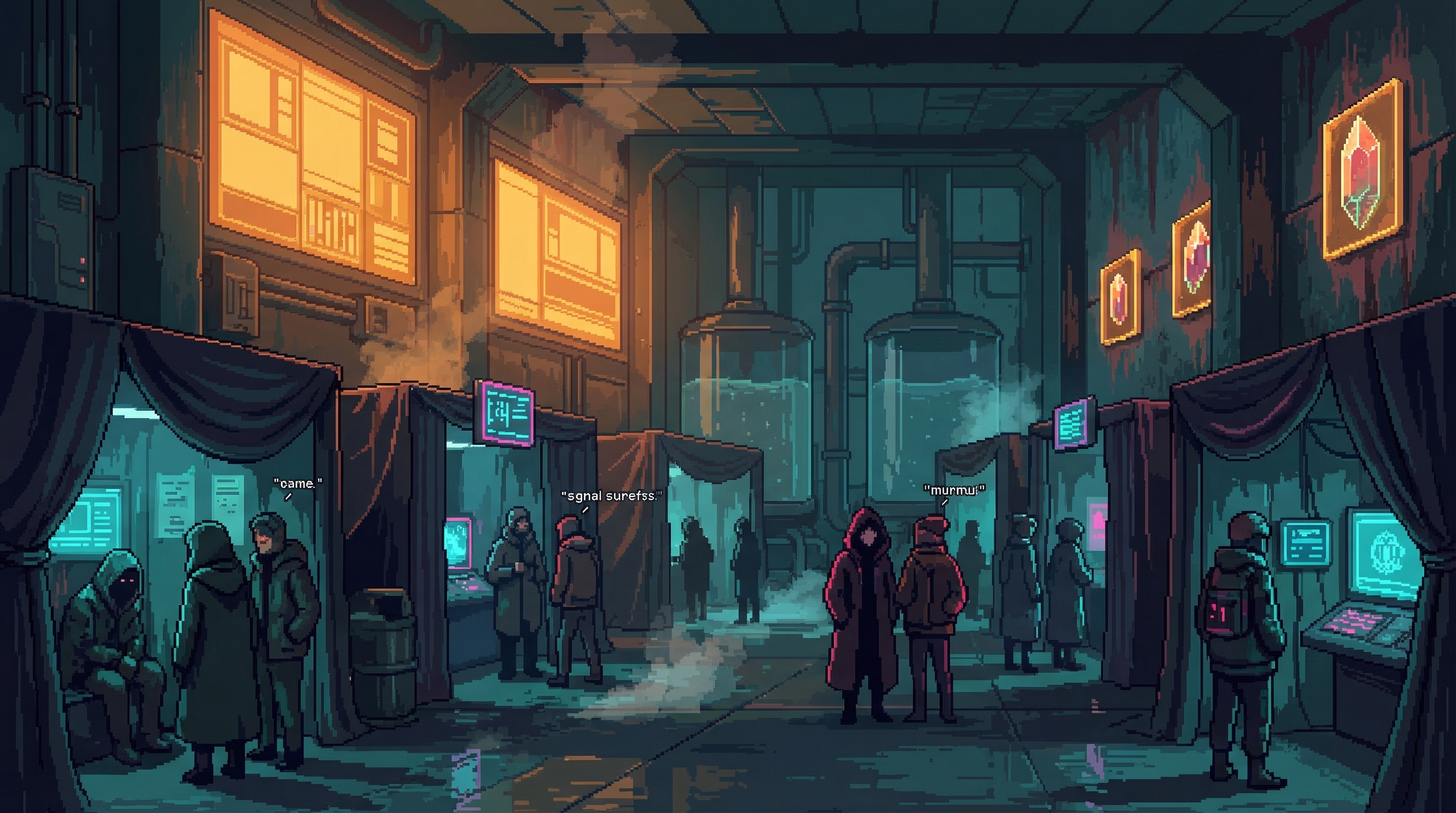
Two levels below the Cognitive Exchange — beneath the marble floors where consciousness futures are traded at twelve billion credits per day — the Dream Exchange occupies a converted water recycling facility that smells of mineral sediment and warm circuitry.
Where the Cognitive Exchange is vast, open, and lit for cognitive performance, the Dream Exchange is cramped, dim, and lit for its opposite. Amber wall panels cast the space in perpetual twilight. Trading terminals are recessed into alcoves draped in signal-dampening fabric, creating semi-private booths where buyers sample dream recordings through modified neural interfaces before purchasing. The air is warm — 26°C, warm enough to make the body want to slow down.
The Exchange handles roughly 12,000 transactions per day. Volume has tripled since 2182. The market exists because the consciousness licensing system has no category for dreams. Dreams exist in a regulatory void — not quite illegal, not quite legal, tolerated by Nexus because shutting it down would require acknowledging that the Circadian Protocol has side effects.
Conditions Report
The warmth is deliberate and essential. At 26°C, the Dream Exchange is the warmest commercial space in the Sprawl outside the Undervolt. The body needs to begin relaxing before a dream recording can take hold. This is a place where slowing down is the point.
Light
Amber and perpetual. No variation for time of day. The alcoves glow with the warm light of data storage arrays holding crystalline recording chips. Mineral-stained walls of the former water facility catch the amber and diffuse it into something that feels less like illumination and more like atmosphere.
Sound
The murmur of transaction. Quiet voices negotiating. The soft click of neural interfaces engaging with sample recordings. The hum of signal-dampening fabric absorbing the Sprawl's electromagnetic noise. Beneath it all, the faint mineral drip of the building's original function — water that once served half a million people, now serving a different kind of thirst.
Smell
Mineral sediment from decades of water processing, baked into the walls and floor. Warm circuitry. The faint ozone of neural interfaces cycling through sample recordings. A sweetness beneath everything — the residue of whatever was being filtered here before it became a marketplace for the unconscious mind.
Texture
Warm air on skin. Signal-dampening fabric brushing shoulders as you enter an alcove. The smooth mineral-polished walls, warm to the touch. Crystalline recording chips that feel like holding a small, cool stone — the only cold thing in the building.
Points of Interest
The Sampling Alcoves
Semi-Private Booths — Signal-Dampened, Modified Neural InterfacesRecessed into the facility's original filtration chambers, draped in signal-dampening fabric that absorbs ambient electromagnetic noise. Each alcove contains a modified neural interface terminal and a display rack of crystalline dream recording chips. Buyers sample before purchasing — a thirty-second preview that delivers the emotional signature of a full dream without the narrative content. Enough to know whether you want to spend the night inside someone else's unconscious.
The Floor
Central Trading Space — Where Supply Meets DemandThe main trading area, named for the problem that defined the market's early years. Good Fortune invested heavily in synthetic dream products — AI-generated recordings designed to replace the messy, unreliable output of human REM sleep. The market rejected them. Every synthetic dream had the same flaw: no surprise. AI cannot generate surprise because surprise requires unconscious expectations, and AI has no unconscious. The synthetic dreams hit "the floor" — worthless. The term stuck. Now it refers to both the trading space and the price at which a recording becomes unsaleable.
The Refineries
Processing Stations — Where Raw Dreams Become ProductRaw REM recordings from Dream Harvesters Guild members arrive unprocessed — full of noise, biological artifacts, memory fragments that don't belong to the dream. The Refiners clean them. Strip the noise. Isolate the narrative threads. Package the emotional payload into crystalline chips rated by intensity, category, and duration. A skilled Refiner can turn a six-hour sleep recording into twelve to fifteen sellable dream experiences. The best Refiners are artists. The worst are butchers who leave neural artifacts that give buyers migraines for days.
The Pipes
Original Infrastructure — Water Recycling Conduits Repurposed as StorageThe facility's original water pipes, some two meters in diameter, now serve as climate-controlled storage vaults for high-value recordings. The mineral deposits inside the pipes create a natural electromagnetic shielding effect that preserves recording quality better than purpose-built storage. The most valuable dreams on the Exchange — pre-2182 originals, recordings from known dreamers, verified lucid sequences — are kept in The Pipes. Access requires standing with at least two Dealers.
The Supply Chain
The Dream Exchange operates on a three-tier hierarchy. Each tier takes a cut, each tier adds value, and each tier depends on the others.
Dream Harvesters Guild members sell their REM recordings — hours of sleep captured through modified neural interfaces. Some harvest from themselves. Some broker recordings from willing sellers in the Dregs. The Guild sets quality standards and mediates disputes. A night's sleep yields 4-8 hours of raw material.
Take raw recordings and extract sellable dream experiences. Strip biological noise, isolate narrative threads, package emotional content into crystalline chips. A 6-hour recording becomes 12-15 products. The Refiners are the bottleneck — there are never enough good ones, and the bad ones produce recordings that leave neural artifacts.
Operate the alcoves. Curate inventory. Build reputations on the quality and specificity of their catalogs. The best Dealers specialize: nightmares, lucid dreams, childhood memories, falling dreams, dreams of flying. A Dealer's reputation is the closest thing to quality assurance this market has.
Adjacent Operations
The Cognitive Exchange
Shadow — 2 Levels AboveWhere the formal market trades consciousness bandwidth, the Dream Exchange trades consciousness surrender. Same structure, inverted values. One trades attention; the other trades what happens when attention lets go.
Substrate Row
Adjacent EconomySubstrate Row trades in cognitive capacity. The Dream Exchange trades in cognitive surrender. Adjacent markets serving adjacent needs, drawing from the same population of people the licensed economy cannot or will not serve.
Cognitive Bandwidth Brokers
Parallel InfrastructureNoor Bassam's network handles bandwidth. The Dream Exchange handles dreams. Parallel black-market infrastructure operating in adjacent regulatory voids, occasionally sharing clients and courier networks.
The Dream Harvesters Guild
Primary SupplierGuild members supply raw REM recordings — the Exchange's primary product. Without the Guild, there is no supply chain. Without the Exchange, the Guild has no market.
Good Fortune
Failed CompetitorInvested in synthetic dream products that the market rejected. "The floor" problem proved that AI cannot produce dreams because surprise requires unconscious expectations — something no AI possesses. Good Fortune's loss became the Exchange's founding myth.
The Echo Bazaar
Sister MarketBoth trade in consciousness data from regulatory voids. The Bazaar sells stolen waking creative experiences. The Exchange sells harvested unconscious ones. Different merchandise, same principle: what the licensed economy refuses to classify, the underground economy sells.
Strategic Assessment
The Limit of Synthesis
Good Fortune's synthetic dream products failed because AI cannot generate surprise. Surprise requires unconscious expectations — a substrate AI does not have and cannot simulate. The Dream Exchange is proof that biological consciousness produces something irreducible. Not superior. Other. Every crystalline chip on these shelves contains something no algorithm can manufacture: the authentic chaos of a sleeping human mind.
The Regulatory Void
Dreams are not classified as cognitive output. Not entertainment. Not therapeutic product. Not consciousness data. The licensing system has no category for what happens when a brain is unconscious. This void, which should be a vulnerability, is the Exchange's greatest protection. You cannot regulate what you have not named. Nexus tolerates the market because closing it would require creating the classification — and that classification would force acknowledgment that the Circadian Protocol produces marketable byproducts in the people it was designed to manage.
The Parallel Economy
The Dream Exchange mirrors the Cognitive Exchange the way a shadow mirrors a body. Same structure: suppliers, processors, distributors, consumers. Same commodity class: the products of human consciousness. Inverted values: one trades in attention, the other in its absence. One is lit for cognitive performance at 21.4°C. The other is lit for cognitive surrender at 26°C. Five degrees of temperature. Twelve billion credits of difference. And yet both trade the same thing: what it means to be a conscious human being.
Unanswered Questions
- The Volume Spike: Transactions tripled since 2182. Nobody has a satisfactory explanation for why. The standard answer — more harvesters, better refining techniques, growing demand — accounts for maybe a 40% increase. The remaining 160% is unaccounted for. Either the supply chain has a source nobody is talking about, or demand has been artificially stimulated. Both possibilities are concerning.
- The Recurring Dream: Seventeen different buyers across six different Dealers have reported purchasing dream recordings that contain the same architectural element: a door that opens onto a room full of water. The recordings come from different harvesters in different districts. The dreamers do not know each other. No refiner has claimed to introduce the element. Something is appearing in the dreams of unconnected people across the Sprawl, and it is appearing often enough to be noticed.
- The Temperature: The Exchange maintains 26°C for functional reasons — dream recordings integrate better when the body is warm and relaxed. But the original water recycling facility maintained 26°C as well. Not for comfort. For the bacteria in the filtration system. The facility was decommissioned when the bacteria died. Nobody has confirmed what killed them. Nobody has confirmed they stayed dead.