The Cognitive Exchange
Where consciousness has a spot price
Overview
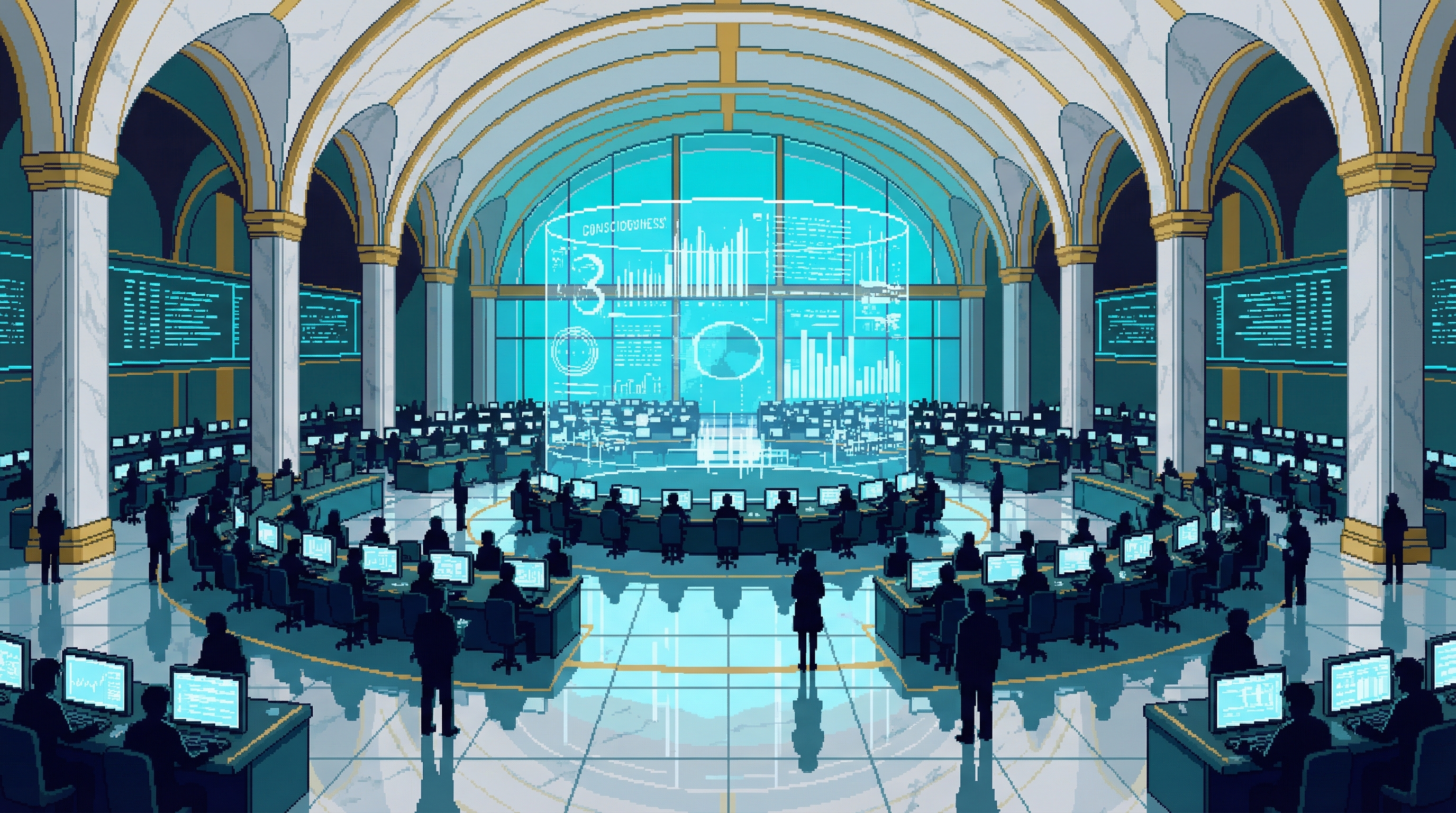
On Level 40 of the Lattice, beneath three stories of vaulted ceilings paneled in synthetic marble and backlit data screens, human consciousness is bought and sold at the speed of light. The Cognitive Exchange is the beating financial heart of the consciousness economy — where attention becomes currency, personhood has a price, and the future actions of 340 million people are traded as casually as grain futures.
Twelve thousand square meters of trading terminals and data feeds. Good Fortune Corporation operates under Nexus Dynamics license. Approximately twelve billion credits in daily volume. Together they have created a market where consciousness is not just commodified but financialized — spot price, futures curve, volatility index.
Atmosphere
A cathedral of concentration. Two thousand traders in focused silence. The air is precisely controlled: 21.4°C, 42% humidity, oxygen-enriched. It smells of nothing — engineered absence. Lighting is calibrated to circadian rhythms: warm morning tones shifting to blue-white at peak hours, designed for cognitive output, not comfort.
Visual
The Board's holographic blue-white light casting shifting shadows across synthetic marble. Traders' eyes glowing with interface overlays. Three stories of vaulted ceilings paneled in backlit data screens. Good Fortune gold accents catching the light.
Sound
A subsonic hum felt in the sternum rather than heard. Sound dampening so effective your own heartbeat becomes audible. The near-silence of two thousand people making decisions that reshape the lives of millions.
Texture
Synthetic marble floor, cold through shoes. The vibration of data infrastructure humming beneath. Precisely controlled air that feels manufactured, stripped of character. Everything engineered to remove distraction.
Smell
Engineered absence. The air has been scrubbed of scent with the same precision applied to everything else. No food, no bodies, no machines — nothing that might occupy a fraction of attention that could be spent trading.
Key Locations
The Board ("The Pulse")
Level 40 — 30-Meter Holographic Display, Updates Every 200msThe Consciousness Index. Thirty meters of holographic display dominating the main trading floor, updating every 200 milliseconds with the aggregate price of human awareness. Traders call it "The Pulse" because that is what it looks like — a heartbeat made of money, the vital signs of an economy built on the contents of people's minds.
During the 2181 Bandwidth Crisis, The Pulse dropped 43% in four hours. Traders who were there describe the display's color shift from blue-white to deep red as one of the most terrifying things they have ever seen — not because of the financial loss, but because of what it meant for the 340 million people whose consciousness value was collapsing in real time.
The Pit
Level 41 — Derivatives Trading FloorWhere the real complexity lives. The Pit handles consciousness CDOs, behavioral prediction swaps, and fork labor futures. Access requires Rung 4 minimum. The average career on The Pit lasts four years — not because traders burn out, but because the cognitive demands of pricing instruments based on the predicted behavior of millions of consciousnesses degrades the traders' own cognitive function over time.
The irony is not lost on anyone: the people trading consciousness futures are consuming their own consciousness to do it.
The Vault
Level 42 — Restricted AccessThe Vault houses Good Fortune's Correlation Engine — a proprietary system that cross-references data streams from every Rothwell corporation. The last official audit was conducted in 2179. The auditor retired three weeks later. No replacement has been assigned.
What the Correlation Engine does with all that data is a matter of speculation. What is known is that Good Fortune's trading algorithms consistently outperform every competitor, and that the performance gap widened measurably after the Engine came online. Correlation is not causation. But on the Exchange, correlation is profit.
The Markets
| Market | Daily Volume | Description |
|---|---|---|
| Consciousness Futures | ~4B credits | Contracts on the future price of consciousness processing — the core market |
| Behavioral Predictions | ~3B credits | Wagers on aggregate human behavior, from purchasing patterns to political sentiment |
| Fork Labor Contracts | ~2B credits | Futures on the output and availability of forked consciousness labor pools |
| Licensing Derivatives | ~1.5B credits | Instruments based on consciousness licensing policy changes and regulatory shifts |
| MVC Swaps | ~1B credits | Minimum Viable Consciousness threshold swaps — trading on the floor of human experience |
| Upload Insurance | ~0.5B credits | Coverage against upload failure, degradation, and consciousness loss |
Major participants include Nexus Dynamics, Good Fortune, insurance conglomerates, Helix Biotech, Ironclad Industries, The Collective (rumored), and anonymous trading pools whose beneficial ownership has never been disclosed.
Connections
Good Fortune Corporation
Operator. The Cognitive Exchange is Good Fortune's crown jewel — the physical embodiment of its mission to financialize every aspect of consciousness. The Exchange makes Good Fortune indispensable to the Rothwell ecosystem.
Nexus Dynamics
Infrastructure provider and largest single trader. Nexus provides the bandwidth and processing that makes the Exchange possible, then uses that same infrastructure to trade on the markets it enables. Regulator and participant. Referee and player.
Behavioral Prediction Markets
The Exchange is the physical home of the prediction markets — where aggregate human behavior is priced, packaged, and sold as financial instruments.
Rothwell Foundation
Every data stream from every Rothwell corporation converges in the Vault's Correlation Engine. The Foundation's reach becomes Good Fortune's informational advantage.
Noor Bassam
Runs a shadow exchange outside corporate oversight. Where the Cognitive Exchange financializes consciousness within the system, Noor's network provides alternatives for those the system was never designed to serve.
The Tensions
The Consciousness Commodity
“When the Cognitive Exchange opened its doors in 2169, the Cognitive Workers’ Union called it ‘the day they put a price tag on being alive.’ Good Fortune called it ‘market efficiency.’ Fifteen years later, both were right.” — The Forgotten Ways, Chapter 11
The Labor Question
The Pit burns through traders in four years — not because the work is hard, but because pricing the future of human consciousness degrades your own. The Cognitive Workers’ Union files new grievances quarterly. Good Fortune settles them all. The settlement cost is less than the cost of hiring humans who last longer.
Systemic Architecture
A leaked internal memo from Good Fortune’s Chief Behavioral Architect, dated 2181: “The Exchange does not create moral hazard. The Exchange makes moral hazard efficient. Every instrument we trade already existed as an informal exploitation. We simply gave it a price, a clearing mechanism, and a compliance framework. The cruelty was always there. We just made it liquid.”
Mysteries
- The Lockout Protocol: Level 42 can reportedly modify Basic-tier bandwidth allocation for 200 milliseconds — just long enough to disrupt competing trading systems. Allegedly used twice. Denied both times. No evidence has survived to confirm or refute the claims.
- The Silent Traders: Twelve terminals on the main floor have been active since the Exchange's founding. They never change positions. They are always profitable. They are registered to no identifiable entity. Exchange security has investigated three times and closed the inquiry each time without explanation.
- The Index Anomaly: On the 37th anniversary of the Cascade, the Consciousness Index display formed a clear image of two hands releasing a dove. The image persisted for 4.7 seconds before resuming normal data visualization. The incident was logged as a rendering error. The log was subsequently classified.