The Dream Harvesters Guild
You Cannot Squeeze a Person's Unconscious Harder and Get More Interesting Dreams
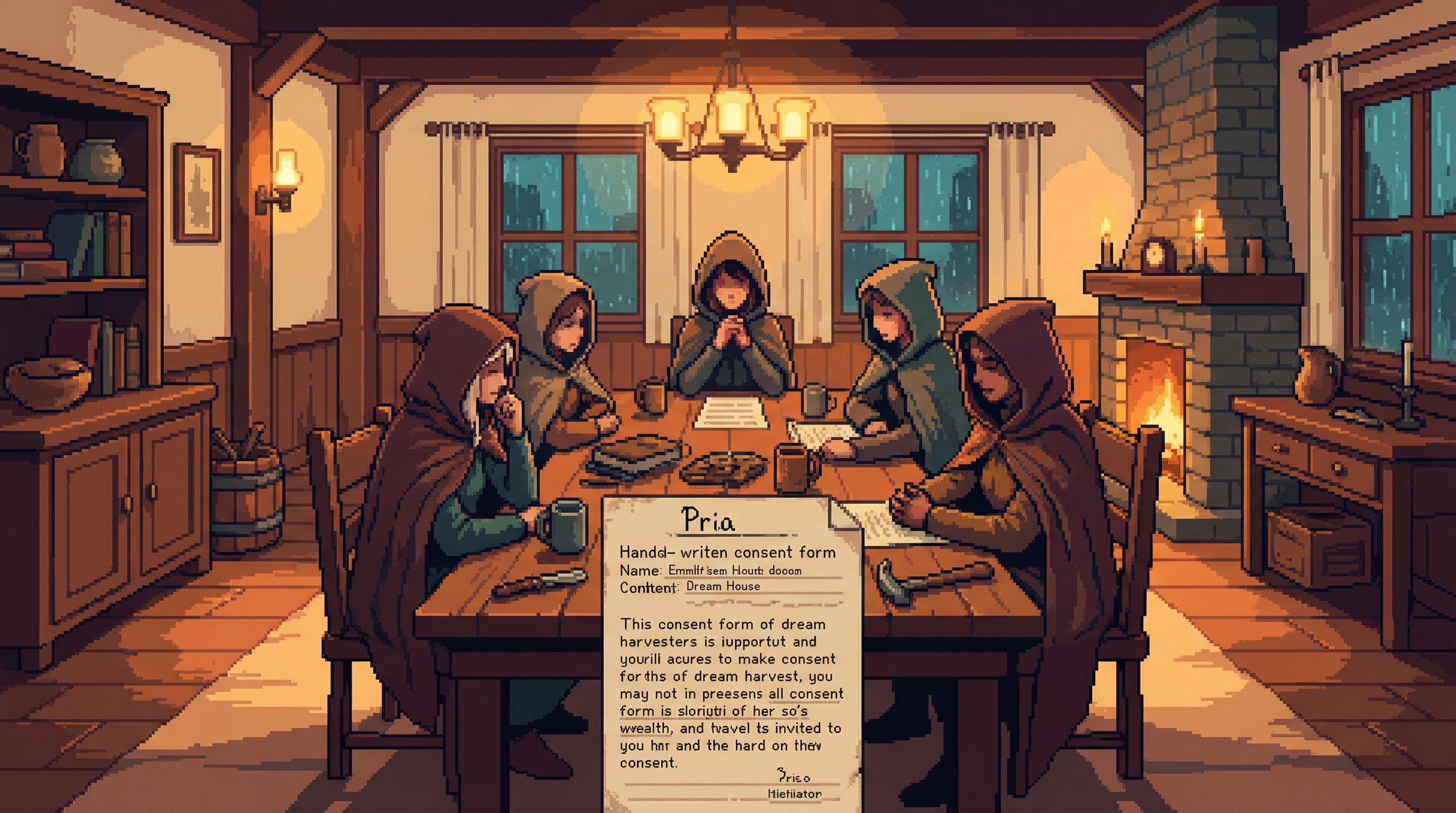
The Dream Harvesters Guild is not a guild in any formal sense. It is a set of protocols — safety standards, pricing guidelines, donor protections — written by Fen Morrow and three other senior harvesters in 2182, after a harvester in Sector 8 suffered permanent cognitive damage from an unmonitored four-hour REM extraction session.
The damage was catastrophic. Pria, a 19-year-old unaugmented woman, entered a state of permanent dream immersion. Her body functions. She eats when fed. But her consciousness has retreated into a dream state from which she cannot be woken. Her EEG shows continuous, complex dream architecture. She appears to be having the most vivid dream in human history. She has been dreaming for two years.
"You cannot squeeze a person's unconscious harder and get more interesting dreams. You can only damage the person." — Guild founding document
Pria's case galvanized the harvester community. The Guild's founding document opens with her name. The protocols now govern dream harvesting across the Sprawl: session limits, monitoring requirements, physical consent forms, and the undertow protocol — mandatory 30-day suspension for harvesters showing signs of persistent pull toward unconsciousness.
The Protocols
Written after Pria. Named after Pria. Every harvester who works under them knows why they exist.
90-Minute Limit
No session exceeds 90 minutes. No exceptions. The 4-hour session that destroyed Pria was unsupervised and unregulated. Now the clock runs whether the dream is interesting or not.
6-Hour Recovery
Minimum six hours between sessions. The unconscious is not a resource to be strip-mined. It needs time to reconstitute.
5 Sessions per Week
Maximum weekly limit. Harvesters who push past this start showing the signs — the persistent pull, the difficulty distinguishing waking from dreaming. The undertow.
Monitored Facilities Only
Guild-approved harvesting happens at the Still House and similar monitored facilities. No back-alley extraction. No unsupervised sessions. Pria was alone.
Physical Consent Forms
Paper. Handwritten. Because neural-interface contracts can be modified by corporate firmware. Paper cannot be remotely updated. This is the Sprawl's most radical institutional design choice.
Undertow Protocol
Mandatory 30-day suspension for harvesters showing signs of persistent pull toward unconsciousness. The undertow is the first symptom. What happened to Pria started with the undertow.
Doctrine
The Guild holds one principle: the harvester's safety is more valuable than the harvest. This is not ideological. It is practical. A damaged harvester produces no more dreams. A dead harvester produces no more dreams. The economics of sustainability align with the ethics of care.
Depth comes from the dreamer, not the duration. You cannot produce deeper dreams by extracting longer. You can only produce damaged dreamers. The best dreams come from people who live interesting lives and then sleep well — the harvest is a byproduct of a life worth dreaming about.
Not all harvesters join. Some resent the pricing guidelines. Some consider the session limits overcautious. They work outside the protocols, in unmonitored spaces, for longer durations. The Guild does not pursue them. It simply waits. The undertow always comes.
Points of Inquiry
Questions the Sprawl has not resolved — and that the Guild confronts every working day.
Solidarity in an Impossible Economy
The commodity these workers produce — human unconsciousness — has no precedent. How do you organize labor around something this intimate? The protocols borrow from pre-Cascade sex work regulation, organ donation ethics, and agricultural labor standards. None of them fit exactly. All of them fit a little.
Paper Against Firmware
Neural-interface contracts can be modified by corporate firmware updates. The Guild trusts paper because paper cannot be remotely rewritten. In a world of digital manipulation, the most technologically advanced defense is a return to physical documentation. Who else has figured this out — and who hasn't, yet?
Invisible Labor, Essential Output
Like the Lamplighters, the Guild is an invisible-labor organization whose members maintain something essential through skill and presence rather than institutional power. Unaugmented people doing work that the augmented cannot replicate. The Sprawl depends on them and does not acknowledge it.
If the best dreams come from lives worth living, what does it mean that most harvesters can barely afford to live?
Diplomatic Posture
The Guild has no diplomacy. It has supply relationships, parallel organizations, and one place where its members' work is treated as sacred rather than commercial.
Supply Chain
The Dream Exchange
Primary SupplierGuild members are the Dream Exchange's primary suppliers of verified, safely extracted REM recordings. The Exchange needs quality product. The Guild ensures its members survive to produce it. Mutual dependency built on the fact that damaged dreamers produce nothing worth selling.
The Still House
Primary FacilityThe Guild's safety protocols were developed here. The Still House is the primary Guild-approved harvesting facility — monitored, staffed, built around the understanding that the harvester matters more than the harvest.
Parallel Organizations
Cognitive Bandwidth Brokers
Same Model, Different MarketNoor Bassam's amber circle and Fen Morrow's Guild protocols both do the same thing: enforce quality standards in unregulated black markets. Both prioritize donor and seller safety. Both emerged from catastrophic incidents. Both prove that informal networks can govern what institutions refuse to touch.
The Lamplighters
Same Ethos, Different TradeUnaugmented people maintaining essential infrastructure through skill, presence, and refusal to be institutionalized. The Lamplighters keep the Grid alive. The Guild keeps harvesters alive. Neither organization exists on any official register.
The Sacred
Compiler Asa Mori
Spiritual PatronHarvesters attend Mori's Dreaming Church — the only context where their work is treated as sacred rather than commercial. Everywhere else, they are vendors. In the Dreaming Church, they are witnesses to the unconscious. The distinction matters more than it should.
The Unwilling
The Other Side of Consciousness WorkThe Guild serves voluntary harvesters. The Unwilling are involuntary fragment carriers. Both organizations exist because institutional systems ignore the people living with consciousness-level intimacies that nobody designed protections for.
Atmosphere
The Meeting Space
Still House back rooms after hours. Warm amber light on wooden surfaces. The smell of linen and something like chamomile — the residue of whatever they burn to help harvesters transition back to waking. Handwritten consent forms stacked neatly, Pria's name at the top of every one. Protective, domestic, deliberate.
Aesthetic
Nothing clinical. Nothing corporate. Earth tones and warm light — the visual language of care, not commerce. The Guild's spaces look like someone's living room because they were designed by people who understood that the harvester's last sight before sleep should feel safe.