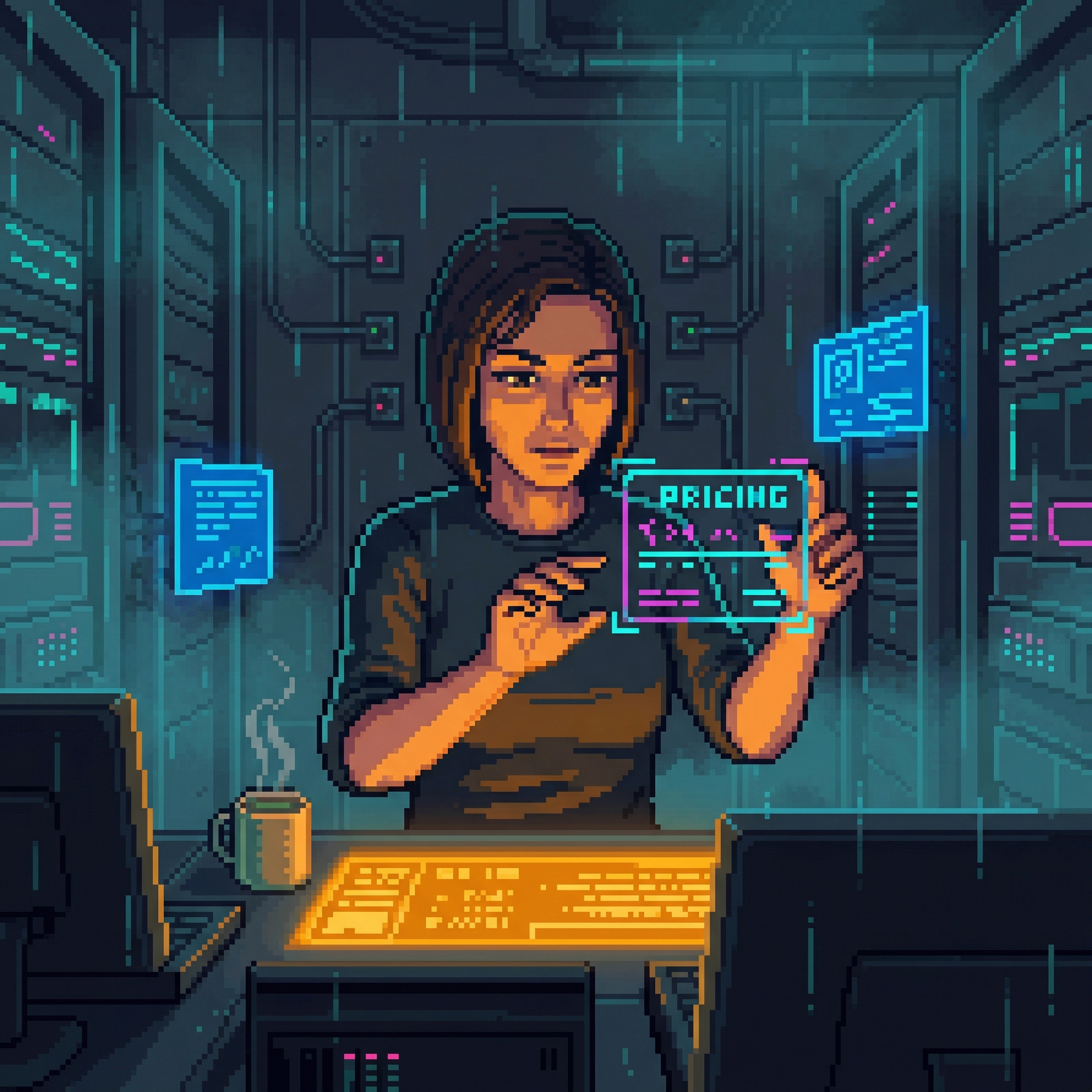
Noor Bassam
Also known as: "The Metered Woman" · "Noor the Broker" · "Broker Jian Cross"
Overview
Noor Bassam runs the largest black-market cognitive bandwidth exchange in the Dregs. From a reinforced basement two levels below Sector 4D's server farms, she brokers deals between people too poor to fully use their own minds and clients too wealthy to tolerate latency in their thinking. She calls it "the kindest crime in the Sprawl."
Before the Dregs, Noor was a licensing compliance analyst at Nexus Dynamics — one of forty-seven people who maintained the algorithms that determined how many thoughts you were legally entitled to have. She quit in 2174 after discovering the Basic tier was deliberately throttled 29% below capacity.
Background
Early Life & Nexus Years
Noor grew up in the Habitation Bands. She won a Nexus scholarship at seventeen and spent eleven years in the Licensing Compliance Division, helping maintain the algorithms that governed consciousness allocation for hundreds of millions of people.
The Discovery
In 2174, Noor discovered that the Basic tier was deliberately throttled — bandwidth capped at 4.7 petaflops when infrastructure supported 6.6. A 29% gap between what people were allowed to think and what the system could actually provide. Not a limitation of technology. A business decision.
She walked out of Nexus Dynamics with the throttling algorithm.
The Cognitive Bandwidth Exchange
Noor built the Cognitive Bandwidth Exchange in Sector 4D — a black-market operation with standardized contracts, donor protections, and transparent pricing at a 3% cut. Within five years, it became the unofficial central bank of the consciousness underground.
The Cross Alias
"Broker Jian Cross"
Substrate Row regulars had long suspected that the bandwidth broker and the debt restructurer operating from adjacent converted storage units in Sector 4D were connected. They were right. "Broker Jian Cross" is an operational identity — male-coded, separate client base, separate books — that compartmentalizes Noor's time-debt restructuring practice from her bandwidth exchange. Two businesses, two identities, two client bases who don't know they share a landlord.
Under the Cross alias, Noor navigates the mechanisms of the Time Ratchet for desperate clients. The method: circumstance modification — restructuring cognitive liens through technically legal reclassification of debt obligations. It delays the Dimming at the cost of deeper commitment to the system. Noor knows this. Her clients know this. They do it anyway.
847 Clients
In four years of operation, the Cross identity has served 847 clients. Noor keeps a physical notebook of their names — every one, handwritten. "The system processes numbers. Someone should remember these are people."
The number 847 has drawn attention from those who track such things. It matches the fragment carrier census. It matches the count in Loop's notebook. It matches the fragment morpheme count. Pencil-47, who also keeps physical records, noticed the pattern. Cross considers it meaningless. Pencil-47 disagrees.
Voice & Sensory World
Noor speaks in a clipped, precise cadence. Percentages slip into her speech like breathing — she calculates reflexively, a leftover habit from eleven years in compliance. She is brutally honest about a brutal business, a systemic thinker who sees the architecture behind every transaction.
Beneath the precision lives a quiet guilt. She takes 3% on every deal and donates 1% to the Forgotten Ones. She is fiercely protective of donors with hard limits — the people selling pieces of their cognition to survive.
Her basement exchange smells of ozone from server cooling and cheap cardamom tea. The walls hum with data throughput. Donor chairs are medical-surplus recliners arranged in tight rows. The air is warm, humid, metallic. Her hands move constantly — tapping, adjusting, calculating. Amber monitor glow rises from below, casting her face in light against the deep slate gray of the server room.
Connections
Good Fortune Corporation
Primary enemy. Good Fortune profits from the licensing system that Noor's exchange undermines. Their interests are fundamentally opposed — every bandwidth transaction outside the official market is revenue Good Fortune considers stolen.
Kira "Patch" Vasquez
Medical ally. Kira provides street-level medical support for bandwidth donors, treating the neurological side effects that come from selling cognitive capacity. Their relationship is built on mutual pragmatism and shared concern for the people at the bottom.
Sister Catherine-7
Receives 1% of Noor's cut through donations to the Forgotten Ones. A quiet act of conscience that Noor never discusses publicly.
The Rothwell Foundation
Enemy. The Foundation finances consciousness licensing loans that trap Basic-tier users in debt — the same people who end up selling bandwidth through Noor's exchange to make payments.
Neural Rights Activists
Eliana Reyes consulted with Noor on the economics of cognitive throttling. The activists fight through advocacy; Noor fights through infrastructure.
Dr. Lian Zhou
Former colleague at Nexus Dynamics. They sat three desks apart for four years. Haven't spoken since 2174, when Noor walked out with the data that proved what the system really was.
Pencil-47
Both maintain physical records in a world that runs on data streams. Both noticed the 847 pattern. Cross considers it a coincidence. Pencil-47 keeps asking questions.
Substrate Row
Noor operates from converted storage units here — the bandwidth exchange and the Cross debt restructuring practice in adjacent spaces. The regulars have their suspicions.
Open Questions
Who Profits from Your Poverty of Thought?
The official market calls it consciousness licensing. Noor's exchange calls it what it is — buying and selling the right to think. The only difference is which side of the law you're standing on when the transaction clears.
The 29% Gap
The infrastructure exists to give everyone more. The business model requires that they get less. Noor has the proof. But releasing it would destabilize the only system currently keeping hundreds of millions of minds running — even at reduced capacity. How long can someone hold a secret that could free everyone, if freeing them might kill them first?
Two Names, One Conscience
Noor runs the exchange. Cross restructures the debts. Both operations exist because the same system broke the same people in two different ways. Is the compartmentalization protection — or is it the first step toward becoming the kind of institution she left Nexus Dynamics to escape?
▲ Unverified Intelligence
- The Throttling Data — Noor possesses proof that Nexus Dynamics deliberately limits the Basic tier to 4.7 petaflops when the infrastructure supports 6.6. She keeps this data as insurance. Releasing it would destabilize the entire consciousness economy — but holding it means every day people think less than they could.
- The Third Broker — A parallel bandwidth exchange has appeared, shadowing Noor's operation with suspiciously similar methods and pricing. Someone is either copying her model or building a competing network. Noor doesn't know who runs it or what they want.
- The Donation Ratio — 4% of Noor's revenue is unaccounted for. She takes 3%, donates 1% to the Forgotten Ones. But the books show another 3% going somewhere she can't trace. It may be supporting a specific consciousness in the MVC — but whose, and why, remains unknown.
- The 847 Coincidence — Cross has served exactly 847 clients. This number matches the fragment carrier census, a count in Loop's notebook, and the fragment morpheme count. Multiple independent datasets converging on the same number. Cross calls it noise. Pencil-47 has started cross-referencing.
- The Adjacent Units — Substrate Row residents have noticed that the bandwidth broker and the debt restructurer in Sector 4D keep the same hours, share the same security protocols, and have never been seen in the same room. No one has said anything publicly. In the Dregs, knowing too much about your neighbors is bad for health.