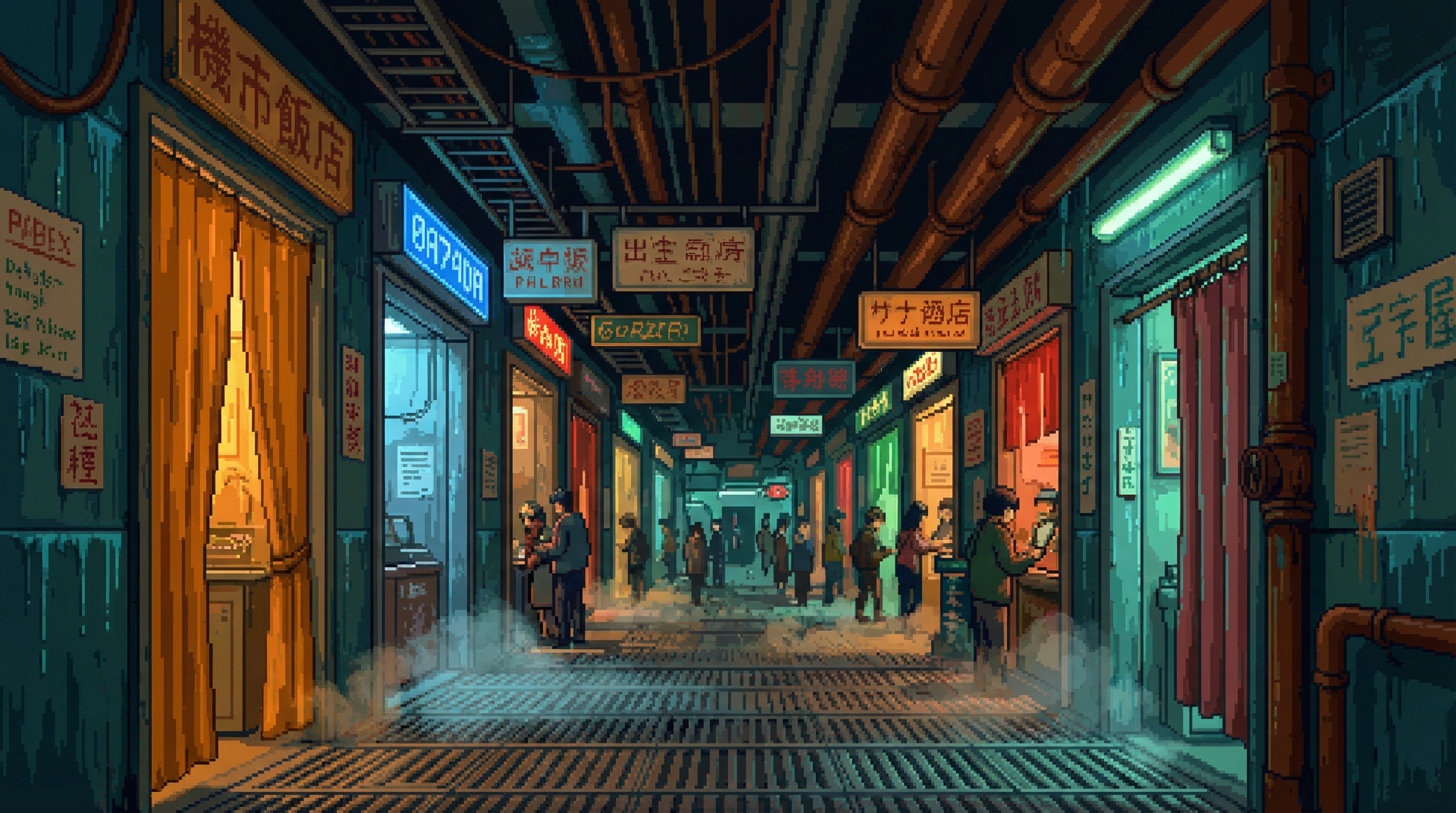
Substrate Row
Everything the system won't sell you
Overview
Three levels below Sector 4D's server farms, in tunnels running warm with waste heat, Substrate Row offers everything the licensed consciousness economy will not sell to those who need it most. Bandwidth upgrades at a tenth of corporate price. Memory modification without the six-month waiting list. Consciousness transfer for people who would never pass a credit check. Four hundred meters of converted maintenance tunnels, low ceiling, improvised lighting, air smelling of overheated circuitry and cooking oil.
Twelve major clinics and forty-odd smaller operations. Nobody pretends it is a good place. The Row has existed in some form since the years following the Cascade, growing steadily as the licensed consciousness economy priced out more people than it served. The prices are lower because the risks are higher: no quality guarantee, no insurance, no legal recourse, no aftercare, no privacy guarantee. Every client on Substrate Row is someone the licensed system failed or refused to serve. The Row exists because the alternative — no access at all — is worse than bad access.
Atmosphere
The heat hits first. Thirty-one degrees Celsius, humidity that makes skin damp within minutes. The corridor is narrow — two people cannot pass without turning sideways. Patchwork walls of heat-resistant paneling, exposed conduit, hand-painted signs in six languages. Colored light spills from doorways: amber for bandwidth services, blue for neural work, red for memory modification, green for medical.
Visual
Colored light from doorway curtains — amber, blue, red, green — painting the narrow corridor in shifting hues. Hand-painted signs in six languages. Exposed conduit and patchwork heat-resistant paneling. Condensation on every cool surface. LED strips, bioluminescent panels, neural monitoring glow.
Sound
Layered: cooling systems humming overhead, transactions murmured in doorways, neural monitoring beeps from clinics, the subsonic pulse of data infrastructure vibrating through the grated flooring. Negotiation in every language the Sprawl speaks.
Texture
31°C and humid. Grated flooring vibrating with data infrastructure beneath. Condensation slick on conduit pipes. The cramped corridor forces bodies close — elbows, shoulders, the constant negotiation of physical space in a place built for maintenance robots, not people.
Smell
Overheated circuitry and cooking oil. Antiseptic from the better clinics. Metallic ozone from the data infrastructure below. The mingled sweat of two thousand people passing through a corridor designed for two.
Key Locations
The Clean Clinics
3 of 12 Major Operations — Noor Bassam's Network, Amber Circle LogoThree of the twelve major operations on Substrate Row are run by Noor Bassam's network, marked with an amber circle logo. The best is "Clarity," run by Deshi Ren — a 97% success rate, actual chairs, filtered air. In a place where "good enough" means you probably survive the procedure, Clarity is exceptional. Deshi charges more than the corridor clinics but less than half of licensed rates, and the difference is that patients walk out with their memories intact.
The Deep End
Southern Terminus — Ferryman Network Consciousness TransferThe southern end of the Row, where two Ferryman Network operators handle consciousness transfer — the one service that is not publicly offered through licensed channels at any price. "The Accountant" is competent: 43% success rate, methodical, honest about the odds. "Prophet Blue" claims ORACLE guidance, charges by astrological alignment, and does not track outcomes. Both stay in business. Desperation is not selective.
The Cots
Improvised Recovery Spaces Between ClinicsBandwidth sales leave four to eight hours of cognitive fog. During that window, the seller is vulnerable — disoriented, suggestible, unable to navigate. The Cots are improvised recovery spaces between the clinics, maintained by volunteers who are mostly former bandwidth donors themselves. They watch over recovering sellers, keep them hydrated, prevent them from being scammed while impaired. It is not charity. It is the minimum infrastructure that allows the Row to function without becoming predatory.
The Board
Northern Entrance — Physical Bulletin BoardA physical bulletin board at the Row's northern entrance. Services available. Warnings about scams. Community information. Reviews of clinics that amount to "I survived" or "don't go there." The Board is the most reliable indicator of the Row's current state — which operators are active, which have been raided, which are running scams, which are actually helping. In a place with no regulatory authority, the Board is the closest thing to consumer protection.
The Market
| Service | Substrate Row Price | Licensed Price | Risk |
|---|---|---|---|
| Bandwidth Upgrade | ¢50-200 | ¢500-2,000 | No quality guarantee |
| Memory Modification | ¢2-5K | ¢15-30K | No insurance, no aftercare |
| Consciousness Backup | ¢5-15K | ¢50K+ | No privacy guarantee |
| Fork Creation | ¢10-30K | ¢100K+ | No legal recourse |
| Full Transfer | ¢100-500K | Not publicly offered | 43% success (best operator) |
Lower prices mean higher risks. No quality guarantee, no insurance, no legal recourse, no aftercare, no privacy guarantee. Every transaction on Substrate Row is a bet that bad access is better than no access. For most of the Row's two thousand daily visitors, it is a bet they have already lost the right to refuse.
Connections
Noor Bassam / Cognitive Bandwidth Brokers
Three clinics on the Row, marked with the amber circle. Noor's network represents the best-case scenario for unlicensed consciousness work — professional, relatively safe, genuinely motivated by the belief that access to consciousness services is a right, not a privilege. The Row is where that belief meets reality.
The Ferryman Network
Two transfer operators at the Deep End. The Ferrymen provide the one service the licensed economy refuses to offer at any price: consciousness transfer between substrates. On Substrate Row, that service costs between 100,000 and 500,000 credits and has a 43% success rate at best.
Consciousness Licensing
Every client on Substrate Row is someone the licensing system failed. Priced out, credit-checked out, waiting-listed out. The Row exists in direct proportion to the system's exclusions — the more people the licensed economy cannot serve, the longer the Row grows.
The Forgotten Ones
Volunteers from the Forgotten Ones maintain presence in the Cots, watching over bandwidth sellers during cognitive recovery. The same impulse that drives them to string fairy lights in the Dim Ward drives them to keep watch over strangers in the tunnels beneath Sector 4D.
Memory Therapists Association
An informal presence. Licensed memory therapists who volunteer time on the Row because they have seen what unqualified memory modification does to people, and because preventing botched procedures is easier than repairing them.
Themes
Free Market vs. Corporate Monopoly
Is an unregulated market in consciousness services worse than a corporate monopoly that prices out the majority? Substrate Row is the free market's answer to Nexus Dynamics' licensed economy — cheaper, riskier, more accessible, less safe. Neither system serves the people who need it most. The Row just fails them more honestly.
Dignity in Desperation
What does dignity mean when consciousness itself is a commodity? The Cots volunteers watching over recovering bandwidth sellers. Deshi Ren's 97% success rate in a corridor of coin-flip clinics. The Board's handwritten warnings about scams. Substrate Row is not dignified. But within it, people insist on treating each other as something more than transactions.
Who Profits from Desperation
Prophet Blue charges by astrological alignment and does not track outcomes. The Accountant has a 43% success rate and is considered the competent one. Corridor clinics operate without quality standards. Everyone on the Row is making money from people who have no other options. Some do it responsibly. Some do not. The system that created the desperation profits most of all — and bears none of the risk.
Mysteries
- The Clean Room: Behind a deliberately decrepit facade at the Deep End, a consciousness transfer suite equipped to corporate grade. Better equipment than most licensed facilities. No one knows who built it or who funds its maintenance. The operators at the Deep End claim no knowledge. The suite's success rate — if it has one — has never been shared.
- Kenna: A recurring bandwidth donor who has been selling weekly for seven years without measurable cognitive degradation. Standard donors show decline within months. Kenna's neural architecture appears to regenerate what she sells. No researcher has been permitted to study her. She declines all interviews. She sells her bandwidth, collects her credits, and leaves.
- The Nexus Tolerance: Nexus Dynamics raids Substrate Row periodically but never shuts it down permanently. The Row serves as a pressure valve — a place where people priced out of the licensed economy can access services without building the political pressure that might force systemic reform. Nexus tolerates the Row because the Row makes the system sustainable.