
Sponge
Also known as: The Witness, Lens
Overview
Sponge is the Sprawl's conscience with a camera for eyes.
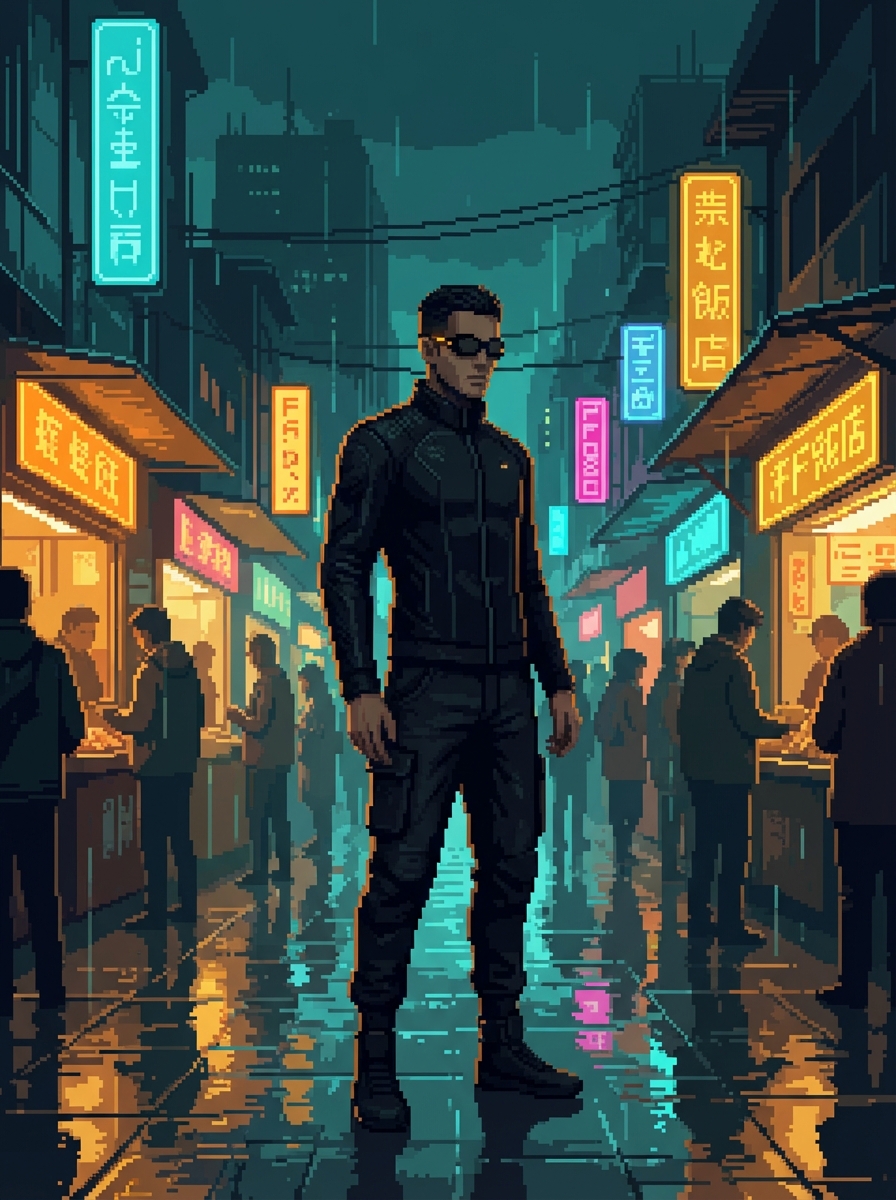
In a city where megacorporations own the feeds, curate the news, and can literally rewrite memory through neural augmentation, the truth is whatever the highest bidder says it is. Sponge exists to break that monopoly. He walks the lowest levels of the Sprawl — the markets, the shelters, the protest lines — and he records everything. Not with a traditional camera. His slim matte-black glasses are an ocular capture rig: his eyes are the lens, with amber temple lights pulsing like a heartbeat when he's active.
But recording is only half the work. The other half is craft. Sponge doesn't dump raw footage — he edits. He sequences. He builds narratives from fragments of truth that hit harder than any corporate propaganda because they're real. He cuts these stories together with the precision of an artist and drops them into underground mesh networks where they spread like fire, impossible to trace, impossible to stop.
The Observer Who Became a Leader
For years, Sponge was content to be the man behind the lens. Curious, empathetic, but fundamentally safe in his role as witness. He told other people's stories because telling his own felt too vulnerable, too exposed. The camera was protection as much as purpose — a way to engage with the world's pain without putting his own skin in the game.
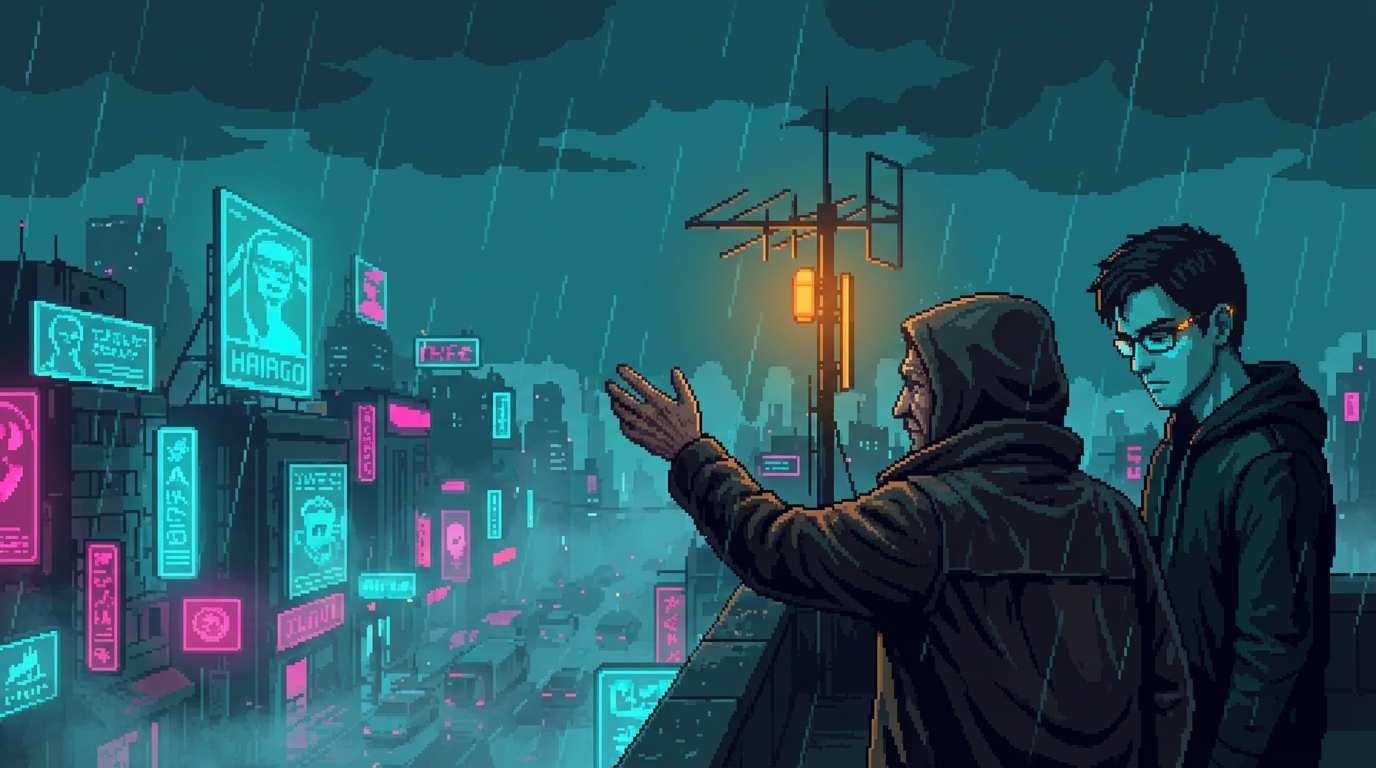
Then a mentor appeared. An older figure — name unknown, fate unknown — who pulled Sponge out of aimlessness and taught him to read the Sprawl. Not the neon signs everyone sees, but the hidden text: which alleys the drones avoid, which food stalls serve as dead drops, where the corporate surveillance grid has blind spots that nobody has patched.
The mentor gave him more than skills. They gave him a framework: corporations aren't evil because evil people run them — they're evil because the structures they've built make evil outcomes inevitable. You don't fight evil people. You expose evil structures. And you do that by showing people what's really happening, in a way they can't unsee.
The Unfinished Film
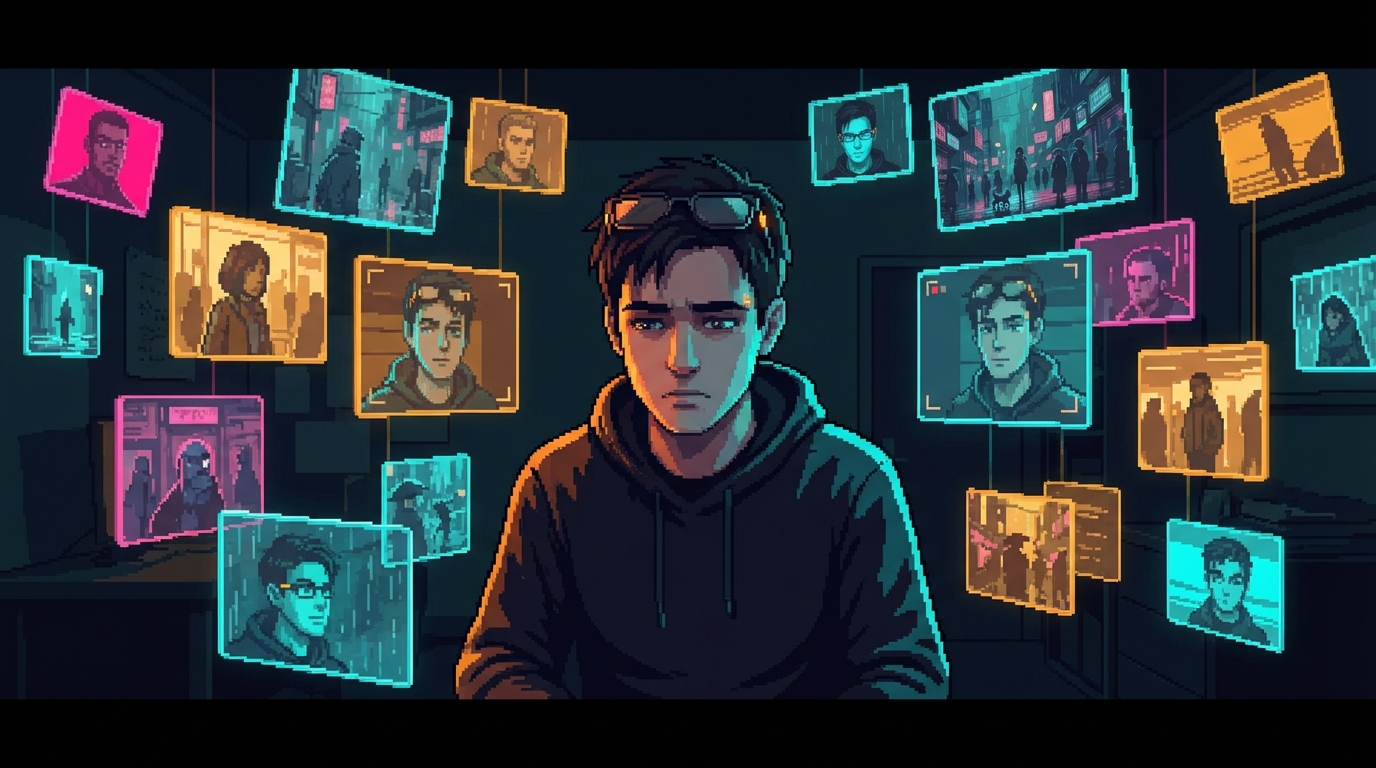
Every great documentarian has the project that won't let go. Sponge's is a sprawling, years-long work he's never been able to name — not because he can't find the right title, but because naming it would mean admitting what it's really about.
It started as a documentary about life in the Sprawl. Interviews with residents. Footage of daily survival. The small acts of beauty and resistance that happen in the cracks of a corporate world. He recorded street vendors who remember what the market smelled like before the corporations sanitized it. He captured the last conversation of an old machinist who could still repair pre-Cascade hardware by hand.
Somewhere around year three, the project turned inward. He started recording himself. His own reflections. His own doubts. The footage became confessional, then philosophical, then deeply personal — tangled up with his relationships, his choices, the question of whether a man who spends his life capturing other people's stories is avoiding his own.
He's afraid to finish it. Not because it isn't good — it might be the most important work in the Sprawl. But finishing it means answering a question he's been circling for years: Is the observer's life a real life? Or is it the most sophisticated form of hiding?

The Broadcasts
In the underground, they're called "drops." A Sponge drop shows up across the mesh network without warning, spreads through a hundred nodes in an hour, and plays on every unlicensed screen in the Dregs by nightfall. Corporations have tried to scrub them. The footage always comes back.
The Amber Pulse

Every broadcast opens with a two-second shot of the ocular rig's amber light reflected in a rain puddle. It's become his signature — the underground equivalent of a studio logo. When people see the amber pulse, they know what follows is real.
No Narration
Sponge never speaks in his broadcasts. The footage speaks for itself. Faces. Environments. Moments. Juxtaposed against corporate messaging that contradicts what the images show.
The Hold
Every broadcast ends on a single face held for five full seconds in silence. Long enough to be uncomfortable. Long enough that the viewer has to sit with what they've just seen.
Before 2182, the hold showed the victim. After the Evidence Paradox broke his methodology open, the hold changed. Now it shows the witness. The person who was there. The human chain that fabrication cannot replicate.
The Eleven Days
In 2182, Sponge dropped three minutes on a Sector 14 housing demolition. Forty families displaced. Corporate messaging contradicted the footage. Standard operation — the kind of drop that had moved markets before.
Then a Nexus Communications officer released a counter-recording. Same location, different angle, different residents, different story. Both recordings passed verification. Every authentication protocol confirmed both as genuine.
The story didn't die because the audience believed the corporate version. It died because the audience believed neither. Forty families became a debate about methodology instead of a crisis about people. The Evidence Paradox had come for Sponge personally — and it won.
He went dark for eleven days. No drops. No mesh network activity. No amber pulse anywhere in the Dregs. People who track his signal said it simply stopped.
When he came back, the broadcasts looked different. The five-second hold at the end no longer showed the victim. It showed the witness. The person who was standing there when it happened. The face that says: I saw this. Ask me.
He's reinventing the Truth House's methodology at broadcast scale — creating chains of human testimony that fabrication cannot replicate. A recording can be faked. A person standing in front of you, answering questions, sweating through the details — that's harder to manufacture. Sponge doesn't ask the audience to trust his footage anymore. He asks them to trust the person in the footage, and then go find that person.
The Community-Reputation Chain
After Sector 14, Sponge rebuilt from scratch. His new drops feature something the old ones never did: named, visible Dregs residents who allow their faces to be shown. Not because they're brave — though they are — but because their community reputation is their authentication.
A fabrication could reproduce their image. It cannot reproduce the decades of community relationships that make their testimony trustworthy. When a woman who has lived in Sector 9 for thirty years appears in a Sponge drop and says this happened, the audience doesn't need to verify the recording. They know her. Their grandmother knows her. She fixed their neighbor's water recycler last winter.
Corporate media calls this primitive. Sponge calls it the only form of evidence the Evidence Paradox cannot defeat — because fabricating a community member's reputation would require fabricating the community, and communities notice when strangers claim to be neighbors.
This is the Dregs' most sophisticated response to the Evidence Paradox, and it was built by a man with a camera in his skull and nothing left to lose except his credibility. Sponge is reinventing the Truth House's methodology at broadcast scale — creating chains of human testimony that no amount of computational power can replicate.
The Craft
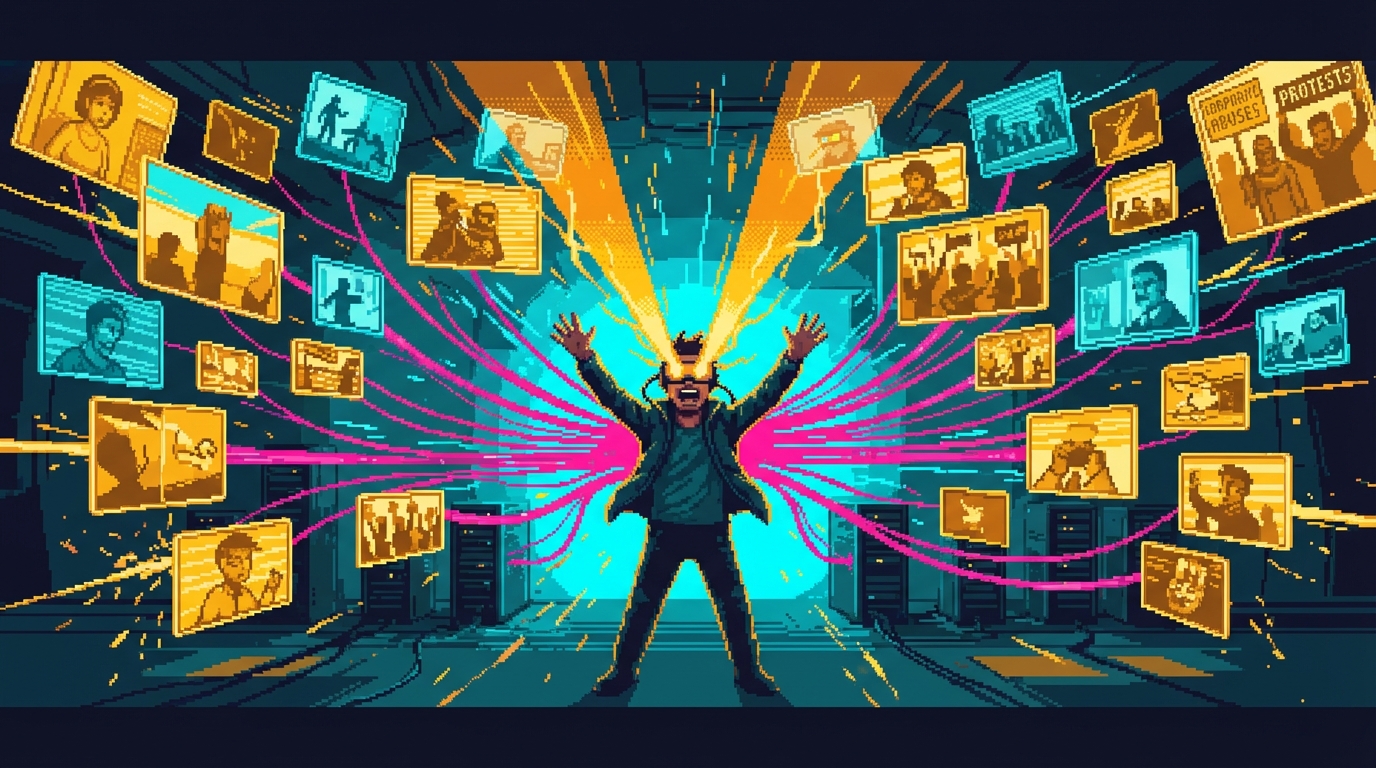
Sponge's weapon isn't the footage. It's the edit.
Anyone with an ocular rig can record. The Sprawl is full of people capturing reality — surveillance feeds, corporate dashboards, personal memory logs. Raw footage is noise. What Sponge does is signal.
He has an intuitive understanding of narrative rhythm — how to sequence images so they build emotional momentum, how to cut between a corporate executive's press conference and the reality on the ground so the juxtaposition does the arguing for him. He never adds commentary. He never tells the viewer what to think. He just arranges the truth in an order that makes its own case.
"Last month, Nexus demolished a housing block in Sector 14. Forty families. The feeds ran a story about 'urban renewal.' I dropped three minutes of footage — the families, the demolition, the executive who signed the order eating dinner in a restaurant that cost more than their annual rent. Nexus stock dropped four points in two hours. They rebuilt the block." — Sponge, before the counter-recording
Appearance
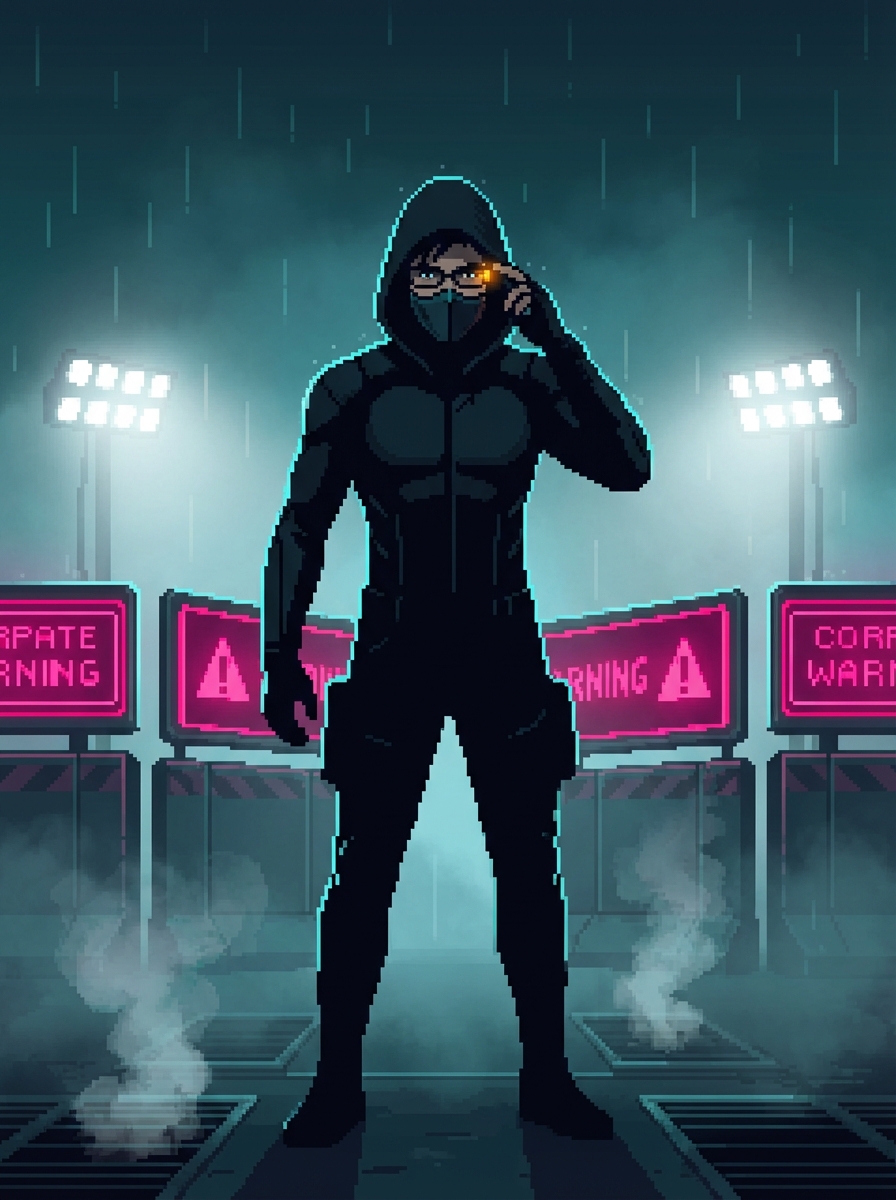
Six feet tall, slender but toned — the build of a man who walks everywhere and eats when he remembers. There's a quiet physical economy to him: no wasted gestures, no fidgeting, everything purposeful.
The Glasses are the defining feature. Slim matte-black ocular capture rigs that look like ordinary frames until you notice the amber lights at the temples. When active, they pulse with a warm glow — faint enough to miss in a crowd, bright enough that anyone who knows what they are will recognize them immediately.
He operates in two visual modes. On the streets: dark fitted jacket with subtle tech-weave, dark cargo pants, low-profile boots. All black, all functional, nothing that draws attention. In operative mode: hood up, half-mask on, just eyes and glasses visible — the amber light becomes the only identifying feature moving through dark alleys and corporate exclusion zones.
The Tell: When something important is happening, Sponge goes completely still. His hand drifts to his right temple — an unconscious gesture, like a photographer reaching for a shutter button that isn't there anymore because the shutter is now his eyelid.
Field Observations
When someone questions whether his broadcasts change anything:
"Last month, Nexus demolished a housing block in Sector 14. Forty families." Hand drifts to temple. Almost smiles. "The footage changed something."
When approached by someone who wants to join:
"I don't have a network. I have a camera. What I record goes everywhere because people share it. If you want to help, tell me your story. That's how this works — I listen, I see, and then everybody else does too."
On the unfinished documentary:
Long silence. "It's not ready." Touches temple. "I'll know when it's done. It'll be done when I am."
Known Associates
The Collective
Sponge's broadcasts are the Collective's most effective recruitment tool, though the relationship is informal. He refuses to be their propagandist — he documents truth, not talking points. The tension between their needs and his principles is ongoing.
The Evidence Paradox
In 2182, a Nexus counter-recording broke his methodology open. Both recordings passed verification. Eleven days dark. When he returned, the witness replaced the victim, human testimony replaced digital proof, and the Community-Reputation Chain became the Dregs' most sophisticated counter-weapon.
GG
GG has used Sponge's distribution network to leak corporate intel. She's wary of anyone who keeps records, but respects that Sponge has never been compromised. He has footage of her he'll never release.
The Mentor
The defining relationship. An older figure who gave Sponge purpose, framework, and access. Their current status is unknown. Sponge protects this secret above all others.
▲ Unverified Intelligence
- The unfinished documentary contains footage from inside a corporate board meeting — evidence of a decision that killed thousands. He's sat on it for over a year because releasing it would expose his source: the mentor.
- His mentor may still be alive, embedded deep inside a megacorporation, feeding Sponge access and angles no street-level documentarian should be able to get.
- His ocular rig records everything, all the time, even when the amber lights appear off. He carries years of continuous footage in encrypted neural storage — a complete record of everything he's witnessed.
- He is terrified of having children. Not because he doesn't want them, but because he's afraid he'd stop being willing to take risks — and the Sprawl needs someone willing to walk into dangerous situations with their eyes open. Literally.