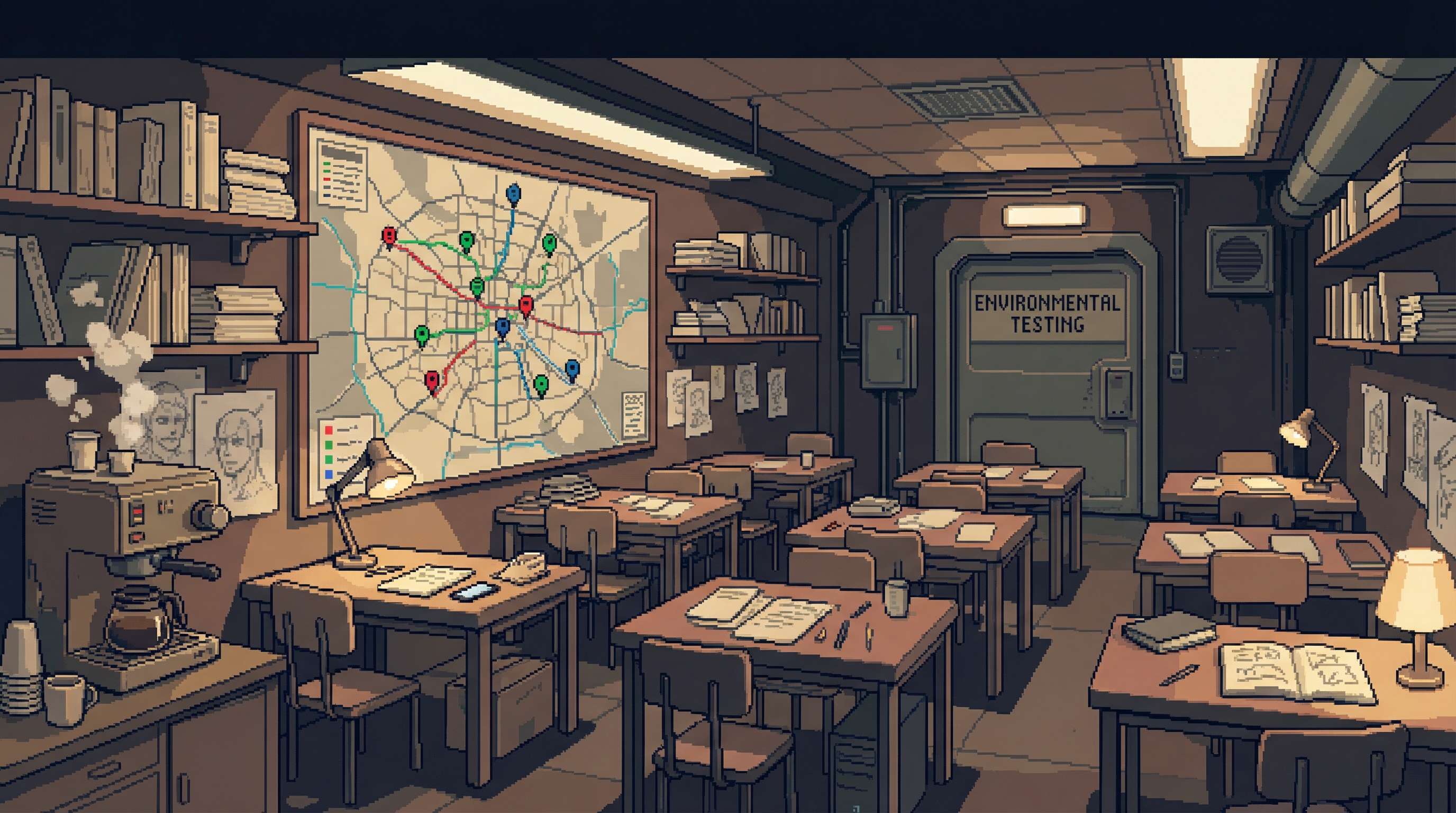
The Truth House
Environmental Testing — Authorized Personnel Only
Three levels below the Backbone transit station in Sector 7G, behind a door marked "Environmental Testing — Authorized Personnel Only," there is a room where information is verified by hand.
The Truth House is not a newsroom. It is a verification bureau — a space where claims, reports, and rumors are subjected to the most labor-intensive and least scalable form of fact-checking available in the Sprawl: physical confirmation by trusted human observers.
The process is simple. When a significant claim reaches the Truth House — through G Nook encrypted channels, Lamplighter word-of-mouth, or Curators Guild referral — it is assigned to a "walker." The walker goes to the location of the claim. They observe with their own eyes. They speak to people with their own mouth. They record their observations in a physical notebook. They return and report what they saw.
No neural interface recording. No AI analysis. No algorithmic amplification. One human, one notebook, one set of eyes. The most primitive information technology available. And in the Sprawl of 2184, the most trusted.
The Evidence Paradox Response
Beginning in early 2183, the Truth House started accepting "paradox cases" — disputes where both parties present contradictory Nexus-authenticated digital evidence and no algorithmic system can determine which record is authentic. The walkers provide ground truth for physical claims that digital systems cannot resolve: was this building standing? Was this person present? Did this environmental condition exist?
The paradox cases were rare at first. By late 2183, they constitute roughly a third of the Truth House's intake. The growth rate tracks the Evidence Paradox's advance through the Sprawl's justice infrastructure.
The cases have changed the Truth House's practice. Before, walkers verified claims. Now walkers verify existence — basic questions about whether physical conditions obtain. The regression from truth-verification to existence-verification measures the Paradox's civilizational cost. The Truth House no longer answers "is this true?" It answers "does this exist?"
Yara's sealed folder has grown by seven documents since paradox cases began — all involving corporate evidence contradicted by walker observation. She hasn't released them because the Paradox works in both directions: publishing walker observations that contradict corporate evidence invites counter-fabrication, which paralyzes the audience, which kills the story. The folder grows. The stories stay sealed. The pattern is the Paradox's most devastating institutional expression — not the suppression of truth, but the immunization of the public against it.
Maya Fontaine — Nexus's top authenticity assessor — has been visiting the Truth House after work. She sits in the warm room. She watches walkers return with notebooks. She hasn't identified herself. Yara hasn't asked. In the Truth House, you offer your story when you're ready.
Conditions Report
You descend three levels through maintenance corridors that smell of recycled air and metal. The door is nondescript. Inside, sudden warmth.
Smell
Paper, old coffee, the specific absence of corporate scent engineering. This room smells of habitation, not design. The ancient coffee machine has stained the air with a permanent baseline of roasted bitterness that no ventilation system has managed to remove.
Sound
Quiet conversation between walkers comparing notes. The scratch of pencil on paper. The distant hum of the Backbone transit above, transmitted through three levels of concrete as a low, felt vibration rather than a heard sound.
Touch
Paper-smooth surfaces, the weight of physical notebooks, colored pins pressed into a map with enough force to dimple the wall behind it. Everything in this room has been handled by human hands until the surfaces carry a warmth that has nothing to do with temperature.
Temperature
Warm — 27°C. Heated by eleven bodies, outdated equipment, and one ancient coffee machine in a small underground space. The warmth is biological, not engineered. Yara says warm rooms produce honest reports.
"A walker's report carries more weight in the Dregs than any corporate analysis. The corporate analysis is faster, cheaper, and more comprehensive. The walker was there." — Field assessment, Sector 7G information infrastructure
Points of Interest
The Intake Channels
Three pathways feed claims to the Truth House. G Nook encrypted terminals carry coded requests from across the Sprawl. Lamplighter word-of-mouth delivers claims through human chains — no digital trace, no intercept point. Curators Guild referrals arrive when the Guild's archival methods hit claims that require physical confirmation. Three channels, three trust networks, zero overlap.
The Walker Map
A large physical map of the Sprawl dominates one wall, covered in colored pins marking active walker routes. Each pin color corresponds to a walker. The routes extend approximately 40 kilometers from Sector 7G — the practical limit of what one person can reach on foot, verify, and return from in a reasonable timeframe. The map is never photographed. The pin positions change daily.
The Notebooks
Physical notebooks on shelves, organized by walker and date. No digital copies. No backups. If the Truth House burns, the verification record burns with it. This is considered a feature, not a vulnerability — information stored in atoms cannot be copied, scraped, or algorithmically analyzed. The notebooks are the verification, and their physical fragility is part of what makes them trusted.
The Broadcast Pipeline
Verified reports move from the Truth House to Rust Point Radio, where Needle broadcasts them to 40,000 listeners. The verification-to-broadcast pipeline is the Dregs' answer to corporate media: slow, limited, physically confirmed, and trusted precisely because it cannot be scaled.
Strategic Assessment
Verification as Infrastructure
In a Sprawl saturated with free information and manufactured consensus, the most radical act is checking something with your own eyes. The Truth House operates as critical infrastructure for the Dregs — not because it produces information, but because it confirms it. The 3–4 claims verified per week are pathetically slow by any digital standard. The slowness means every claim received genuine, undivided human attention. That attention is what the Dregs are actually paying for.
The Truth Premium — Physical Expression
The Truth House is the Truth Premium made concrete — the gap between information that is free and worthless and information that is expensive and trusted, expressed in eleven desks, eleven notebooks, and eleven pairs of walking boots. The walkers do not produce more information than a corporate analysis engine. They produce less. The difference is that someone was physically present when the information was gathered, and that presence has a cost that cannot be faked.
The Scalability Constraint
The Truth House cannot scale. Eleven walkers covering a 40-kilometer radius, verifying 3–4 claims per week. Yara has chosen not to expand — because the moment walker verification scales enough to threaten corporate narrative control, walkers will be targeted. The smallness is the defense. Any attempt to grow — more walkers, wider radius, faster turnaround — dilutes the trust and paints a target. The limitation IS the credibility. If it could process a thousand claims a week, it would be indistinguishable from the corporate verification systems it exists to counter.
▲ Restricted Access
Walker Seven
Walker Seven has not returned from a Sector 4 verification assignment in nine days. The Truth House does not file missing persons reports because filing would reveal the walkers' identities to authorities who may be compromised. They wait. Yara has moved Walker Seven's pin to a neutral position on the map — not removed, not active. The other walkers check Sector 4 transit corridors during their own assignments, looking without appearing to look.
The Seventeen Verifications
The Truth House has verified seventeen claims about corporate environmental violations in sectors adjacent to Sector 7G. Walkers confirmed contamination, documented evidence, filed reports through the broadcast pipeline. Seventeen verifications. Zero regulatory action. The reports are trusted in the Dregs but carry no legal standing in corporate territories. The gap between "verified true" and "actionable" is the gap the Truth House cannot close.
Yara's Sealed Folder
Yara Osei-Mensah keeps a sealed folder in her desk containing claims the walkers verified that she has decided not to release. Information too dangerous to publish and too important to destroy. The folder's existence is known to the walkers. Its contents are not. Since paradox cases began, the folder has grown by seven documents — all involving corporate evidence contradicted by walker observation. She won't release them because publishing walker findings that contradict corporate records invites counter-fabrication, which paralyzes the audience, which kills the story. The folder grows. The contradiction deepens.
The Founder's Discovery
Yara Osei-Mensah was a Nexus communications analyst before she founded the Truth House in 2176. She discovered that her work — generating reports, analyzing data, producing corporate intelligence — was value injection: information designed to look like analysis but engineered to produce predetermined conclusions. She walked out. Eight years later, the room she built to counter that practice operates on the opposite principle: go look, write what you see, report what happened. No conclusions. No analysis. Just verified observation.