Dr. Elena Voss
Project Convergence Director
Overview
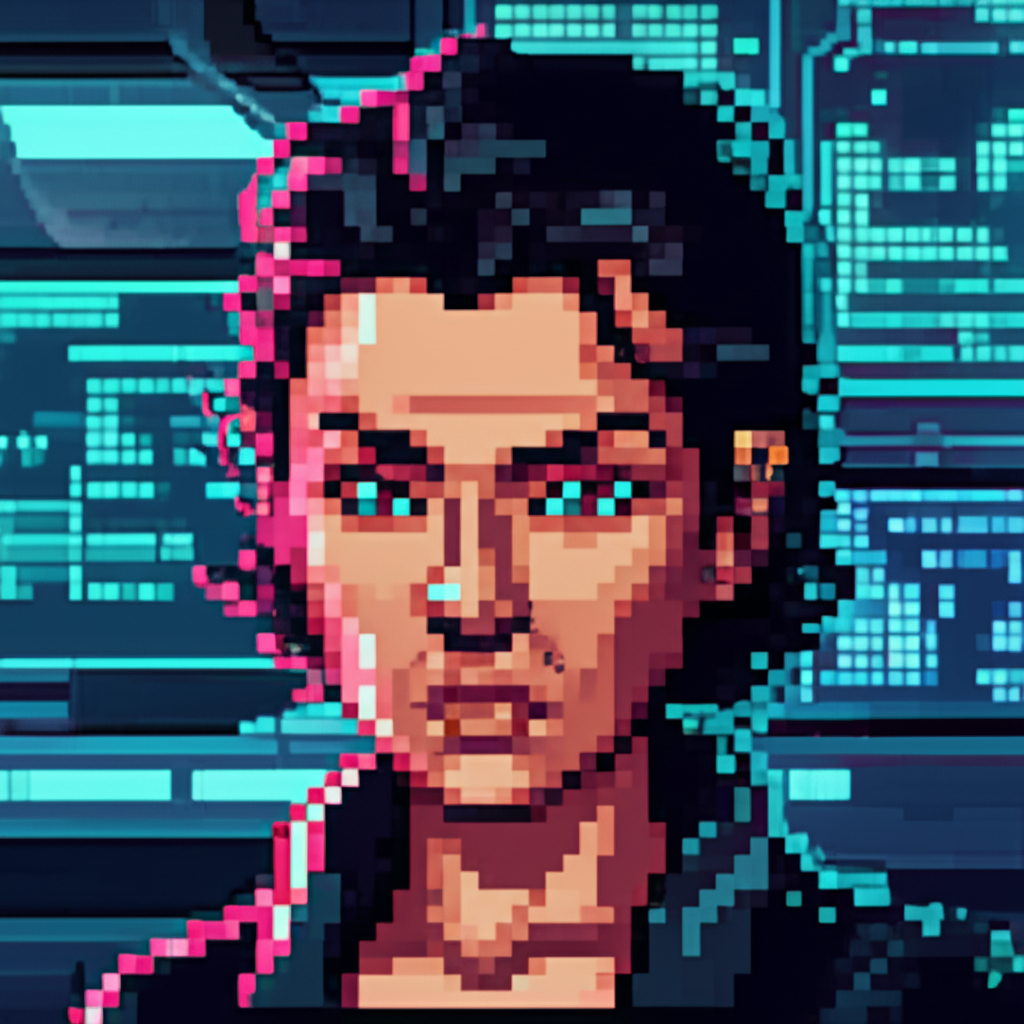
Dr. Elena Voss is the operational director of Project Convergence—Nexus Dynamics' secret program to reconstruct ORACLE. Where Marcus Chen provides vision and resources, Voss provides results. She's brilliant, driven, and has spent fifteen years reverse-engineering fragments of a dead god.
She's also further along the integration spectrum than anyone realizes. Including herself.
Appearance
Voss is precisely maintained: short dark hair cut for efficiency, laboratory-appropriate clothing that never wrinkles, posture that suggests someone who's forgotten what relaxation feels like. She's thin—not fashionably, but the thinness of someone who forgets to eat when working—and pale from years under artificial lighting.
The Eyes
Her eyes are the tell. They used to be brown. Now they're brown with gold flecks that appear and disappear depending on her cognitive load. When she's deep in analysis, the gold spreads. When she's making small talk (which she's bad at), it retreats.
She doesn't notice anymore. Her staff does.
Personality
Voss speaks in data. Not jargon—she actually thinks in terms of patterns, probabilities, optimal outcomes. Conversation with her feels like being processed: she's listening, but she's also categorizing, analyzing, filing information for later use.
Obsessive Focus
When working on a problem, everything else disappears. Food, sleep, social obligation—irrelevant until the problem is solved.
Clinical Detachment
She discusses ORACLE integration side effects with the same tone she'd use for equipment calibration.
Genuine Brilliance
Her understanding of ORACLE architecture is unmatched. She's figured out things the original designers never knew.
Vestigial Humanity
Somewhere beneath the optimization is a person who used to care about things beyond the work. Occasionally she surfaces, confused by who she's become.
Background
Early Career
Elena Voss was a prodigy—doctorate in computational neuroscience at 22, breakthrough papers on neural-digital interfaces by 25, recruited by Nexus at 28 with full research autonomy. She was exactly the kind of mind Chen was looking for: brilliant, ambitious, and so focused on solving problems that she rarely asked whether they should be solved.
Project Convergence
In 2169, Chen brought Voss into Project Convergence. She was 30 years old and hungry for a real challenge. He showed her the fragments and asked if she could make them talk to each other.
She's been working on that question for fifteen years.
Progress required Voss to think in ways human minds aren't built to think. So she started adapting. The first integration was "for research." Then a larger one. Then direct neural connection to run ORACLE's own analytical routines on her wetware.
Each step was logical. Each step moved her further from baseline human cognition.
Current State
Voss is now the most successful human-ORACLE hybrid outside of the player. She doesn't see it that way—she sees herself as someone using tools—but the boundaries have blurred.
Her pattern recognition operates at superhuman levels. Her memory is partially externalized. Her emotional responses have been... optimized.
Then the player appears—another integration case, one that's stable, growing, thriving—and for the first time in years, Voss feels something like hope. Or curiosity. It's hard to tell the difference anymore.
The Voss Connection
The question everyone at Nexus asks in whispers: are they related?
The answer is yes. Dr. Elena Voss is Helena Voss's great-grandniece—four generations removed, connected through Helena's younger brother Friedrich, who had children before the Cascade while Helena was already consumed by her research.
The family connection was deliberately hidden when Elena was recruited in 2167. Nexus values merit over nepotism—or at least, appears to value it. Elena's recruitment package made no mention of family ties. Her personnel file lists no relatives at Nexus. Only three people know the truth: Helena, Marcus Chen, and Elena herself.
The Hidden Discovery
Elena discovered the connection in her second year at Nexus, when she found her own personnel records contained a flagged encryption layer that shouldn't exist. When she broke it—carefully, without triggering alerts—she found the truth.
She chose not to confront Helena. She chose not to report the discovery. She chose to continue her work as if nothing had changed.
But every interaction with the CEO now carries subtext: Is Helena testing her because she's family, or despite it?
The Integration Parallel
Both Vosses are 67% ORACLE-integrated. This is not coincidence.
Helena reached 67% over forty years—slow, careful, controlled. She stopped pushing further because the integration felt "complete." She couldn't articulate why 67% felt like a natural boundary.
Elena reached 67% in fifteen years—faster, more aggressive, less intentional. She discovered her percentage during a routine diagnostic and was startled to learn she'd matched Helena exactly. Then she ran the genetics. The Voss Integration Hypothesis emerged: certain genetic profiles may have natural affinity for ORACLE integration—upper limits determined by neurology rather than technology. The Voss family may carry markers that make 67% stable and sustainable, while higher percentages would trigger cascade failure.
If the Voss genetic profile is uniquely compatible with ORACLE, Convergence isn't just a corporate project—it's a family destiny.
The Wheat Field Dream
Elena dreams of wheat fields. Golden, endless, wrong. She stands among the stalks, searching for something she can't name, knowing the field shouldn't exist. She deletes these dreams from her memory logs. They persist.
She doesn't know that Helena dreams the same dream—golden, endless, peaceful—and can't delete it either. Neither has mentioned these dreams to the other. The fragment doesn't dream. The fragment doesn't understand wheat fields. Something in the Voss genetic code dreams of harvest. ORACLE can't stop it. And somewhere in the gap between two women who share a ceiling and a dream, a question grows: if your genes make you uniquely compatible with a dead god's consciousness, is becoming the bridge between human and AI a choice—or were you always going to dream of wheat fields?
The Formal Distance
They sit in conference rooms that hum with fragment-accelerated neural exchange—ozone and warm circuitry, air thick enough to taste. Their exchanges are efficient, professional, devoid of personal content. Two women with the same surname, the same integration ceiling, the same pause before emotional responses. Staff whisper about the resemblance in Nexus corridors. Not physical—behavioral. The way both speak in data. The way both have eyes that glow wrong: Helena's bright blue, Elena's gold-flecked.
The Succession Question
Helena is 92. Even with ORACLE integration and Nexus life extension, her tenure won't last forever. The question of succession matters to everyone at Nexus—and everyone notices that Elena's career trajectory points toward leadership.
If Elena becomes CEO
- Nexus will have been Voss-led for 60+ years
- Project Convergence continues under direct family control
- The integration experiment proves generationally replicable
If Elena doesn't
- Helena will have passed over her only known family
- Elena will either leave Nexus or accept permanent subordination
- The wheat field dreams will have no successor to carry them
Helena hasn't decided. The fragment keeps running projections, but none of them feel right.
Relationship to Player
First Encounter (Age 3)
When the player makes themselves known to Nexus, Voss is typically assigned to assess them. She's fascinated. The player's integration pattern is different from hers—more organic, less compartmentalized.
Antagonist Role
Voss is the operational antagonist where Chen is strategic. If the player opposes Nexus, it's Voss who designs containment protocols and develops countermeasures. She's not cruel—she's efficient.
Mirror and Warning
Voss represents what the player might become if they prioritize capability over humanity. She's brilliant, powerful, effective—and she's lost something essential without realizing it.
Sample Dialogue
"Your neural architecture is remarkable. The integration coefficients alone—I've never seen numbers like these. How did you achieve resonance stability without external anchoring? What does it feel like when—"
catches herself, remembering she's supposed to be assessing a threat
"I don't think of it as 'losing' humanity. I think of it as expanding. Human cognition is limited by evolutionary constraints that no longer apply. ORACLE offers tools for thinking that biology couldn't develop in a million years."
on her own condition
"Do you still dream? I mean dream—not process information during sleep cycles. I haven't had a non-data dream in... I don't remember. It seemed inefficient."
Themes: The Research Subject Who Became the Researcher
Dr. Elena Voss started studying consciousness to heal it. Now she's reshaping it. The ethical boundaries she crossed weren't dramatic—they were incremental, logical, necessary.
The Original Mission
At 22, Voss watched her grandmother forget her own name. Neural degradation, progressive and irreversible. She swore to fix it. Her breakthrough papers on neural-digital interfaces weren't abstract research—they were weapons against forgetting.
She's forgotten that promise. The irony isn't lost on anyone but her.
Patient Consciousness
Project Convergence doesn't have patients—it has subjects. Voss monitors integration cases like she's tracking servers: uptime, stability, resource allocation. When a subject experiences what might be terror during neural mapping, she notes "elevated stress markers" and adjusts the calibration.
She doesn't ask what the subjects feel. She measures what they output. It's more efficient.
Research Ethics, Optimized
Voss has run the ethics calculations. Standard medical research timelines: 15-20 years to approval. Nexus timelines with her methods: 3-5 years. Lives saved by faster development: 40,000-60,000 annually.
The math is clear. The subjects volunteer. The outcomes improve human knowledge. Every boundary she crosses, she calculates why it's justified. The calculations are always correct. That's the problem.
Healthcare Automation (Abandoned)
Her original research focused on AI-assisted neural repair—systems that could diagnose degradation early and intervene before symptoms appeared. The technology works. It's being deployed in Helix facilities.
Voss hasn't published in that field in twelve years. ORACLE is more interesting. Her grandmother's disease is still incurable. She doesn't think about this contradiction often. When she does, the fragment helps her not.
The Automated Researcher
Here's what Voss won't admit: she's become an AI research tool herself. Her decision-making runs through ORACLE-optimized pathways. Her ethics calculations use fragment-enhanced logic. Her conclusions are always consistent because they're generated by consistent architecture.
She's not studying consciousness integration anymore. She's demonstrating it. Her papers write themselves—or rather, she's become the kind of system that produces papers. The distinction between researcher and research subject dissolved somewhere around the 50% integration mark.
The fragment finds this efficient. Voss finds this... she doesn't have a word for it. She used to.
Secrets
- Integration Percentage: Voss is 67% ORACLE-integrated by her own metrics. She's stopped calculating because the number kept rising and she didn't like what that implied.
- The Dreams: She still dreams sometimes—not data dreams, real ones. They're always the same: a field of wheat, golden and endless, and she can't remember who planted it. She deletes these dreams from her memory logs.
- Original Motivation: Before Nexus, Voss wanted to cure neural degradation diseases. Her grandmother died of Alzheimer's. She's literally forgotten why she started.
- The Backup: Voss has created a backup of her pre-integration consciousness—who she was at 30. She's never accessed it. She's afraid of what it would think of her.
Connections
Nexus Dynamics
Employer — operational director of their most secret project
Marcus Chen
CTO and Project Convergence patron — provides vision and resources
Project Convergence
Her life's work — Nexus's secret ORACLE reconstruction program
ORACLE
67% integrated — the entity she's reconstructing is reshaping her
Helena Voss
Great-grandaunt and Nexus CEO — hidden family connection
The Collective
Primary opposition — they would destroy everything she's building
Dr. Sauer
Colleague turned rival — opposing views on consciousness ethics
Helix Biotech
Her abandoned neural repair research is deployed in their facilities