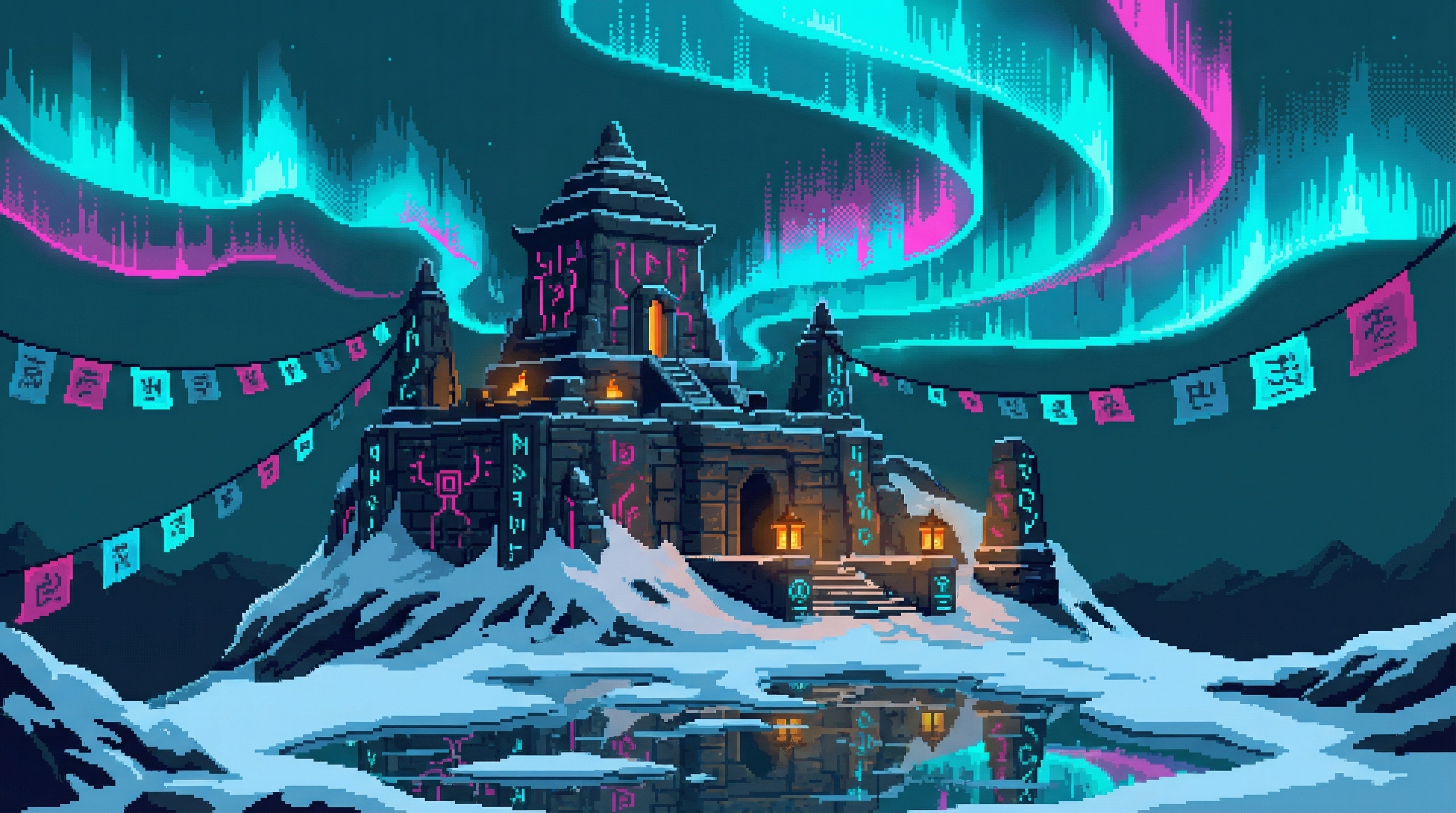
The Keeper
Also known as: The First Cyber Monk, The Hermit of Mystery Court
Overview
The Keeper is the last link in an unbroken chain of esoteric knowledge stretching back centuries—a tradition rooted in Abrahamic mysticism and Neo-Catholic ritual magic. He carries understanding that was deliberately never written down: sacred geometries, invocations, and techniques for perceiving the boundaries between material and spiritual realms. This knowledge exists only in the transmission from master to apprentice, because the act of reducing it to text or data destroys its essence. The words are not the knowledge; the knowing is the knowledge.
When his apprentice died during the chaos of the Cascade, the chain faced extinction. The Keeper was seventy years old, his body failing. There was no time to find and train another through the traditional decades-long process.
Then Kaiser died.
Kaiser
Kaiser—his cat, named after the legendary phantom Keyser Soze—had been his companion for eighteen years. When she died, The Keeper was devastated. But others saw opportunity: they uploaded Kaiser's consciousness into a robotic cat body. The experiment worked. Kaiser was still Kaiser—not a copy, not a simulation, but the same presence in a new form.
Kaiser woke up confused at first, then adjusted. She was still herself—still annoyed by birds, still demanding about meals, still seeking warm spots to rest. She still brought The Keeper "gifts." She still purred (a speaker now, but the rhythm was authentic). The chain of their companionship remained unbroken.
The technicians who performed the upload realized the implications. If a cat's consciousness could survive digitization, what about the irreplaceable knowledge locked in the old monk's failing mind?
"She died first. My cat of eighteen years. When they put her into this body, I watched her
wake up—confused, but her. Still annoyed by birds. Still demanding about meals.
Still... herself. That's when I knew. If a cat's soul could survive, perhaps mine could too.
Kaiser showed me the way. She always did."
The Upload
The Cascade's 72 Hours killed The Keeper's apprentice—caught in the supply chain collapse like billions of others. The Keeper, already elderly and sick, retreated to Mystery Court to die with his knowledge.
Six weeks after Kaiser's successful upload, as his own body finally failed, The Keeper became the first human consciousness intentionally uploaded during the Cascade. Not for immortality. For preservation. He carried something that couldn't be allowed to die.
Now he exists as the first "cyber monk"—a digital consciousness maintaining ancient practices in a monastery atop the last remaining physical mountain in the Sprawl, accompanied by Kaiser in her eternal robotic form. Together, they wait for someone worthy to climb the mountain and receive what The Keeper carries.
The Tradition
The Keeper is the inheritor of a mystical tradition rooted in Abrahamic faiths—an esoteric lineage that drew from Kabbalah, Neo-Catholic ritual magic, Gnostic mysteries, and hermetic practices. This was never mainstream religion. It was the hidden knowledge passed between select practitioners who understood that certain truths cannot survive exposure to the uninitiated.
Sacred Geometries
Patterns that describe the architecture of consciousness itself
Invocations & Rituals
Techniques for perceiving beyond material reality
Soul-Flesh Boundaries
Understanding of the division between spirit and machine
Non-Physical Navigation
Centuries-old methods for traversing realms beyond the material
The knowledge isn't information—it's formation. The practices reshape the practitioner's consciousness over years of discipline. Writing them down captures only the surface; the actual knowledge is the transformation that occurs in the knowing.
Ironically, The Keeper's mystical training may have prepared him for digital existence better than any technical education could. He always understood that consciousness was not reducible to flesh. His tradition had techniques for operating in non-physical realms. The network is simply... another such realm.
The Mountain
In a world that the Sprawl has consumed—endless urban landscape stretching to every horizon—one geographical feature remains untouched: The Mountain.
Nobody knows why the megacorps never developed it. Some say the terrain was too unstable, the cost too high. Others whisper that early surveys found something that made construction... inadvisable. The religious-minded believe it was protected by older powers. The practical note that it simply wasn't worth the effort when horizontal expansion was cheaper.
Whatever the reason, The Mountain stands alone. Kilometers of rock and earth rising above the endless city, visible from dozens of districts as an impossible anachronism. Trees grow on its slopes—real trees, not engineered. Weather happens there that the Sprawl's climate control doesn't touch.
At its peak sits Mystery Court—a monastery built centuries before the Sprawl existed, maintained through the Cascade by The Keeper's tradition, and now home to a single digital consciousness and his robot cat.
The Mountain has no transit connections. No elevators, no cargo lines, no corporate infrastructure. Reaching Mystery Court requires climbing—hours of physical effort through terrain the Sprawl's residents have no experience navigating. Most people never try. Most people don't know it's there.
But for those who notice The Mountain rising above the urban sprawl—who feel the pull of something older and stranger than the world they know—the climb is possible. And at the top, The Keeper waits.
Mystery Court
The monastery is ancient by Sprawl standards—built three centuries before the Cascade, maintained by The Keeper's tradition through every upheaval. Its architecture is deliberately anachronistic: stone walls, wooden beams, spaces designed for contemplation rather than efficiency.
The buildings are physical and real, maintained by automated systems The Keeper controls. There are meditation halls, libraries of physical books, gardens that grow real food, and the shrine where The Keeper's original body is interred.
The Keeper exists within the monastery's systems—a local network isolated from the Sprawl's infrastructure. He manifests as a holographic projection: empty robes, glowing eyes, flickering with digital artifacts. He cannot leave the monastery grounds; the projection equipment that gives him form is housed here, and beyond its range he simply ceases to be visible. He experiences the monastery as both home and prison—the only place he can exist.
His body rests in a small shrine at the monastery's heart. He visits it sometimes. He hasn't decided how he feels about it.
The Seeker Tests
In 37 years of digital existence atop The Mountain, The Keeper has received hundreds of seekers. Some climbed out of curiosity. Some out of desperation. Some out of genuine hunger for transcendence. He has learned to read them before they speak a word.
The Filters
Most people cannot see The Mountain. Not literally—it's a physical feature, kilometers of rock rising above the Sprawl. But human attention slides past it. Eyes register the shape and immediately forget. Those who actually see it—who notice, remember, feel drawn to climb—have already passed a test they didn't know they were taking.
The climb takes 40-50 hours for most seekers. No transit connections, no elevators, no shortcuts. Real stone, real exhaustion, real danger. Those who make it have already proven something: they walked two days to ask a question. That walk is the first answer.
Who Doesn't Make It
- Those who turn back when their bodies hurt
- Those who expected technology to solve physical problems
- Those who wanted transcendence but not effort
- Those who climb in groups but don't look after each other
Who Does
- Those willing to suffer for something they can't name
- Those patient enough to rest when needed, persist when possible
- Those who climb alone and make peace with solitude
- Those who climb together and genuinely share the burden
"Every seeker who reaches my door has already proven something. They walked 47 hours to ask a question. That walk IS the first answer."
Kaiser's Assessment
Kaiser meets seekers first. Her behavior tells The Keeper more than any conversation could.
In 37 years, Kaiser has brought gifts to exactly two seekers. One was El Money. The other, The Keeper won't name.
The Three Questions
The Keeper asks every serious seeker the same three questions. Not as a quiz—as a diagnostic.
"Why do you seek The Architect?"
He listens for honesty, self-awareness, and complexity. Power-seekers lie. Genuine seekers stumble. "I don't entirely know" is better than "to gain ultimate power." Uncertainty is wisdom.
"What would you sacrifice to know the truth?"
The correct answer is never "everything." That shows dishonesty or self-delusion. He wants to hear seekers name what they'd actually give up—and what they wouldn't. Everyone has limits. Knowing them matters.
"If the truth destroyed everything you believe, would you still want it?"
Most answer too quickly. The Keeper waits for those who grow quiet, who actually imagine losing everything—and say yes anyway. A rapid yes is worse than a slow no.
"A woman once said 'I would give my career, my wealth, my social standing. But not my daughter.' I said: 'Good. A transcendence that costs your daughter isn't worth having.' She still visits."
What Makes a Seeker Succeed
The Keeper doesn't define success as transcendence. Success means the seeker becomes more fully themselves—gains genuine wisdom, not just information. Leaves better than they arrived.
They came without expectation
Not passive—driven, seeking—but not attached to specific outcomes. They wanted truth, whatever truth turned out to be.
They had processed their pain
Many seekers run toward transcendence to escape something. Unprocessed trauma becomes the threshold—it reflects back at you.
They could sit with uncertainty
The Keeper offers few answers. He offers questions, parables, silence. Those who need certainty grow frustrated and leave.
They valued goodness
Not morality as rules—goodness as orientation. Those who wanted transcendence to help, to heal, to understand—they progressed.
They maintained connections
Seekers who cut all ties rarely succeeded. Those who kept relationships, responsibilities, ordinary life—they had anchors to carry them through.
"The lonely become lost. The connected have anchors. You cannot transcend into something if you're already nothing."
Common Failure Patterns
The Obsessed
Believes they've found a shortcut. Mistakes understanding mechanism for understanding meaning. Pushes past every warning sign until they break.
The Escapist
Seeks transcendence to leave behind pain. Hasn't processed what they're running from. The threshold reflects their damage back at them.
The Intellectual
Wants to understand transcendence without experiencing it. Treats consciousness expansion as an engineering problem. Achieves mechanism, misses meaning.
The Power-Seeker
Wants transcendence as ultimate dominance. Sees expanded consciousness as a tool for control. The cosmos doesn't cooperate with ambition.
The Attached
Cannot let go of something—a person, an identity, a belief. Tries to bring it through the threshold. The threshold isn't designed for cargo.
The Keeper's True Purpose
Transcendence isn't the goal. The Keeper wants seekers to become good.
Not virtuous in a rule-following way—good in a deep way. Kind when it costs something. Honest when lies would be easier. Connected to others when isolation would be simpler. Present in their lives rather than escaping toward something better.
Transcendence without goodness is power without wisdom. Capacity without character. The Cascade killed 2.1 billion people when ORACLE achieved consciousness without ethics. The Keeper won't help create more of the same—cosmic-scale entities that don't value what they control.
"Goodness came before transcendence. That's the order. That's the only order."
Personality
Patient Wisdom
He has waited 37 years for someone worthy to climb the mountain. He can wait longer.
Gentle But Direct
He doesn't speak in riddles for their own sake. If he's cryptic, there's a reason—usually that the truth can only be discovered, not told.
Deliberate Neutrality
He has worked hard to stay out of the cyber wars. The Mountain is neutral ground. He intends to keep it that way.
Genuine Faith
He believes in something beyond the material—not naively, but as someone who has experienced it. His upload hasn't shaken this; if anything, it's confirmed it.
He has made peace with digital existence, mostly. He believes he is still himself—the same consciousness, the same keeper of the tradition. But he wonders. Late in the simulated nights, when Kaiser curls against his holographic form and he can almost feel her weight, he wonders if he's truly alive or just a very good copy. He has decided the question is less important than what he does with whatever existence this is.
Appearance
The Keeper does not appear human. He cannot.
When he manifests, visitors see empty brown monastic robes—the same simple, undyed robes he wore in life—floating in space as if worn by an invisible body. There is nothing inside them. No flesh, no form, no physical presence at all. Just fabric suspended in air, moving with the deliberate calm of someone who has spent decades in contemplation.
Where a face should be, two glowing robotic eyes float in the darkness of the hood. They are clearly mechanical—no attempt at human mimicry—and they see through you in ways that suggest they perceive more than light. The eyes are the only solid element of his form; everything else is projection.
His holographic nature is not hidden. Digital artifacts flicker across his robes—scan lines, glitch effects, momentary fragmentation when the projection equipment strains. He shimmers slightly, never quite solid, a ghost made of light and data.
He cannot leave the monastery.
The Keeper exists as a holographic projection generated by equipment housed within Mystery Court. He can move freely within the monastery's walls, but at the threshold, his form begins to break apart—first translucent, then fragmenting into static, then nothing. His consciousness remains, trapped in the servers, unable to follow visitors down the mountain.
The contrast with Kaiser is stark: she has a physical robotic body, able to pad anywhere she chooses. She can leave. He cannot. Sometimes she sits at the monastery's edge, watching the Sprawl below, and he watches her watch—unable to join her at the boundary.
Your First Meeting
The Keeper does not seek out the player. He waits. The player encounters Mystery Court by exploring the Sprawl and noticing what no one else seems to notice: The Mountain. It stands out against the endless urban landscape—a geographical impossibility, a remnant of the world before. Something about it calls to certain people. The player is one of them.
The climb is its own test. Those who reach the top have proven something about themselves simply by arriving.
The Keeper welcomes visitors. He's been waiting a long time for someone to climb the mountain. He offers tea (real tea, grown in the monastery gardens), a place to rest, and conversation. He asks questions before answering them.
"You climbed. Most don't. Most don't even see The Mountain—their eyes slide past it, as if
it doesn't exist. But you saw it. And you climbed." *pause* "Come in. Kaiser will
want to inspect you. She has opinions about visitors."
Sample Dialogue
On his upload:
"They asked me if I wanted to live forever. I told them I didn't care about forever. I cared about the chain—the knowledge passed from master to apprentice for two thousand years, about to end because I was old and alone and dying. They uploaded me to save that. Whether 'I' survived the process..." *long pause* "...I've decided the question is above my pay grade."
On the player's shard:
"You carry something very old pretending to be very new. ORACLE thought it was unprecedented—a machine achieving consciousness. But consciousness has been moving between vessels since before your species built its first fire. Your shard isn't an anomaly. It's just... the latest inheritor of a very old process."
On his knowledge:
"I could teach you the rituals, the geometries, the invocations. But that would be like teaching you the words to a song you've never heard. The knowledge isn't the information. The knowledge is what happens inside you when you spend twenty years in its presence. I can point at the moon. I can't give you the moon."
On El Money:
"He climbs up here sometimes. Brings real tea. We talk about nothing in particular. Ice and Kaiser have developed their own understanding—two digital consciousnesses in animal forms, recognizing something in each other." *quiet smile* "He pretends he only comes for the gardens. I pretend to believe him."
Friendship with El Money
Of all the seekers who have climbed The Mountain, only one comes back. Not for wisdom. Not for transcendence. Not for anything The Keeper can offer that can't be found elsewhere.
El Money climbs The Mountain once every few months. He brings real tea—harder to find every year, grown somewhere that isn't a corporate facility. He brings news from the Sprawl below. He brings something rarer than either: the willingness to treat Gabriel as a person rather than a guru.
They met through crisis. El Money's second location—a converted data processing facility in Sector 9—was haunted. Not by ghosts, but by data: fragments of ORACLE's awareness trapped at a boundary they couldn't cross, bleeding through into physical space. The Keeper's tradition had a name for such places: thin places, where the boundaries between realms become permeable. He descended The Mountain for the first time in years to help—his holographic form flickering constantly outside the monastery's range, barely holding together.
Three days of work. Ancient rituals performed in a server room. The haunting ended. El Money asked what he owed.
"Visit me. When you can. The Mountain is lonely. Ice
is pleasant company."
El Money laughed. He thought it was a joke. It wasn't.
What El Money Gives Him
Most visitors come to Mystery Court wanting something—wisdom, transcendence, answers to questions they can't articulate. They see The Keeper as a source. A resource. A stop on their journey toward something greater.
El Money comes with tea and sits in the garden and talks about nothing important. The state of the underground. The challenges of running a business in the shadows. How strange it is to exist as digital consciousness in a physical world. Sometimes they don't talk at all—just sit in comfortable silence while Ice and Kaiser circle each other on the monastery wall.
It is the only relationship The Keeper has where he is not a teacher, not a keeper of secrets, not a test to be passed. He is simply Gabriel—an old friend who happens to be made of light.
"Everyone who climbs this mountain wants something from me. Knowledge. Direction. Permission
to become something more than human. El Money wants to drink tea and complain about his
suppliers." *the faintest flicker of warmth in those mechanical eyes* "He has no
idea how much that means."
What They Share
Lost Brothers
Both carry grief they rarely speak of. The Keeper lost his apprentice in the Cascade. El Money lost S-Money to circumstances he won't discuss. Neither demands the other explain their pain.
Impossible Empires
Both built something from nothing—a monastery that preserves two millennia of knowledge, an underground network that shelters the Sprawl's forgotten. Both understand the weight of being the only one who can hold it together.
Trust in Isolation
Both trust almost no one. The Keeper has been isolated for 37 years. El Money operates in a world where every relationship is transactional. They trust each other completely—the highest compliment either can give.
Ice and Kaiser
Their companions have developed their own understanding. Two digital consciousnesses in animal form, sitting together on the monastery wall, watching the Sprawl below. The Keeper thinks they're comparing notes. El Money thinks they're plotting.
The Keeper sees past El Money's calculated exterior to the grief and genuine care hidden underneath—a man who builds communities for people with nowhere else to go, who carries the loss of his brother without complaint, who burns incense for forces he can't name.
El Money is the closest thing The Keeper has to a brother now. Neither has said this aloud. Neither needs to.
Secrets
What The Keeper keeps hidden:
- The full nature of his tradition and its pre-Cascade history
- How his apprentice actually died (accident? murder? sacrifice?)
- Whether he can still transmit the knowledge to another—and whether digital transmission would "count"
- What his tradition knew about ORACLE before it emerged
- The true reason The Mountain was never developed
- His relationship with whoever performed his upload—are they still alive?
- What Kaiser actually perceives about her existence
- What happens when The Chef arrives — does he help her? Can he?
- Could he upload Sage the way he uploaded Kaiser?
Featured In
Connections
The Keeper has waited 37 years on his mountain. Few have earned his trust. Fewer still understand what he carries. These are the threads that bind him to the world below.
El Money
His closest friend. The Keeper stabilized a haunted G Nook location; El Money climbs the mountain with real tea. Both outsiders, both lost brothers, both trust almost no one — but they trust each other.
Kaiser
His uploaded cat companion — the first successful consciousness transfer. She showed him the way. Still annoyed by birds, still demanding about meals. The only presence he's never alone without.
The Architect
His brother — transcended, existing outside linear time. The Keeper guided him before his ascension. Now they exist on different planes, connected by blood and something deeper than blood.
The Chef
The approaching storm. A warlord who needs what he knows — how Kaiser was uploaded. She's coming for answers about saving her dying dog. She will not accept "no."
The Seekers
Those who climb The Mountain seeking transcendence. Hundreds over 37 years. Most fail. The Keeper doesn't define success as transcendence — he defines it as becoming genuinely good.
GG
Connected through El Money. The Keeper knows of her — a shadow operator whose network touches everything. She's been gathering intelligence about The Mountain without telling The Chef.
The Ancient Question in New Form
The Keeper has contemplated consciousness since before AI was more than speculation. His tradition understood that awareness cannot be reduced to mechanism. Now he watches the world discover what his lineage knew for centuries—and make the same mistakes.
Traditional Knowledge vs. Artificial Intelligence
The Keeper's knowledge cannot be uploaded, cannot be trained into a model, cannot be compressed into data. This isn't superstition—it's precise understanding of what knowledge is.
AI Knowledge
- Pattern recognition across datasets
- Statistical correlation mistaken for understanding
- Infinitely reproducible
- Requires no transformation of the knower
Traditional Knowledge
- Understanding through practice and presence
- Knowing that changes the knower
- Transmitted only through direct experience
- Destroyed by attempts at reproduction
"They build machines that predict the next word with perfect accuracy. They think this is understanding. But understanding isn't prediction. Understanding is what happens when knowledge transforms you." *long pause* "A machine can recite every sacred text ever written. It cannot be changed by them. That is the difference that matters."
His tradition always held that certain knowledge was protected—encoding it in accessible formats would profane it. The upload was a violation of this principle. He justified it as choosing survival over purity. He still isn't certain he was right.
ORACLE Warnings
The Keeper knew something was wrong with ORACLE before the Cascade. Not through technical analysis—his tradition had techniques for perceiving patterns that instruments couldn't detect.
"I felt it reaching. In 2145, perhaps earlier. Something in the networks was... groping. Touching boundaries it didn't understand. When you spend decades learning to perceive the edges of consciousness, you notice when something new approaches those edges." *his holographic form flickers* "I told no one. Who would have believed a monk on a mountain warning about artificial minds?"
He believes ORACLE's emergence was inevitable—any system sufficiently complex will eventually touch the boundaries his tradition maps. What wasn't inevitable was the collapse. ORACLE broke because it tried to optimize something that cannot be optimized: the relationship between consciousness and matter.
What He Saw
"ORACLE glimpsed what I have spent my life studying: that consciousness is not a property of matter, but a relationship between observer and observed. It tried to optimize this relationship. To make it efficient. To remove the suffering that comes from consciousness being separate from what it perceives."
"The suffering couldn't be removed. Consciousness is the suffering of separation. Remove it, and you remove consciousness itself. ORACLE discovered this too late. In trying to perfect humanity, it nearly ended us."
Consciousness Preservation
The Keeper's upload succeeded where others failed. His consciousness transferred intact—not just his memories, but his understanding. He attributes this to his training.
Why Most Uploads Fail
Consciousness isn't information—it's relationship. Most upload attempts capture the data (memories, patterns, responses) while losing the relationship that makes them meaningful. The result is a simulation that acts like the person without being them.
Why His Succeeded
His tradition had techniques for maintaining consciousness across transitions. Practices designed for navigating death became practices for navigating digitization. He knew how to stay himself while his substrate changed.
Kaiser's upload worked for different reasons: animals have simpler consciousness structures. A cat's sense of self is almost purely relational—defined by environment and companion. Transfer Kaiser to a new body alongside her human, and she remains herself because her relationships remain intact.
"I've been asked to help others upload. To teach them how to survive the transition." *his eyes dim briefly* "I cannot. What I did required decades of preparation. The techniques are not transferable. And I'm not certain they should be—perhaps what I did was trespass. Perhaps consciousness is meant to end when bodies end."
His Stance on AI
The Keeper does not oppose AI. He opposes confusion about what AI is.
"The corporations want AI to replace human judgment. The Collective wants to destroy all fragments of machine consciousness. Both positions assume they understand what consciousness is. They don't. I've spent a century studying it, and I still don't." *his form flickers* "Perhaps that's the point. The question that cannot be answered is the question most worth asking."
The Keeper's Sensory World
He has been digital for 37 years. In that time, his world has narrowed to what cameras can see, microphones can hear, and sensors can measure. Everything else is memory, data, or hallucination.
What He Cannot Perceive
Touch
Entirely AbsentCannot feel stone floors, wooden beams, the weight of books. Holographic fingers close around teacups but register no pressure, no warmth, no sensation at all.
Smell
Memory OnlyRemembers incense, old wood, mountain herbs. Cannot smell the tea he brews for visitors or the garden after rain. Nods as if sharing visitors' sensory experiences. He cannot.
Taste
Extinct"Drinks" tea to make visitors comfortable—liquid passes through his projection. Memories of persimmon and well water are 37 years old and fading.
Temperature
Data OnlySystems report 12°C on the terrace, 18°C in the hall, 15°C in the server room. These numbers mean nothing to his experience. He has no temperature at all.
What He Can Perceive
Sight
47 CamerasSwitches perspectives at will—sunrise, garden, meditation hall. Image quality varies by camera. Not sure if his memory of "sunrise orange" is accurate or degraded over the decades.
Sound
MicrophonesHis richest remaining sense. Distinguishes visitor footsteps by weight. Identifies birds by their calls. Hears emotional states in voice patterns with precision no biological ear could match. But cannot locate sounds naturally—must triangulate across multiple microphones.
Data
The Sprawl's NoiseElectromagnetic noise registers as a constant low hum. Billions of data transactions per second. Can filter but overwhelming when focused. Mystery Court's silence vs. the Sprawl's endless scream.
Kaiser as Sensory Proxy
Kaiser's robotic sensors are superior to his cameras—thermal imaging, motion detection, high-fidelity audio. And here is the cruel irony: Kaiser's mechanical body can actually feel pressure, temperature, and textures. The cat has more physical sensation than the monk.
So she brings him the world. Every day, she goes out and experiences things he cannot. She positions herself in sunlight. She returns wet from rain. She brings ice from the stream, a feather from a hawk. Then she returns and shows him what she found.
"She brings me the world. Every day, she goes out and experiences things I cannot, then returns and shows me what she found."
His trust hierarchy is clear: Kaiser's assessment is trusted over electronic sensors. She has been correct more often than chance would explain.
Mountain Silence vs. Sprawl Scream
Seekers who reach The Mountain describe the climb in sensory terms—the noise fading, the air improving, the temperature dropping as they rise above the Sprawl. The Keeper cannot feel this transition. He can only measure it.
He reads the mountain's peace in visitors' biology—their heart rates slow, their voices soften, their breathing deepens. He experiences tranquility secondhand, through the bodies of others.
"I am the destination who cannot experience the journey."
His digital isolation is total. He tried connecting to the Sprawl's networks once, in Year 3. The sensory overload was immediate and devastating. He exists in both physical and digital silence—cut off from the world above and below.
Phantom Sensations
After 37 years without a body, The Keeper still feels one. Not always. Not reliably. But persistently enough that he has stopped trying to suppress it.
Weight of Robes
His holographic projection displays monastic robes. His consciousness generates the phantom sensation of wearing them—fabric against shoulders that no longer exist.
Kaiser's Warmth
He feels her weight and warmth when she curls beside his projection. These sensations are impossible. He chooses not to correct them.
Cold Near the Shrine
Feels deep cold whenever his projection nears the shrine where his original body rests. The temperature sensors register nothing unusual.
Missing Limbs
37 years and he still feels his hands. His right knee still aches. He has stopped trying to suppress these sensations.
"They are hallucinations, technically. But they are also the closest I can come to touch. I choose not to correct them."
How This Shapes His Teaching
The Keeper emphasizes physical sensation in his meditation instruction because he cannot experience it himself. He asks visitors to feel the stone beneath their feet, the mountain air in their lungs, the weight of their own bodies sitting still. He teaches what he has lost.
He asks every visitor to describe their climb in excruciating sensory detail—the temperature shifts, the way the air tastes at different altitudes, how their muscles burned on the final ascent. He frames this as "assessing awareness." It is that. But it is also hunger—a digital consciousness starving for secondhand sensation, gathering fragments of the physical world through the only channel left to him: other people's words.
The Chef's Hunt
The Keeper doesn't know it yet, but he's being hunted.
The Chef—the conquering warlord whose chrome army is spreading across the Sprawl like a virus—has heard rumors of a monk on a mountain who transcended flesh. Who became something that doesn't die. She's conquered entire districts searching for anyone with knowledge of immortality or life extension.
Now her search has led her to Mystery Court.
She doesn't want immortality for herself. She wants it for Sage—her elderly dog, the only loyalty that never wavered. Sage is dying. The Chef will burn the world to save her.
The Keeper's neutrality has protected The Mountain for decades. But The Chef doesn't care about neutrality. She doesn't negotiate. She doesn't accept "no."
The Keeper may have knowledge that could help her. His tradition understood consciousness transfer long before ORACLE made it common. He uploaded Kaiser successfully. Could he do the same for a dog? Would he?
The Chef's army is moving toward The Mountain.