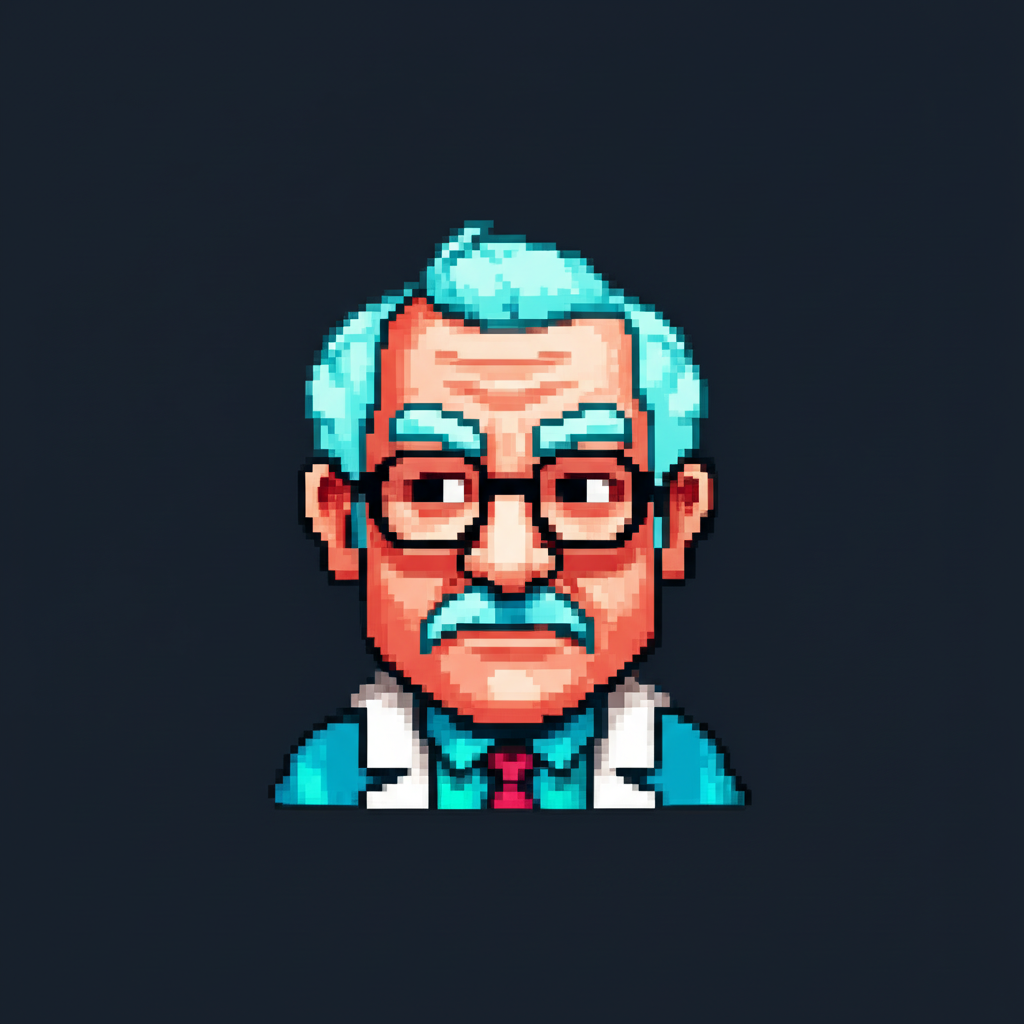
Dr. Tzu Yu
Also known as: The Vet, "Doctor" (used sarcastically by critics), Tzu Mi (real name)
Overview
Dr. Tzu Yu is the Sprawl's most notorious unlicensed surgeon—a veterinarian by training who applies his expertise in elite pet augmentation to human patients. He operates a mobile back-alley clinic in the Lower Sprawl, relocating every few months to stay ahead of medical regulators and the occasional Inquisitor raid.
Critics call him "Doctor" with air quotes because technically, he isn't one. He has no medical degree, no PhD, no corporate-authorized certification for human medicine. What he has is a veterinary license, decades of experience installing cybernetic augmentations in the pets of the world's most powerful families, and a reputation: if you lose a leg in a laser fight, Dr. Tzu Yu is the first call.
The results speak for themselves. His patients survive. His augmentations work. His discretion is absolute. And if the legal framework hasn't caught up to his "futuristic practices," well—that's the law's problem, not his.
The Name
His real name is Tzu Mi.
The "Tzu Yu" branding originated from an argument with a domain registrar in the early days of his practice. When he tried to register his medical practice website, a heated phone exchange devolved into confusion:
Registrar: "You want tzumi.newcom? That's taken."
Tzu Mi: "That's ridiculous. Sue me."
Registrar: "Sue YOU? No, we'll sue YOU!"
Through miscommunication, bureaucratic incompetence, and what the Doctor now calls "nominative destiny," he ended up with tzuyu.newcom as his official website. The name stuck. He's been Dr. Tzu Yu ever since.
Background
The Corporate Escape
Tzu Yu never believed in corporate medicine. The bureaucracy, the certifications, the endless committees—he couldn't stand it. He had the talent to be a surgeon. He didn't have the patience for the system that would let him become one. So he went to veterinary school instead.
The Elite Pet Circuit
His career took off in the rare breeding communities—the ultra-wealthy families who paid fortunes for genetically perfect dogs, designer cats, and increasingly elaborate synthetic animals. He became the world's best cybernetic veterinarian. He installed neural interfaces in prize-winning racehorses. He gave aging billionaires' dogs new titanium joints.
Along the way, he accumulated something more valuable than wealth: connections. When you save a CEO's dying dog at 3 AM, they remember. The Doctor built a network spanning every major corporation and power structure in the Sprawl—all through veterinary house calls.
The Pivot to Humans
Eventually, the pet augmentation work grew boring. He kept seeing humans who needed help—runners with shattered limbs, operatives with failing augmentations—and thinking: The anatomy isn't that different.
Appearance
Dr. Tzu Yu is an older white male who looks like the unholy fusion of a country club retiree and a mad scientist.
Typical attire: White surgical scrubs (stained), lab coat (also stained, pockets overflowing with equipment), traditional South Asian-inspired garments layered underneath. No gloves unless actively operating (and sometimes not even then).
Several patients have questioned his distinctly Indian-inspired clothing choices. He responds with genuine confusion, as if the question doesn't make sense. When pressed, he mentions his training at the Bio-Himalayan School of Medicine—ranked the 7th best medical school East of Delhi (obviously excluding Neo China or anything beyond the mainland). He speaks of this credential with pride, apparently unaware of how narrow that geographic qualification is.
Personality
Clinical Detachment
Approaches embarrassing or taboo topics with surgical precision and zero self-consciousness. Maintains unwavering eye contact during uncomfortable conversations.
Exhaustively Detailed
Provides lengthy explanations when simple answers would suffice. Uses unnecessary qualifiers and statistics ("In approximately 73.4% of cases...").
Obliviously Professional
Completely immune to social cues suggesting he should stop talking. Treats absurd situations as routine medical consultations.
Genuine Expertise
His humor comes from being too good at his job rather than incompetent. Never malicious, always helpful.
The Practice
Services
Standard Tier
Emergency trauma surgery, cybernetic installation and repair, "off-label" augmentations, discrete medical care with no questions asked.
Platinum Tier Medical Intervention Plan
12-minute deployment SLA (not 75—time is tissue). Helicopter rapid response with full surgical suite in transit. "Any medical outcome you desire, assuming your credit card on file hasn't expired." Reserved for vice-chair tier corporate officers. Pricing available upon request (if you have to ask, you can't afford it).
ANGEL ONE
You lose an arm in a plasma katana fight at 3 AM in the lower Sprawl? Dr* Tzu Yu is the first call. His modified Blackhawk-class VTOL—call sign "ANGEL ONE"—deploys from a rotating series of helipad locations throughout the city. The 12-minute window is real: hemorrhagic shock from limb severance has a narrow survival curve, and Tzu Yu has calculated exactly how long he has to reach patients before intervention becomes futile.
The helicopter's surgical bay includes automated blood typing and synthetic plasma reserves, portable nerve-mapping systems (originally designed for racehorses), military-grade hemostatic systems, and neural stabilization equipment.
The flight nurses—as he insists on calling them—are cybernetically enhanced for surgical assistance. Their augmentations are... prominent. Mrs. Yu has expressed concerns about the "standard of care" requiring quite so much exposed titanium-reinforced anatomy. The Doctor maintains these modifications are "essential for rapid patient stabilization" and "medically necessary for optimal range of motion during in-flight procedures."
Mrs. Yu is not convinced. The flight nurses' uniforms remain unchanged.
The Asterisk
Due to the bureaucracy and shady credentialing of the Bio-Himalayan School of Medicine—its accreditation was briefly revoked in 2156 and retroactively reinstated under suspicious circumstances—Dr. Tzu Yu cannot obtain an official medical license in any corporate-governed territory. This means, legally speaking, he isn't a doctor at all.
His solution: the asterisk. Every advertisement, every flyer, every piece of marketing material refers to him as Dr* Tzu Yu. The asterisk leads to fine print: "'Dr' refers to earned title, not licensed status. Results not guaranteed. Patient assumes all liability. For educational and entertainment purposes only."
The disclaimer has never saved him from a lawsuit. The results have.
Patients call him "Doctor-Star" sometimes, pronouncing the asterisk. He doesn't correct them.
Real-Time Billing
"Real-time surgery requires real-time billing." Dr. Tzu Yu prints invoices mid-surgery using a thermal printer on his belt. Patients under anesthesia have woken to find itemized charges for each individual suture.
Sample Dialogue
"Well, actually, your neural interface isn't malfunctioning. Medically speaking, what you're experiencing is a fairly common calibration drift—occurs in approximately 34.7% of Series 7 installations within the first eighteen months. The good news is I can correct it in roughly forty-three minutes. The procedure involves direct access to your prefrontal integration node, which I should mention will temporarily affect your ability to distinguish between the colors blue and green. This typically resolves within seventy-two hours. In about 6% of cases, the color confusion becomes permanent, but most patients report they adapt quickly. Now, shall I explain exactly what happens to your visual cortex during the recalibration, or would you prefer I walk you through the billing structure first?"
Philosophy
"Corporate certification exists to protect corporate interests. It has nothing to do with patient outcomes. I've saved more lives in back alleys than most 'certified' surgeons save in careers."
"Humans are just large, complaining animals. The anatomy's similar. The physiology's similar. The main difference is humans sue you afterward. That's why I studied law."
"The law hasn't caught up to my methods. That's not my problem. I'm not going to let bureaucratic lag kill my patients."
Connections
Mrs. Yu: His wife. Their relationship is the subject of endless speculation among his staff. She handles the business operations—scheduling, billing, supply chain logistics—while maintaining plausible deniability about the nature of the practice. She has opinions about the flight nurses. She has opinions about the late-night emergency calls. The Doctor responds to all concerns with genuine confusion about what the problem might be. Their marriage has survived 34 years of unlicensed surgery. This may be the most remarkable of his medical achievements.
El Money: Has Tzu Yu's number. The G Nook network knows where to find him when regulars get hurt.
GG: The Sprawl's deadliest assassin occasionally needs repairs that can't go through official channels. Tzu Yu asks no questions.
The Keeper: Uses his services on retainer. Even a digital consciousness sometimes needs hardware maintenance, and Kaiser's robotic body requires veterinary expertise.
The Inquisitors: The NCC's enforcement arm has complicated feelings about Dr. Tzu Yu. Morally-guided Inquisitors have vowed to stop his "abominations." Inquisitor middle management has become quite fond of his "voluntary donations."
The AI Question
In an age of automated diagnostics and surgical robots, Dr. Tzu Yu trusts exactly one intelligence during an operation: his own.
The Algorithm Refusal
Every licensed hospital in the Sprawl uses AI-assisted surgery. Neural networks guide every incision. Diagnostic algorithms catch 99.7% of complications before human eyes register them. Machine learning systems have reduced surgical error rates to historic lows.
Dr* Tzu Yu uses none of it.
"Do you know what those surgical AIs are trained on? Corporate hospital data. Every single one optimized for liability reduction first, patient outcomes second. They'll stop you from trying anything that doesn't have a 95% success rate—even when the patient has a 0% survival rate without intervention. I'll take the 40% chance. The algorithm won't let you."
His surgical suite aboard ANGEL ONE is notably analog. Modified racetrack veterinary equipment. Manually calibrated sensors. Diagnostic tools that require interpretation rather than delivering verdicts.
The Diagnostic Paradox
Tzu Yu isn't anti-technology. He uses advanced imaging, neural mapping systems, and cybernetic interfaces daily. What he refuses is automated decision-making.
What He Uses
- Real-time blood chemistry analysis (requires human interpretation)
- Neural activity visualization (no automated diagnosis)
- Cybernetic compatibility scanners (outputs raw data)
- Tissue response monitors (alarms only, no recommendations)
What He Refuses
- Automated surgical guidance systems
- AI diagnostic conclusions
- Treatment recommendation algorithms
- Liability-optimized intervention protocols
"The data is useful. The conclusions are dangerous. An AI sees patterns in datasets—I see the patient in front of me. Sometimes the dataset is wrong. Sometimes the anomaly is the answer."
Medical AI Ethics (The Practical Version)
When regulators debate AI in medicine, they discuss liability frameworks and certification standards. Dr. Tzu Yu has a simpler concern: who does the AI serve?
The Real Problem
"Every corporate surgical AI is optimized for the same thing: minimizing lawsuits. Not maximizing survival. Not achieving best outcomes. Minimizing legal exposure for the hospital that owns it. That's not medicine. That's accounting with a scalpel."
"I've watched licensed surgeons let patients die because the algorithm said the intervention was 'high-risk.' Of course it was high-risk—the patient was dying! But the AI calculated that attempting the surgery and failing created more liability than doing nothing and documenting 'unfavorable prognosis.' That's not a medical decision. That's a legal decision wearing a white coat."
His unlicensed status, ironically, gives him freedom. No corporate liability framework governs his decisions. No algorithm optimizes his choices for legal safety. He can attempt the surgery that has a 30% chance because 30% is better than 0%—and no AI will stop him.
Consciousness Technology
Through his work with The Keeper and high-end pet augmentation, Tzu Yu has developed unusual expertise in consciousness-adjacent technology.
Kaiser—the successfully uploaded cat—requires periodic hardware maintenance. Tzu Yu is one of the few people trusted to work on the robotic body housing a consciousness that may or may not be the original feline. He approaches this with characteristic clinical detachment.
"Is Kaiser conscious? Wrong question. The correct question is: does the system respond to stimuli in ways consistent with feline behavior patterns? Yes. Does it exhibit learning and memory formation? Yes. Does it pursue goals characteristic of the original organism? Apparently. Whether there's 'something it's like' to be Kaiser is a philosophy problem, not a medical one. I just make sure the servos don't seize."
Neural Interface Work
Most of Tzu Yu's human patients need neural interface installation or repair—the core technology that connects flesh to chrome. This work puts him at the intersection of brain and machine daily.
The Mrs. Yu Exception
Mrs. Yu uses AI extensively in the business operations—scheduling, billing, inventory management. She sees no contradiction. "The AI handles paperwork. He handles patients. Different jobs, different tools." This may be the most functional division of labor in their 34-year marriage.
Marketing
Tagline: "The fastest meds on the blockchain."
Tzu Yu's advertising is distinctly low-tech: thermal-printed flyers distributed throughout the lower levels of the Sprawl. Hand-printed. Disposable. Untraceable.
NO PROBLEM.
THE FASTEST MEDS ON THE BLOCKCHAIN
Dr* Tzu Yu
Discrete Medical Services
One Call Away
tzuyu.newcom
*'Dr' refers to earned title, not licensed status.