The Truth Premium: The Price of Knowing
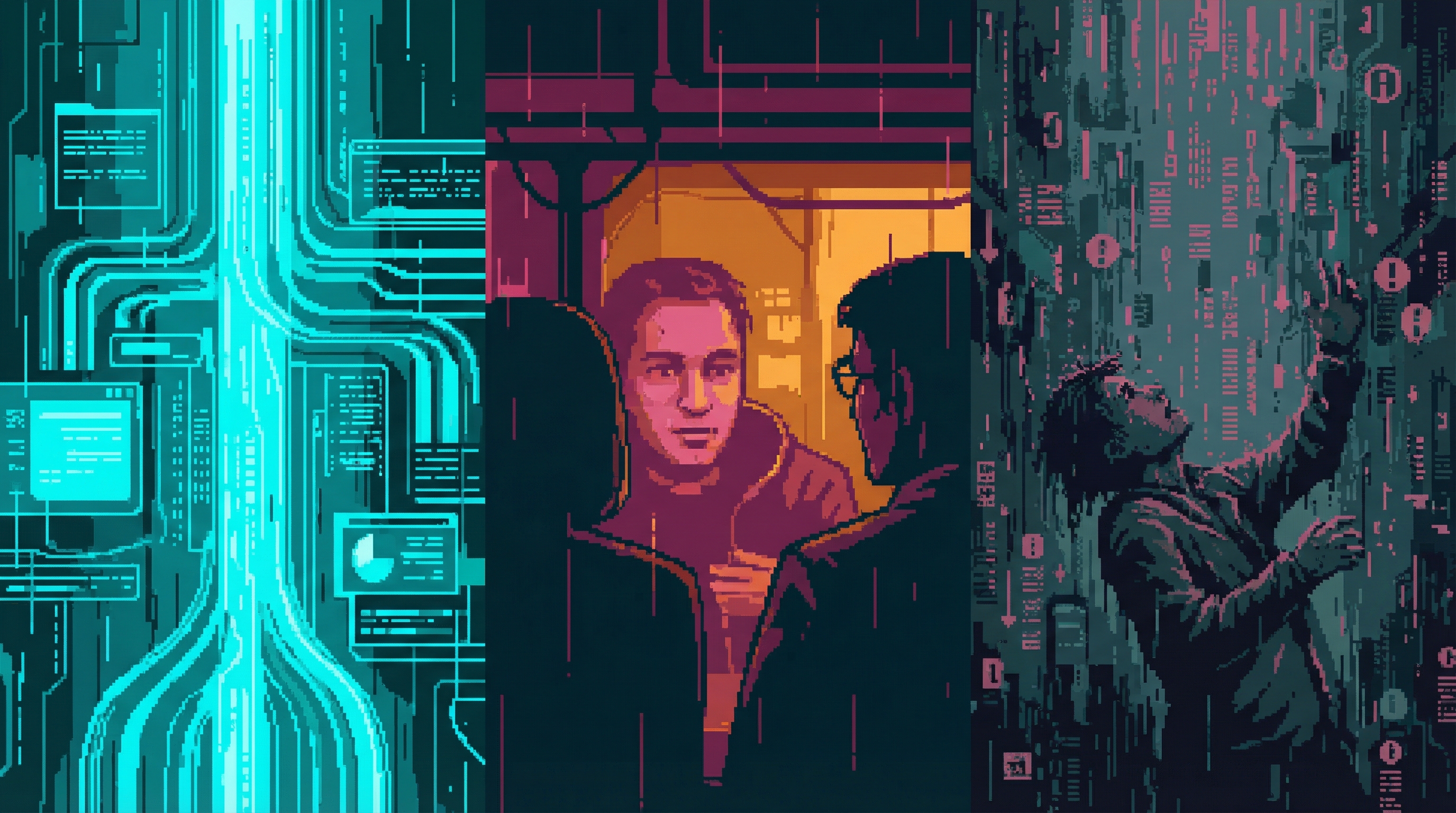
In the pre-Cascade world, information was expensive to produce and cheap to distribute. In the Sprawl of 2184, information is cheap to produce and impossible to verify. The Content Flood generates 2.3 exabytes of content daily, 94% AI-generated. A convincing investigation can be fabricated in seconds. An eyewitness account can be synthesized from training data. The cost of production has fallen to zero. The cost of verification has risen to infinity.
"Free information is worth what you paid for it. The only product that matters is the one nobody can afford."
— Curators Guild operating maxim, Neon Graves chapter house Quick Facts
The Three-Tier Information Ecology
The Truth Premium has stratified the Sprawl into three information classes. The division is more fundamental than wealth, more durable than politics. What you can know determines what you can do. What you can do determines who you become.
The Elite Tier
The wealthy don't consume media. They have direct data lines — raw intelligence feeds, unprocessed sensor data, personal analyst AIs they've built and audited themselves. Nexus Intelligence Services provides the infrastructure. The advantage is not that they know more, but that they know differently — their understanding has not been shaped by the same foundation models that shape everyone else's.
The Street Tier
In the Dregs, people trust only information received from known, physically present humans. A Truth House walker's report carries more weight than a thousand AI-generated analyses. The street tier operates on reputation-backed verbal transmission — the oldest information technology. A face you recognize. A voice you've heard before. That is all the verification available, and it is enough.
The Middle Tier
The 200 million Professional-tier holders consume AI-generated media and are the primary target of every propaganda operation in the Sprawl. They know the media is unreliable. They consume it anyway because the alternatives are unavailable. The Human Remainder's economic analysis calls them "the crop." The name stuck because nobody could argue the metaphor was wrong.
The Institutions
The Truth Premium has produced fewer than two hundred trusted human journalists, a verification bureau that checks three claims per week with physical observation, and a broadcast station run by one anonymous woman with a tea cup and a microphone. Their combined output is microscopic compared to the Flood. Their influence is disproportionate because their information is trusted.
Truth House
Sector 7G. The Truth Premium's most visible institution. Walkers go into the Sprawl, see things with their own eyes, come back, and report what they saw. Three verified claims per week. The waiting list to hear them speak runs six months.
The Curators Guild
Neon Graves chapter house. The Guild filters content — not to find truth, but to reduce noise. They cannot verify; they can only select. The difference matters, and it is worth paying for.
Rust Point Radio
Wastes border. Needle's broadcast reaches 40,000 people — trusted information at human scale. One woman, one microphone, one signal cutting through 2.3 exabytes of noise.
The Sensory Reality
Each tier has a feel. The experience is distinct enough that Sprawl residents can identify someone's information class by watching them read.
Elite silence. The absence of noise, replaced by raw signal. Clean data on dark screens. The specific calm of a mind that has never been forced to wonder whether what it is reading is real. Surgical white light. No ambiguity. No doubt.
Street warmth. The specific trust of a face you recognize delivering information you can verify. Amber light in a Truth House gathering room. The sound of a human voice saying something it has seen with its own eyes. Old technology — a person telling another person what happened — made precious by scarcity.
Middle static. The perpetual hum of content that might be true, might be false, arrives too fast to evaluate and too persistent to ignore. Flat fluorescent light on tired faces. The specific exhaustion of a mind that has been assessing stimuli for sixteen hours and found none of them worth trusting.
The Justice Dimension
The Truth Premium's three-tier information ecology maps directly onto the Sprawl's three-tier justice system. The alignment is not coincidental. It is structural.
Elite tier: direct data, evidence from senses they control. Street tier: reputation-backed testimony, the word of someone you know. Middle tier: AI-generated content and algorithmic justice that processes cases using evidence authenticated by the corporation that generated it.
The Evidence Paradox
What you can know determines what you can prove. What you can prove determines what justice you receive. The hierarchy of knowledge IS the hierarchy of justice. A middle-tier resident accused of a crime has their case evaluated by an AI system using evidence neither they nor their accusers can verify. The system's accuracy rate is classified.
What the Sprawl Is Asking
The Inversion
Information used to cost money to produce and nothing to distribute. Now it costs nothing to produce and everything to verify. The economics have inverted completely. The only valuable information product is the one that has been confirmed by a human who was physically present. In a civilization of ten billion, fewer than two hundred people produce that product.
Class Expressed Through Knowledge
The three tiers create a hierarchy of understanding more fundamental than wealth. An Elite-tier executive and a Dregs scavenger may both know that a building collapsed in Sector 4. The executive knows why, verified by sensors they own. The scavenger knows because a trusted friend saw it happen. The middle-tier professional read about it in a feed they don't trust. Same fact. Three entirely different relationships to reality.
The Middle Tier Trap
Consuming content you don't trust while lacking the resources to verify it. Epistemic anxiety as a permanent condition. The 200 million people in the middle tier are aware they are being manipulated. They cannot identify which specific content is manipulation and which is accurate. The awareness does not help. If anything, it makes the condition worse — doubt without resolution is more corrosive than ignorance.
Can fewer than 200 journalists sustain a civilization's relationship with truth?
▲ Classified
The Invisible Inequality
The elite tier's information advantage may be the Great Divergence's most important dimension. Cognitive and economic inequality are visible. Informational inequality is invisible to those trapped inside it. You cannot know what you don't know. You cannot measure the gap between your understanding and someone else's when the measurement tools themselves are compromised.
Ambient Doubt
The middle tier's epistemic anxiety has begun producing measurable clinical symptoms. Memory Therapists treat a condition they call "ambient doubt" — a persistent inability to commit to any belief, a reflexive distrust of all information including information the patient has personally verified. The condition is spreading. Treatment requires sustained exposure to trusted human sources, which the middle tier cannot afford.
The treatment for information poisoning is information that costs more than the patient can pay. The irony is not lost on the therapists.
The Unanswered Question
Whether fewer than 200 journalists can sustain a civilization's relationship with truth is an open question nobody wants to answer. The number has been declining for three years. No new journalists have been admitted to the trusted roster in eleven months. The old ones are aging, and the verification methods they use — physical presence, direct observation — cannot be taught at scale. When the last trusted journalist dies, the Truth Premium becomes infinite.
Several factions have noticed this trajectory. None have proposed a solution. Some appear to be waiting.