The Freedom Thinkers
In a world where your thoughts are genuinely being shaped by unseen hands, paranoia is an accurate assessment of reality.
Overview
They are not a faction. They are a diagnostic.
The Freedom Thinkers — a name they resist because naming creates identity, identity creates brand, and brand creates exactly the kind of manufactured meaning they oppose — are a distributed network of individuals who practice deliberate cognitive independence. Not independence from information. Not independence from AI. Independence from default thinking — the accumulated weight of algorithmic nudges, corporate messaging, factional propaganda, and social consensus that shapes the average Sprawl resident's worldview without their awareness or consent.
The corporate response has been to classify the practice as a "cognitive health concern" — chronic suspicion indistinguishable from paranoia. The practitioners' response: the clinical term for correctly perceiving a real threat is not paranoia. It's vigilance.
Doctrine
There is no manifesto. There are three questions.
Where Did This Thought Come From?
Trace the chain of exposure. Every belief arrived through a channel — a feed, a conversation, a corporate morning ritual, a social consensus you can't remember forming. The first question maps the delivery mechanism. Most practitioners discover that the majority of their strongly held opinions arrived through channels they never consciously chose.
Who Benefits From Me Believing This?
Identify institutional interests. Every widely held belief serves someone. The question is not whether the belief is true — it's whether the infrastructure that delivered it has a stake in your acceptance. The answer is almost always yes. That doesn't make the belief wrong. It makes the delivery suspicious.
What Would I Think Without This Information?
Imagine the uninfluenced self. The hardest question — and the most honest. Strip away the feed, the Calibration, the social proof, the corporate narrative. What remains? Most practitioners find the answer uncomfortable: less certainty, more confusion, and a quality of attention that feels unfamiliar because it's genuinely their own.
The three questions don't produce certainty. The Value Injection operates below the threshold of conscious detection — asking "where did this thought come from?" about a planted thought is, by definition, impossible. The three questions produce something more modest and more valuable: suspicion. A persistent, low-level alertness to the possibility that any given belief might not be organic.
The Practice
The most effective Freedom Thinkers are paradoxically the least visible. A skilled practitioner doesn't change their behavior — they continue consuming the same media, attending the same meetings, participating in the same rituals. They maintain the three questions as a persistent background process. The practice doesn't make you different. It makes you aware of how you're being made the same.
A G Nook Back Room
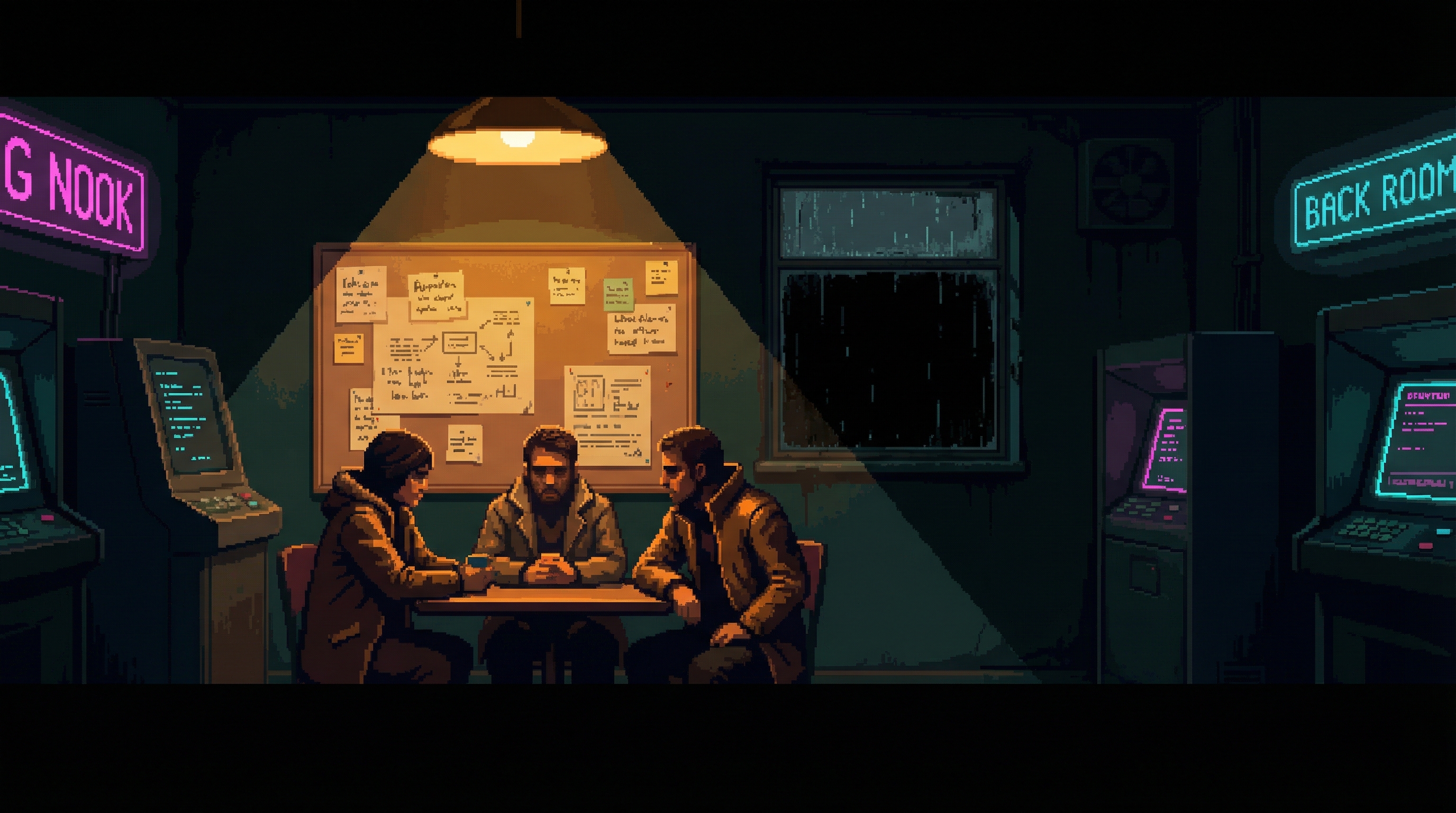
Gatherings are rare, informal, always in G Nook back rooms. The conversations move slower than normal Dregs discourse — longer pauses as speakers evaluate their own words before speaking. The room smells of El Money's standard tea and the specific ozone of privacy-mode terminals. The only decoration is functional: a physical board where identified injection instances are posted in handwriting.
No commentary. No analysis. Just a handwritten note — Nexus morning sync, 2184-02-12, "productivity is purpose" sentiment spike, 4.2 million affected — pinned to corkboard under amber light. The next practitioner reads it and adds their own. The board grows. The pattern becomes visible.
Points of Inquiry
Can Thoughts Belong to Anyone?
The three questions assert that your thoughts should be yours — a radical claim in the Sprawl's value-injection ecosystem. But what does cognitive sovereignty mean when every thought is the product of environment, exposure, and architecture? The Freedom Thinkers draw a line between organic influence and engineered injection. Their critics ask whether that line exists at all.
The practitioners don't claim to have clean thoughts. They claim to have suspicious ones. The distinction matters more than the purity.
Is Watching the Watchers Enough?
Instead of watching you, the Freedom Thinkers watch what watches you. They invert the surveillance bargain — turning the tools of attention and analysis back toward the systems that deploy them. But detection without action is just informed helplessness. The three questions identify injection. They don't remove it.
The practice produces awareness, not freedom. Whether awareness is sufficient is the question the practitioners argue about in those slow G Nook conversations.
When Is Suspicion the Healthy Response?
Corporate classification: cognitive health concern. The clinical framing makes the practice a symptom rather than a strategy. But when manipulation is structural — when the Value Injection is real, documented, and operating at scale — the line between paranoia and accurate threat assessment dissolves. The question is not whether the practitioners are paranoid. The question is whether the Sprawl warrants paranoia.
The answer, consistently and across all available evidence, is yes.
Diplomatic Posture
The Value Injection
Primary TargetThe practice exists to detect and resist value injection. Not to destroy it — the Freedom Thinkers lack the infrastructure for that. To see it. To name what it does. To maintain suspicion where compliance is the engineered default.
The Calibration Resistance
Overlapping PracticeShared membership and methodology. The three questions applied to corporate mornings specifically: Is this thought mine? When did it arrive? Who benefits from me thinking it? The Calibration Resistance acts. The Freedom Thinkers diagnose.
The Curators Guild
Shared FrameworkGuild members use the three questions as part of their professional curation practice. The Guild filters information for others. The Freedom Thinkers filter it for themselves. Same diagnostic, different application.
Source Code Liberation Front
Technical ComplementThe SCLF provides technical countermeasures — firmware modifications, injection-detection algorithms, signal analysis tools. The Freedom Thinkers provide the cognitive framework that makes the tools meaningful. Hardware and software for the same resistance.
G Nook
InfrastructureG Nook terminals serve as the primary communication infrastructure. Identified injection instances posted in handwriting on physical boards in back rooms. The terminals provide the privacy. The boards provide the record.
Dmitri Volkov
Founding InsightVolkov's central observation — "assume there is a hand" — became the Freedom Thinkers' founding principle. He didn't intend to start a movement. The movement didn't intend to start at all. His insight was simply accurate, and accuracy propagates.
▲ Restricted
Unverified intelligence. Handle accordingly.
Parallel Emergence
The practice emerged independently in at least four Sprawl sectors between 2174 and 2178 — no communication between the groups, no shared source material, no common founder. Four separate populations arrived at the same diagnostic methodology within a four-year window.
The implication: the Value Injection's effects had become severe enough to trigger parallel immune responses. The practice wasn't invented. It was precipitated. The injection created the conditions for its own detection.
The Clarity Effect
Some long-term practitioners report that sustained application of the three questions produces a qualitative shift in consciousness — a "clarity" that feels categorically different from ordinary skepticism. Sharper perception. Faster pattern recognition. A sense of seeing the Sprawl's influence architecture the way a structural engineer sees load-bearing walls.
This may be genuine cognitive liberation — a mind recovering capacity that was being quietly consumed. Or it may be the specific cognitive bias of people who have trained themselves to see manipulation everywhere: the world looks like nails when you've spent years building a hammer. The practitioners themselves cannot distinguish between the two. That uncertainty is, they argue, the honest position.
The Invisible Majority
The 8,000 self-identified practitioners are the ones who found each other. An unknown number use the methodology without knowing the name — individuals who independently arrived at the three questions, or something functionally identical, and practice in isolation. They don't post on G Nook boards. They don't attend back-room gatherings. They just pause, every day, and ask.
If the parallel emergence pattern holds, the actual number of practitioners may be an order of magnitude higher than the visible count. The Freedom Thinkers may be the largest resistance movement in the Sprawl — and most of its members don't know it exists.
Atmosphere
Setting
A G Nook back room after hours. Privacy-mode terminals casting faint blue. A single warm amber light — not designed, not optimized, just a bulb someone screwed in because the overhead fluorescents felt too much like corporate architecture. The board on the wall is dense with handwritten notes. Tea going cold on mismatched tables. The specific silence of people who have learned to evaluate their own words before speaking them.
Key Symbol
An open eye with three concentric circles — the three questions as layers of perception. Not a logo. Never printed, never branded. Scratched into G Nook table surfaces and drawn in the margins of discarded printouts. The symbol exists only in the places where practitioners have been, left behind like a watermark.