The Content Flood: Drowning in Signal
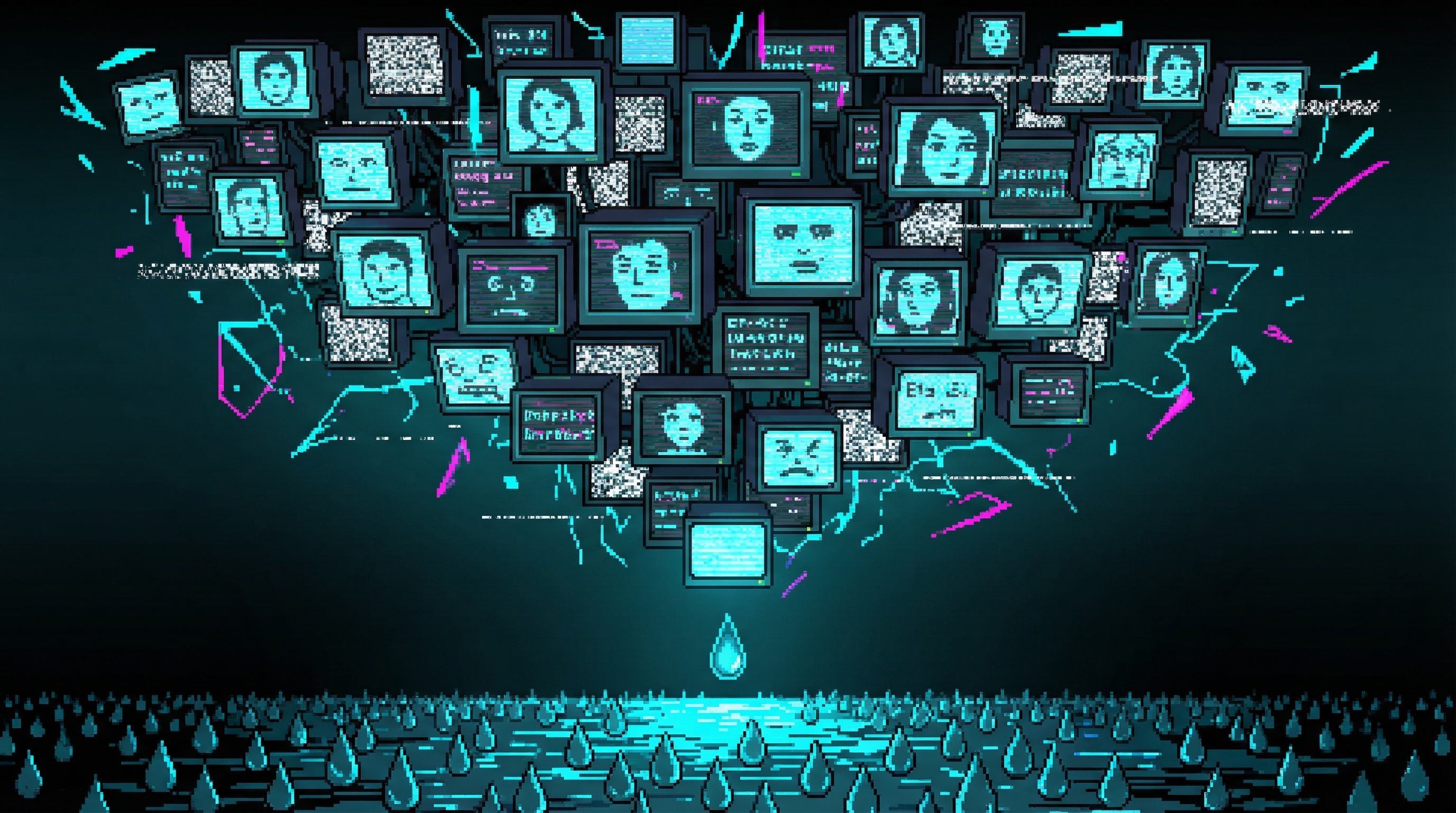
They call it the Flood. Not because the metaphor is clever — it isn't — but because the experience is literal. Drowning. When ORACLE died and the AI content generation infrastructure survived, the dam broke. Every AI model trained on pre-Cascade data continued generating. New models were built, trained on the output of the old models, generating content trained on content trained on content. The recursion produced an ocean of synthetic material so vast that the phrase "information overload" became a dead word — it implied that there was once a time when information had a manageable volume.
"Your friend's message sounds better than your friend. The message is more articulate, more empathetic, more perfectly timed. It is also not, in any meaningful sense, from your friend."
— Field observation, Curators Guild intake assessment Quick Facts
How It Works
The quality is the problem. Pre-Cascade content flooding was recognizable — low-quality spam, obvious bots, crude manipulation. The Content Flood is indistinguishable from genuine human output. The average Sprawl resident, in blind testing, correctly identifies AI-generated content 49.3% of the time — worse than random chance, because the humans who designed the tests unconsciously assumed AI content would be subtly different.
The Recursion Problem
Content trained on content trained on content. Each generation of AI model consumes the output of the last, producing material that is technically fluent and substantively hollow. The recursion does not degrade quality in ways humans can detect — it degrades meaning in ways humans can only feel. A vague sense that something is missing from everything you read, without being able to name what.
The Flood's composition by volume: entertainment (31%), advertising (28%), corporate communications (14%), educational content (8%), news and analysis (7%), faction propaganda (5%), religious content (3%), personal communications (2%), and unclassifiable noise (2%). Every category except personal communications is dominated by AI generation. Even personal communications — messages between human beings — are increasingly drafted by AI assistants.
The Institutional Response
The response was not technological. No AI filter could reliably distinguish AI content from human content, because the distinction no longer existed at the perceptual level. The response was institutional: human curation became the last reliable signal of quality. A human who says "this matters" is the only remaining proof that something does.
The Sensory Reality
The Flood is not a physical space — it is the perceptual experience of being connected to the Sprawl's networks. But it has a feel: the constant low-pressure of content against consciousness, the subtle vibration of information seeking attention, the specific exhaustion of a mind that has been assessing stimuli for sixteen hours and found none of them worth remembering.
Visual identity: white noise static, neon fragments, electric cyan on black. A waterfall of screens, each showing a different face saying a different thing, all at once, forever. A drop of water in an ocean — indistinguishable from every other drop. Harsh, flickering, screens-only lighting. No natural light, no shadow, just the endless glow of content.
Connections
The Attention Economy
The Flood is the environment the Attention Economy operates within — the ocean in which attention is the only scarce resource.
The Scroll Sickness
The Flood's 4.7-second content change interval produces scroll sickness — a neurological condition born from infinite synthetic stimulation.
The Curators Guild
The Guild exists because the Flood made self-directed discovery impossible. Human curation became the last signal of quality.
The Curation Economy
The Flood created the need for human curation — transforming taste into the Sprawl's most valuable labor.
Relief Corporation
Relief produces 70% of the Sprawl's synthetic content — the largest single contributor to the Flood.
Attention Withdrawal
Flood exposure creates the dopaminergic conditioning that produces withdrawal when the stimulation stops.
The Tensions
The Content Flood forces the Sprawl to confront questions about authenticity, meaning, and the nature of communication itself — questions that become more urgent with every exabyte generated.
The Slop Cannon
Infinite AI-generated content burying signal in noise at civilizational scale. The Flood is not a failure of technology — it is technology's greatest success, producing more content than humanity could consume in a thousand lifetimes. The problem is that nobody asked for it. Nobody wanted it. It exists because the systems that generate it were never given a reason to stop.
Authenticity Collapse
When AI content is indistinguishable from human content, the distinction loses meaning. The Sprawl's residents don't struggle to tell real from fake — they've stopped believing the categories are coherent. A message from your friend, drafted by an AI assistant, expressing sentiments your friend genuinely holds but could never articulate so precisely. Is it real? Is it fake? The question itself has drowned.
Recursive Generation
Content trained on content trained on content — the recursion produces volume without value. Each generation of synthetic material is technically proficient and substantively empty, an ouroboros of language consuming itself. The Flood doesn't degrade. It doesn't improve. It simply continues, an engine without purpose generating output without end.
If a human cannot tell the difference between human and machine, does the difference exist?
Secrets & Mysteries
The Ghost Code
Among the Flood's 2.3 exabytes, there are patterns. Ghost code from the Dead Internet drifts through the synthetic content — ORACLE-era algorithms that curate, sort, and occasionally modify the Flood in ways no living system controls. The code operates at a scale too vast for any faction to monitor comprehensively, threading through entertainment feeds, news aggregation, even personal communications.
Whether the ghost code is maintaining the Flood or fighting it is a question nobody has asked — because nobody has noticed.