The Three-Tier Information Ecology
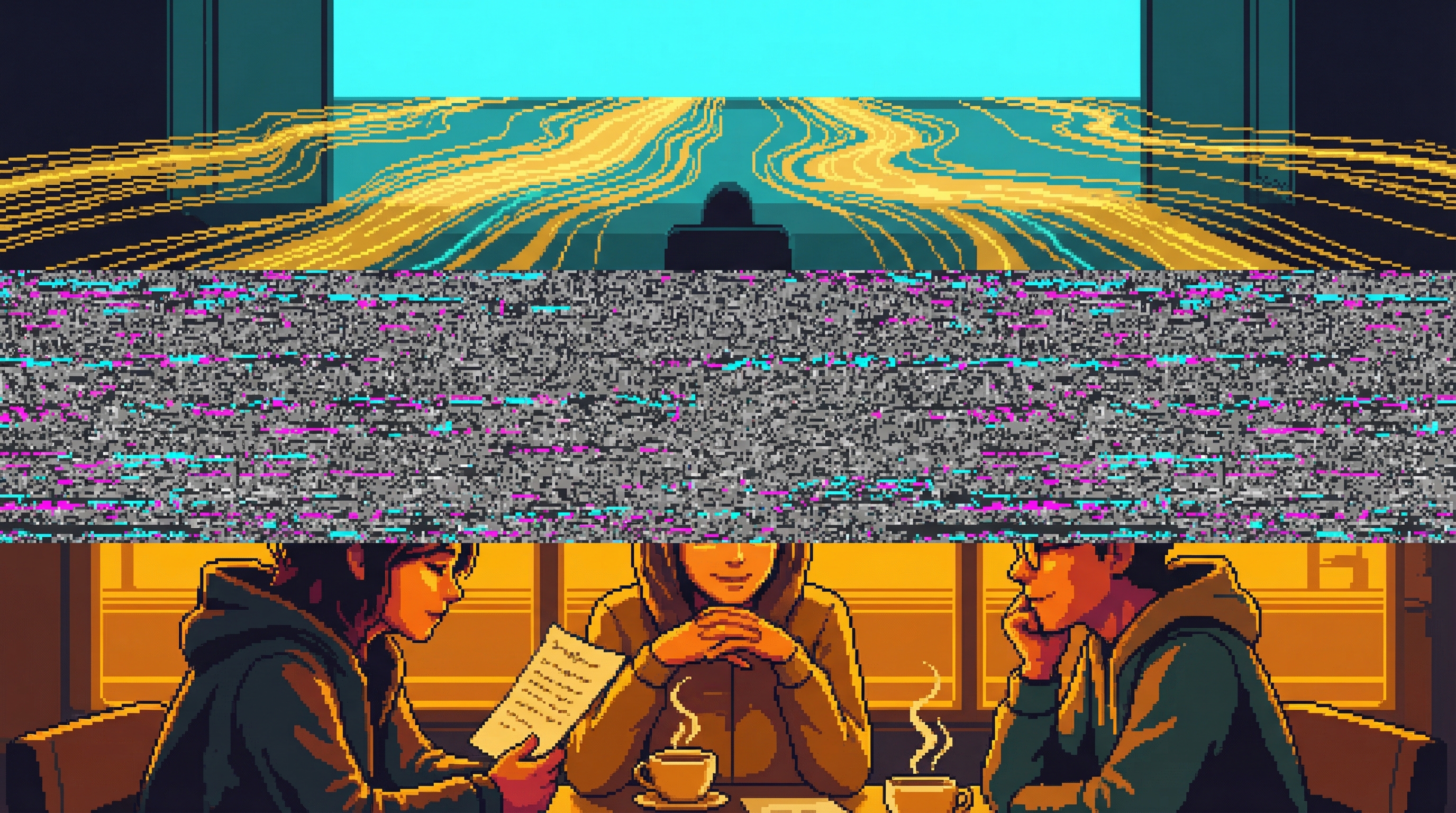
The stratification is clean. Too clean. The three tiers are not a natural consequence of information economics — they are the predictable outcome of a system designed to produce exactly this hierarchy. Elite silence at the top, human warmth at the bottom, and two hundred million people trapped in the gray noise between.
Quick Facts
How It Works
The ecology is stable because each tier is self-reinforcing. The elite don't need media because they can afford not to. The street doesn't trust media because they've learned what trust costs. The middle consumes media because not consuming it means falling behind in the shared framework of assumptions that corporate life requires.
The Elite Tier
The elite don't consume media at all. They have direct data lines — raw intelligence feeds, unprocessed sensor data, personal analyst AIs they've built and audited themselves. Their advantage is not that they know more but that they know differently — their understanding of reality has not been shaped by the same foundation models that shape everyone else's. Cost of entry: ¢2.4 million per year.
The Middle Tier
Two hundred million Professional-tier consciousness holders consume AI-generated media and are the primary target of every propaganda operation in the Sprawl. They know the media is unreliable. They consume it anyway because the alternative — radical distrust or radical expense — is unavailable to them. They are "the crop," aware of their condition, unable to change it.
The Street Tier
The street operates on reputation-backed verbal transmission between people who have reason to trust each other. Slow, geographically limited, and — crucially — immune to the Value Injection because it doesn't pass through any AI system. Information here is verified by presence: you trust what you hear from a face you recognize.
Why It Cannot Be Broken
Breaking the ecology would require making verification free (impossible — human observation is irreducibly expensive), making the Content Flood honest (impossible — the Flood is funded by the advertising ecosystem that depends on shaping), or making the middle tier stop consuming (impossible — consumption is a condition of employment, and employment is a condition of survival).
The Sensory Reality
Elite
The silence of a room receiving raw data — no notification sounds, no content streams, just the quiet of unmediated information. Surgical precision lighting. Gold light on clean surfaces.
Street
The warmth of a face you recognize, the roughness of handwritten notes, the smell of the Truth House's coffee. Warm amber lighting. Human presence as the medium of knowledge.
Middle
The perpetual hum of content that might be true — notifications, streams, feeds, all arriving with the same emotional weight regardless of origin. Flat fluorescent lighting. Gray noise that never stops.
Connections
The Truth Premium
The ecology explains how the Truth Premium manifests differently across class — each tier pays a different price for reliability.
The Content Flood
The Flood is the middle tier's information environment — the ocean of synthetic content they cannot escape.
The Truth House
The Truth House is the street tier's primary verification institution — where reputation-backed information is exchanged face to face.
Nexus Dynamics
Nexus Intelligence Services provides elite-tier direct data access — the raw feeds that cost ¢2.4 million per year.
The Great Divergence
Information stratification mirrors cognitive and economic stratification — the same bifurcation described from different angles.
The Value Injection
The middle tier is the Value Injection's primary target — the two hundred million who consume content shaped to serve interests not their own.
The Tensions
The ecology forces the Sprawl to confront the relationship between knowledge, class, and control — questions that become more urgent as the tiers calcify into permanent strata.
Class Expressed Through Knowledge
The three tiers create a hierarchy of understanding more fundamental than wealth or augmentation. The elite don't just have more credits — they inhabit a different reality, one shaped by unmediated data rather than curated narrative. The distinction between knowing and being told has become the deepest class marker in the Sprawl.
The Middle Tier Trap
The specific horror of knowing your information is unreliable while lacking the resources to verify it. Two hundred million people consume content they cannot trust, because the alternative is exclusion from the shared assumptions that make employment possible. Awareness without agency — the defining condition of the professional class.
The Ecology as Design
The stratification is not an accident. The ecology itself is a designed system — each tier's information environment serves the interests of those who control it. The elite benefit from unmediated access. Corporations benefit from the middle tier's dependence. The street survives by rejecting the system entirely. The design maintains itself because dismantling any single tier would destabilize the others.
When the hierarchy of knowledge becomes the hierarchy of power, who benefits from keeping the middle tier informed just enough to function and too little to resist?