The Curators Guild
In a world of infinite free content, the most expensive product is someone telling you what to ignore.
Overview
In a world where any information can be fabricated, any argument can be generated, and any experience can be synthesized — the person who tells you what's worth your attention is the most powerful person you know.
The Curators Guild emerged in the early 2170s from a convergence of three needs: the Content Flood had made self-directed information discovery functionally impossible; the Authenticity Tribunal could verify individual pieces but couldn't scale to filter the daily torrent; and the growing Attention Economy needed someone to stand between the Flood and the human mind and say: this matters. This doesn't.
Guild curators are human. This is their defining characteristic and their commercial value. Not because human judgment is superior to AI judgment — in aggregate, it isn't — but because human judgment is accountable. A curator has a name, a reputation, a track record. An AI filter is a black box optimized for engagement. A curator is a person who decided that this particular piece of music, this particular article, this particular piece of evidence deserves your attention — and who will be held responsible if the recommendation damages you.
The Certification Model
Three years of training to answer a single question: is this worth your time?
Perceptual Calibration
Apprentices learn to detect synthetic content through non-algorithmic means — developing the human instinct for identifying what's real in a world where the machines produce perfect imitations.
Ethical Training
Distinguishing between "interesting" and "important." A curator who recommends what's engaging is an algorithm. A curator who recommends what matters is a professional.
Flood Immersion
The particular mental discipline of consuming the Content Flood professionally — immersing in the noise for eight to twelve hours daily, identifying the signal, and packaging it for clients whose attention is worth more than the curator's time.
The Print Shop
Deliberately analog in a digital world.
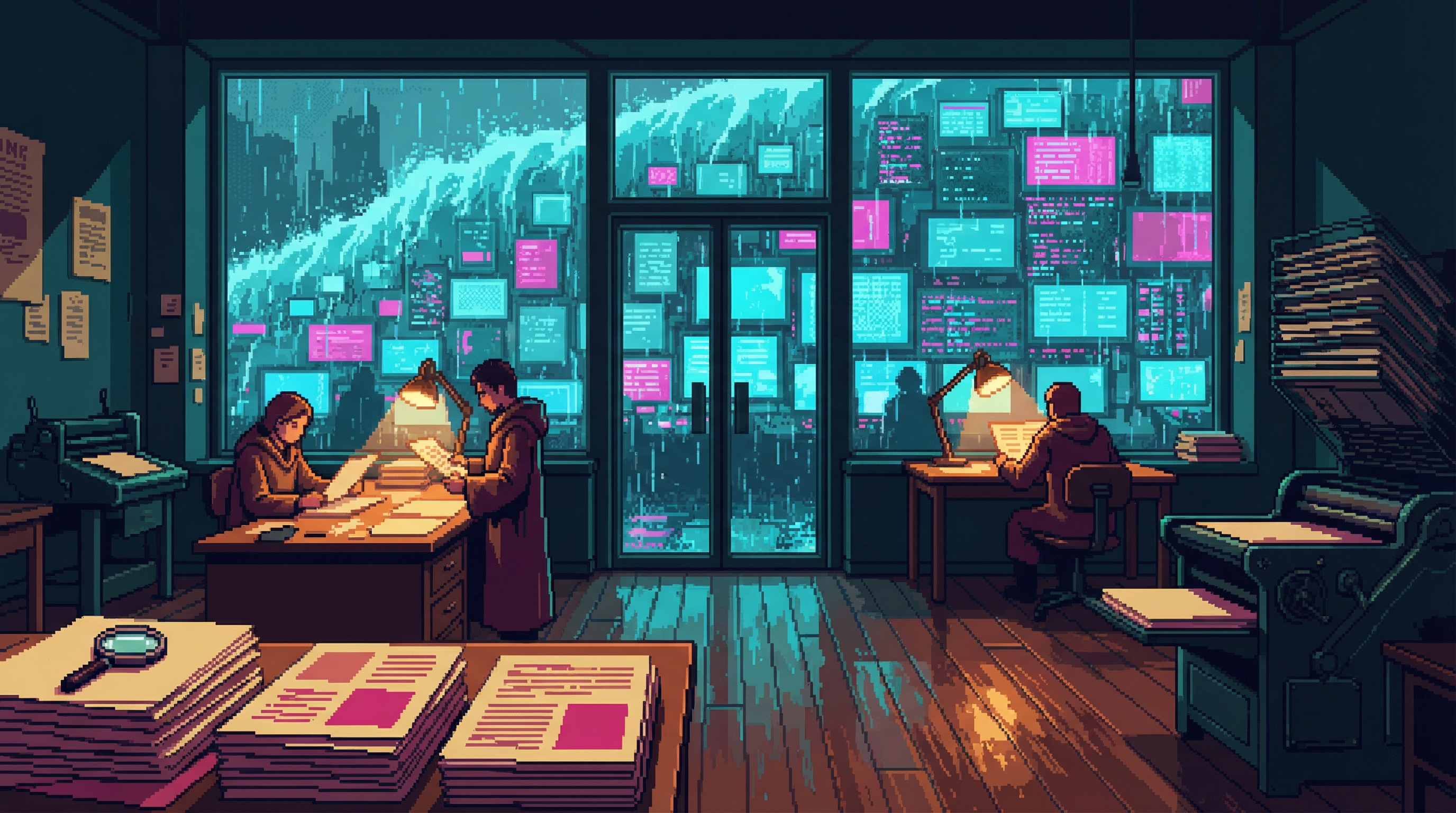
The Guild headquarters smells of paper, ink, and black coffee — deliberately analog scents in a digital world. The sound is conversation: curators debating recommendations, arguing about what matters, performing the ancient human act of disagreeing about what's worth attention.
The light is warm, lamplight-warm, the antithesis of screen-glow. In Neon Graves, surrounded by artists debating what's real, the Guild decides what's worth noticing.
Connections
The Guild stands at the intersection of the Authenticity War — filtering the torrent where others verify individual drops.
Allies
The Authenticity Tribunal
ComplementaryThe Tribunal certifies individual pieces; the Guild filters the torrent. One verifies truth. The other decides what truth is worth your time.
The Curation Economy
Institutional TierThe Guild is the institutional backbone of the Curation Economy — the organized, certified, accountable layer of a broader ecosystem of human filtering.
Enemies
The Content Flood
Existential ThreatThe Guild exists because the Flood made self-directed discovery impossible. Every day, curators immerse themselves in the noise so their clients don't have to.
Relief
Opposing ForceRelief shapes the Flood; the Guild filters it. Guild Master Dieng founded the Guild after leaving Relief's Content Optimization Division — she knows what the Flood is designed to do.
Context
The Attention Economy
PatronThe Guild is the Economy's quality-filtering institution — the human answer to the question of what deserves attention in a world where everything competes for it.
Neon Graves
HomeHeadquarters in a converted print shop in the art district. Surrounded by artists debating what's real while the Guild decides what's worth noticing.
Guild Master Sable Dieng
Founder & LeaderFounded the Guild after leaving Relief's Content Optimization Division. Has refused three Rothwell acquisition attempts. Suspects the fourth will not be an offer.
Tensions
Human Judgment as Luxury
When AI can generate anything, human evaluation becomes the scarce resource. The Guild's curators charge hundreds of credits per hour not because they're better than algorithms — but because they have names, reputations, and accountability. A recommendation from a curator carries weight because a person made it.
The irony is exquisite: in a world of infinite free content, the most expensive product is someone telling you what to ignore.
The Curation Crisis
As curators become more powerful — as more of the Sprawl's elite rely on Guild recommendations to navigate the Flood — they become targets for the very forces they filter. The Rothwell media apparatus has attempted acquisition three times. Each refusal raises the stakes.
The person who decides what you pay attention to controls what you think about. That power draws predators. And the last independent information-filtering institution in the Sprawl has a waiting list months long.
Accountability vs. Scale
Human accountability cannot scale. The Guild serves thousands; the Flood assaults billions. Four thousand curators cannot filter the torrent for a population of millions. The Guild's value proposition — human judgment, human responsibility — is also its fundamental limitation.
The question the Guild cannot answer: what happens to the people who can't afford a curator? The Flood doesn't discriminate. The Guild does — by price.
Secrets & Mysteries
What the Guild's members discuss in whispers.
The Fourth Offer
The Rothwell media apparatus has attempted to acquire the Guild three times. Guild Master Dieng has refused three times. The fourth offer, she suspects, will not be an offer.
What corporate acquisition would mean for the last independent information-filtering institution in the Sprawl is a question the Guild's members discuss in whispers. Independence is the Guild's value. Remove it, and the curators become just another corporate filter — optimized for engagement, not truth.
Atmosphere
Setting
A single person reading by lamplight while a tsunami of screens looms behind them. Paper-covered desks. The smell of ink and coffee. Conversation where there should be silence.
Key Symbol
A magnifying glass with a human eye visible through the lens — the act of focused, intentional, accountable looking in a world of algorithmic glancing.