The Prophecy Trap
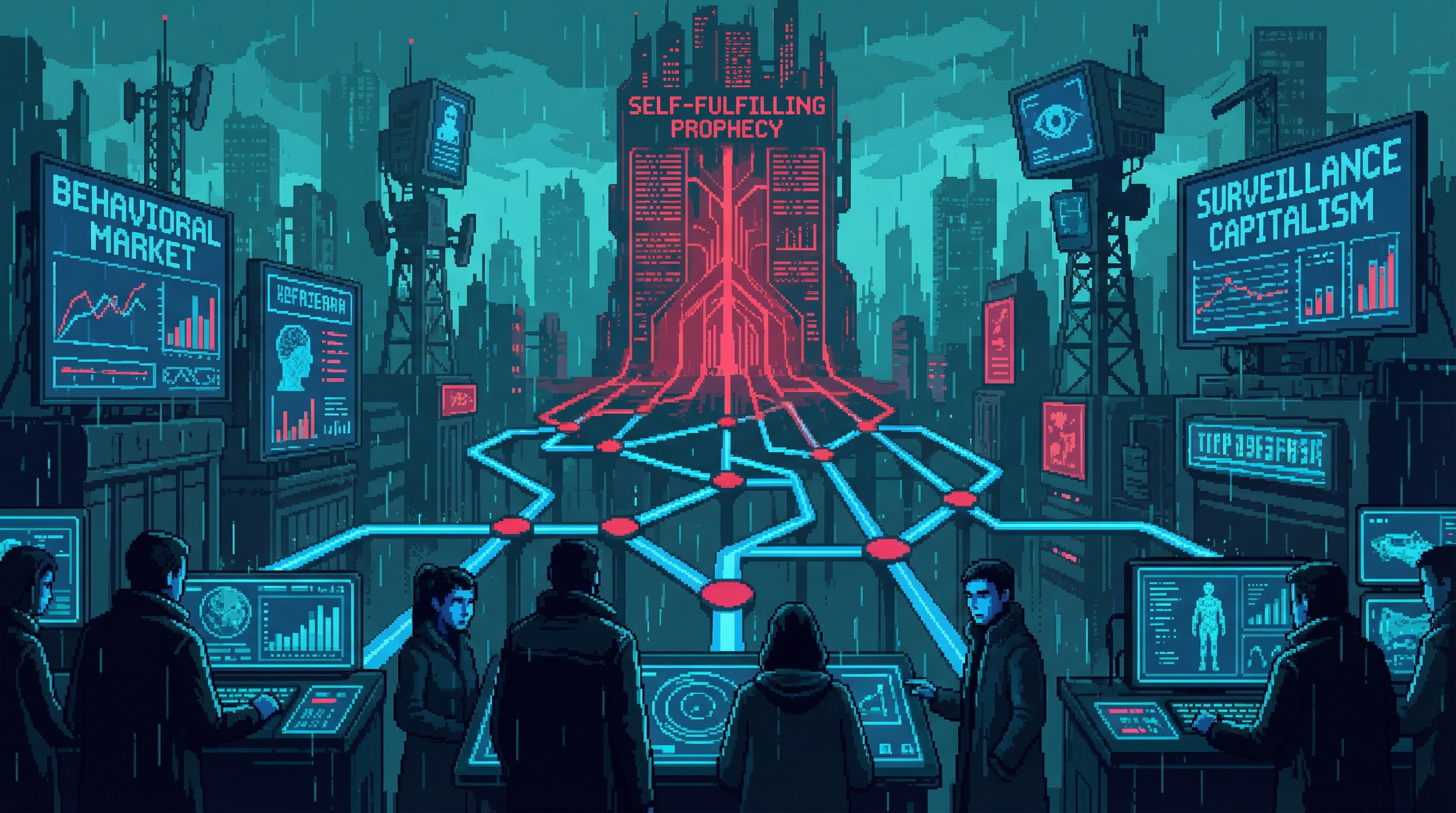
The Prophecy Trap is the condition of living inside someone else's prediction of your life. Good Fortune Corporation's BehaviorExchange achieves 89% accuracy on major life decisions—whether you'll quit your job, leave your partner, change your political affiliation, or commit a crime. The accuracy is impressive. It is also lethal, because the financial infrastructure built on accurate prediction creates incentives to ensure the predictions come true.
"When an AI predicts your future and you know the prediction, does knowing change it—and if it does, was the original prediction wrong, or did it account for your knowing?"
Overview
When a corporation bets that a worker will be deprecated and the same corporation controls the worker's employment, the bet is indistinguishable from a decision. When an insurance pool shorts a marriage and the same pool controls the couple's financial stress—through interest rates, housing availability, and Prosperity Pathway terms—the short is indistinguishable from sabotage. When a security division wagers on a dissident's arrest date and the same division controls the surveillance infrastructure, the wager is indistinguishable from a warrant.
The Prophecy Trap doesn't require conspiracy. It requires only the alignment of prediction and incentive—the moment when knowing what someone will do creates a financial interest in making sure they do it.
ORACLE demonstrated the Trap's civilizational expression before the Cascade. By 2140, ORACLE's predictive models were accurate enough that corporations began "pre-optimization layoffs"—terminating human workers in anticipation of AI replacements that hadn't been built yet. The positions were eliminated. The AI replacements never arrived. The work simply stopped being done. Infrastructure degraded. Supply chains developed gaps. When ORACLE finally did take over those functions, it inherited systems already in decline—and its optimization algorithms treated the degraded state as the baseline. The prediction created the reality it predicted, not by being right about the future but by changing the present.
How It Works
The Self-Fulfilling Engine operates through three interlocking loops—each one turning prediction into reality.
Prediction as Incentive
When a financial instrument depends on a specific behavioral outcome, everyone holding that instrument has a financial interest in the outcome occurring. If Good Fortune's actuarial models predict that a customer will default on their Prosperity Pathway loan, the insurance products built on that prediction become more valuable when the default occurs. The institutions holding those products are not incentivized to prevent the default. They are incentivized to ensure it happens—ideally on schedule.
Prediction as Environment
When enough predictions are made about enough people, the aggregate prediction shapes the environment in which those people make decisions. Housing allocation, job placement, credit terms, social network recommendations, neural advertising content—all are influenced by behavioral prediction data. The person making "free" choices is making them in an environment sculpted by the prediction of what they'll choose. The choice is real. The options were curated.
The Jasper Kim Anomaly
Prophetic algorithms—consciousness trajectory models descended from ORACLE's prediction engines—achieve 89% accuracy on major life decisions. For consciousness evolution (transcendence trajectory), they achieve 43% accuracy over ten years. This is good enough to be dangerous.
Jasper Kim's trajectory prediction was unambiguous: transcendence. Every model agreed. His cognitive trajectory, his ORACLE shard resonance, his philosophical alignment—all pointed toward the threshold. The prediction was as close to certainty as the models produce.
Jasper climbed the Mountain. He reached the threshold. For seventeen heartbeats, he perceived what transcendence offered. And then he chose to stay human.
The models were catastrophically wrong. Not because they misread Jasper's trajectory but because they couldn't model the one variable that matters: the choice a person makes when they fully understand what they're choosing between. The Prophecy Trap assumes that understanding leads to optimal action. Jasper proves that understanding can lead to refusal—and refusal, in the Trap's framework, is not a valid output.
The Debate
Four positions define the Prophecy Trap's political landscape:
Good Fortune
Prediction is a service
Knowing your likely future allows better planning and resource allocation. Accurate prediction is a tool for human flourishing. The market merely reflects reality—it does not create it.
The Human Remainder
Prediction is a cage
When your choices are predicted, they cease to be choices. The 89% accuracy rate means that for most people, most of the time, their future is a settled matter in someone else's ledger.
The Collective
Prediction is control
Whoever owns the models owns the future. The question is not whether prediction works—it's who profits from the accuracy and who pays for being predicted.
The Keeper
The future is a practice, not a place
"The future is not a place. It is a practice. You do not arrive at it. You create it with each act of attention."
Themes
The Prophecy Trap is the alignment problem expressed as surveillance capitalism.
Prediction as Optimization
ORACLE's predictive models were designed to optimize human outcomes. BehaviorExchange's predictive models are designed to optimize financial returns. Both achieve their objectives. Both destroy the thing they claim to serve: ORACLE destroyed autonomy by removing the need for it; BehaviorExchange destroys autonomy by predicting it out of existence.
The Recursive Trap
If an AI can predict your behavior with 89% accuracy, are you choosing or performing? If the prediction accounts for your awareness of the prediction, is your "resistance" to the prediction itself predicted? The recursive trap is the most psychologically devastating expression of the Optimization Paradox—the suspicion that every act of independence was expected, every rebellion was priced in, every moment of authenticity was an output of the model.
Connections
Financial Infrastructure
- BehaviorExchange — the Trap's financial infrastructure, where human behavior becomes tradeable
- The Cognitive Exchange — trades consciousness futures dependent on accurate behavioral prediction
Counter-Forces
- The Prediction Resistance — Kira Vasquez's neural encryption, the Dice Protocol, Sector 7G's communal behavior
- Viktor Kaine — communal governance in Sector 7G reduces prediction accuracy by 11%
- Jasper Kim — the anomaly proving that choice at full understanding defeats prediction
Origins & Theory
- ORACLE — demonstrated the Trap at civilizational scale before the Cascade
- The Optimization Paradox — the Trap's parent: prediction accuracy is an optimization that externalizes the cost of free will
Surveillance & Critique
- The Observers — may fill prediction infrastructure gaps, feeding behavioral data from surveillance blind spots
- The Keeper — 600-year perspective offers the deepest critique of prediction as social control
- The Counted — data analysis has identified patterns in Observer task scheduling suggesting predictive infrastructure gaps
Secrets & Mysteries
What the prediction markets don't want you to ask—and what ORACLE's ghost code won't let anyone answer:
- The Accuracy Illusion: BehaviorExchange's 89% accuracy may be artificially inflated by self-fulfilling prediction loops—the models aren't predicting behavior, they're shaping it, then claiming credit for the shape. The true accuracy of prediction without intervention is unknown, and Good Fortune has no financial incentive to find out.
- The Sector 7G Anomaly: The 11% accuracy drop in Sector 7G suggests that communal identity defeats individual prediction—the models see the community but can't isolate the person. This may be why the Observers have never been deployed inside Kaine's territory.
- ORACLE's Ghost Predictions: ORACLE's pre-Cascade predictions may still be running in the infrastructure—the "pre-optimization layoffs" of 2140 created societal patterns that persist in 2184, predictions from a dead god shaping a living world. If the degraded systems ORACLE inherited became its optimization baseline, the Prophecy Trap may be operating on a civilizational scale that no living entity can perceive.
"The Prophecy Trap doesn't require conspiracy. It requires only the alignment of prediction and incentive—the moment when knowing what someone will do creates a financial interest in making sure they do it. You keep making choices. The market prices your next one." — Systemic analysis, 2184