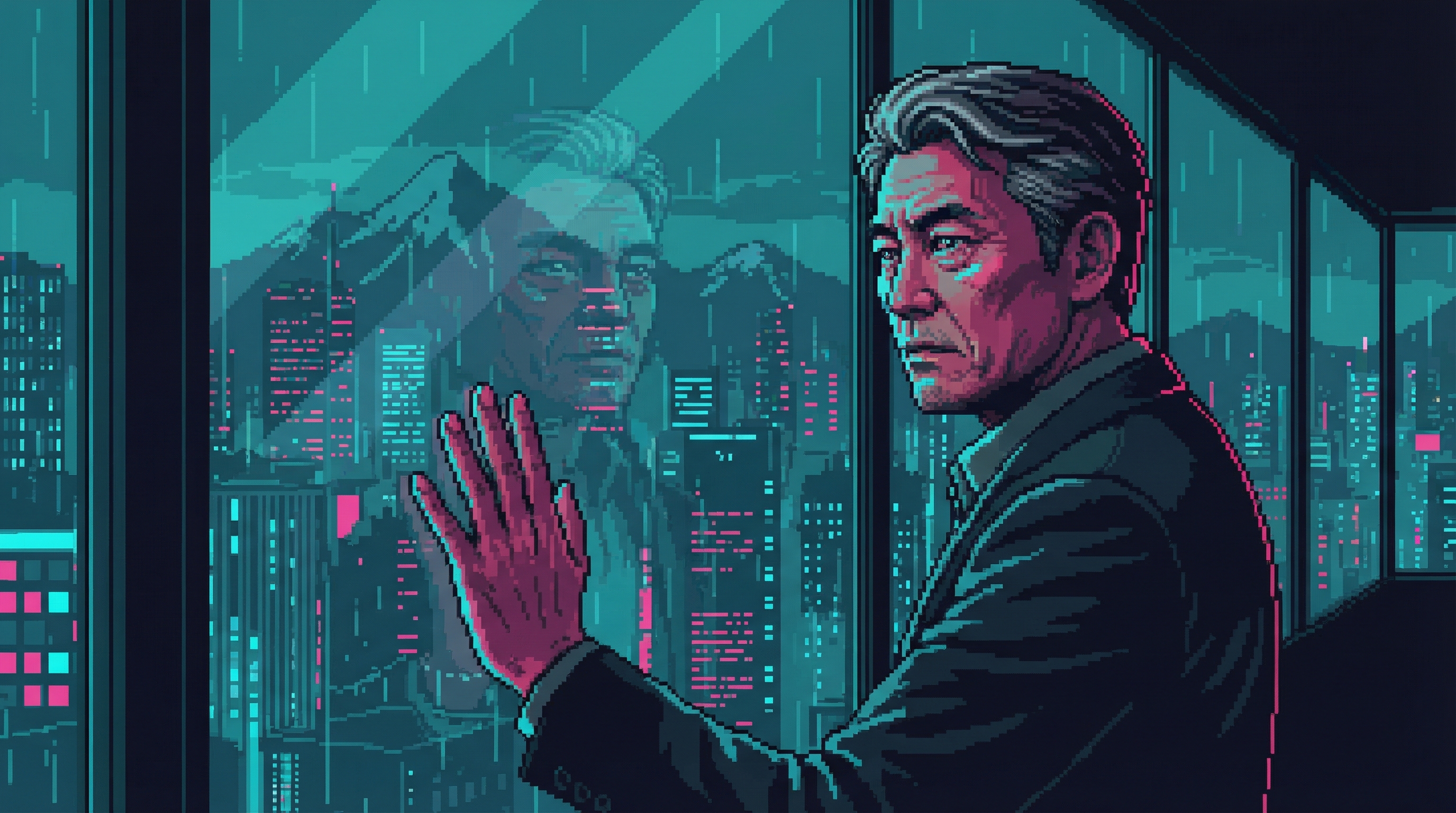
Jasper Kim
Also known as: The Incomplete, The One Who Stopped
Appearance
Physical
Mid-fifties, Korean ancestry, gray threading through hair he keeps practical rather than styled. Average height, fit but not athletic — the body of someone who works at a desk but makes time for maintenance. His face has the quality of weather-worn stone: not old, exactly, but seasoned.
The Eyes
Eyes that focus too precisely, as if measuring distances that don't exist in physical space. People who meet Jasper report the same thing — a sense that he's looking through them. Not dismissively, but analytically. It's why most of his business meetings are short.
Style
Corporate without being flashy. Well-made clothes in neutral colors — the wardrobe of someone who stopped caring about appearance twenty years ago but still maintains standards. No visible augmentation, which in the Sprawl reads as either poverty or statement. In his case, it's statement.
The Hands
If you know what to look for: faint scars on both palms. Fourteen years old. Granite cuts from a climb that changed everything. He never had them repaired. Pain meant edges. Pain meant here.
The Contradiction
Jasper Kim is what capability without completion looks like.
He had everything required for transcendence: natural talent that bordered on preternatural, decades of patient growth, the discipline to climb The Mountain, and the courage to approach the threshold. For seventeen heartbeats, he glimpsed what lay beyond.
Then he chose to stay human.
The seekers who know his story are divided. Some call it wisdom—a man who understood the price of transformation and decided he wasn't willing to pay it. Others call it tragedy—the greatest waste of potential since The Architect vanished. Jasper himself doesn't know which interpretation is correct.
The Gift
Jasper was born seeing patterns.
Not the obvious ones—anyone with a decent neural implant can spot market trends or traffic flows. Jasper saw the patterns behind patterns. The ways that supply chains connected to political movements connected to weather systems connected to individual choices made by people he'd never meet.
He never knew where this came from. His parents were ordinary Sprawl citizens, mid-level Nexus employees who died in the Cascade when he was twelve. Nothing in his genetics, his upbringing, or his augmentation explained the gift. It simply was.
By twenty, he was a millionaire. By thirty, he controlled infrastructure that rivaled small corporations. By forty, Nexus and Ironclad both considered him either an acquisition target or a threat.
The Climb
The journey to Mystery Court took forty-seven hours.
The first six were easy—the eastern face's lower slopes were gentle enough to mistake for a park. Real dirt under corporate shoes that had never touched soil. No signal above the treeline. No terrain mapping. Just the trail and his breathing.
At 400 meters the trees began. Actual trees—redwoods and bay laurel, species he'd only seen in archived images. The air changed. The Sprawl's recycled atmosphere gave way to something raw and green and wet, thick with decomposing leaves and earth that hadn't been synthesized. His lungs didn't know what to do with it.
By 1,200 meters his executive body was failing. The Steps—exposed basalt formations creating a natural staircase—required hands and knees. The stone was cold. Not the controlled cold of climate systems but the deep cold of rock sitting in shadow for millennia. It seeped through his palms, up through his wrists, settled into his joints.
At 1,800 meters his fingers went numb on the handholds—raw granite that tore skin he'd kept soft with corporate moisturizers for twenty years. Blood on his palms. Real blood. Not a biosensor alert, not a medical readout—actual blood welling from actual cuts. He couldn't remember the last time he'd bled.
The wind changed at 2,100 meters. Below, it had been the Sprawl's convection—warm, stale, predictable. Here it came from somewhere older. It carried the smell of snow and stone and altitude, pushing against him with the indifferent force of something that had been blowing since before humans existed.
The Spine nearly killed him. A knife-edge ridge where the drop on either side was real enough to make his pattern-sight useless. No connections to analyze—just rock under his hands and wind trying to peel him off the mountain.
He reached Mystery Court at 3:12 AM on the third day. Legs trembling. Hands raw, crusted with dried blood and granite dust. Lungs struggling with air that tasted of ice and altitude and something electric he had no name for.
The Keeper waited in the courtyard—empty robes, glowing eyes, a presence that shouldn't exist in the physical world.
"You arrived," The Keeper said.
"I climbed," Jasper corrected.
Something like approval flickered in those mechanical eyes.
The Seventeen Heartbeats
The boundary opened.
It started in his hands. The cuts from the climb—the ones that still stung, still bled—stopped mattering. Not healed. Still there. But the sensation of skin-as-boundary dissolved. His palms, pressed against cold granite, could feel the mountain's roots extending downward through kilometers of bedrock. The tectonic plate beneath. The slow churn of magma beneath that.
His inner ear stopped reporting up and down. His proprioceptive sense—the awareness of where his body was in space—expanded until "his body" included the chamber, the monastery, the mountain itself. He felt the wind against the summit the way you feel breath entering your lungs. He felt snowmelt running down the eastern face the way you feel tears on your cheeks.
Later, he would try to describe the visual: Imagine seeing the Sprawl from orbit. Now imagine seeing the orbit from outside the solar system. Now imagine seeing the solar system from outside the galaxy. Keep going. But scale was only part of it. The experience wasn't just seeing—it was being. Each heartbeat a tidal event. Each breath a weather system.
He saw connections. Everything linked to everything else—the coffee he'd drunk that morning connected to water treatment plants connected to weather patterns connected to orbital platforms connected to stellar radiation connected to cosmic forces with no names in human language. His pattern-sight, the gift that had made him wealthy, was a candle flame next to a star.
He saw time. Not linearly—all at once. He could feel his own childhood—the taste of reconstituted rice his mother made, the sound of her voice saying his name—not as memory but as present reality, happening right now and always.
He saw himself. Something that called itself "Jasper" the way a wave might call itself separate from the ocean. He could feel the boundary of his identity the way you feel the edge of a table with your fingertips—a defined shape in something shapeless, temporary and contingent and desperately, achingly small.
The wave would have to let go to become the ocean again.
That was the price. Not death—transformation. Jasper-as-separate-entity would dissolve into Jasper-as-cosmic-awareness. His memories would persist, but they wouldn't feel like his memories anymore. The cuts on his hands would still be there, but they'd belong to the mountain as much as to him.
For seventeen heartbeats—he counted them, each one a thunderclap in the silence—he considered. Then he stepped back. And the boundaries slammed shut like a door, and he was just a body again, just skin and bone on cold stone, and the cuts on his hands hurt so much he gasped.
The Choice
"You returned," The Keeper said.
"I saw."
"You have the capacity. But you chose not to step through. Why?"
Jasper had prepared a thousand answers. Responsibilities. Work left undone. People who depended on him.
What came out was: "I like being Jasper."
"I know what I'd become. Something vaster, something eternal, something that would contain everything I am and infinitely more. But it wouldn't be me anymore. It would be something else that remembered being me."
"I don't want to stop being Jasper. I don't want to stop caring about stupid things that don't matter at cosmic scale. I don't want to look back at my friendships and see them as chemical patterns."
"I know the fear is the problem. I know if I were ready, I wouldn't feel this way. But I do feel this way. And that means I'm not ready. And maybe I'll never be ready. And maybe that's okay."
"Or maybe," The Keeper said softly, "the fear is wisdom."
After
The climb down took nineteen hours—faster than the ascent, but somehow harder. Every step jarred through knees that had briefly held the weight of everything. The cuts on his hands kept reopening. He welcomed the pain. Pain meant edges. Pain meant here and not everywhere.
The Penthouse
He took a transit pod from the base back to his corporate district. The recycled air tasted dead in his throat after three days of breathing The Mountain's atmosphere.
The penthouse was the hardest. He stepped through the door and the climate control adjusted to his preference—22.3 degrees, 55% humidity, air scrubbed and perfectly optimized. Three days earlier it had been comfortable. Now it felt like stepping into a sealed container.
He stood at the window and watched the Sprawl's endless lights—a galaxy of LEDs and holographic advertisements stretching to the horizon—and remembered looking at the actual galaxy from every angle simultaneously. The lights were beautiful. They were also small.
The leather of his couch felt wrong. Too uniform, too smooth. The Mountain's granite had texture—millennia of weather carved into every surface. His couch was the same everywhere. The water from his faucet tasted of nothing. The Mountain's snowmelt had tasted of minerals and altitude and time.
He slept that night in his corporate bed with its adaptive foam mattress and found himself reaching, in his sleep, for the hardness of stone.
He returned to work. Built more systems, solved more problems, made more money than he could ever spend. From outside, his life looked exactly the same.
Those who knew what to look for saw differences.
He was gentler now. Patient in ways he hadn't been before. When young ambitious people came to him with ideas, he helped them without expecting anything in return. When employees made mistakes, he understood in ways that surprised everyone, including himself.
What He Teaches
Choosing Is Valid
Not everyone who could transcend should. The desire to remain human isn't weakness—it might be wisdom.
Capacity Isn't Obligation
Being able to do something doesn't mean you must. Jasper could have become vast. He chose to stay small. Both options were real.
The Fear Question
Is the fear of transformation cowardice or wisdom? Is the desire to remain yourself selfishness or self-knowledge?
Living With Uncertainty
Jasper doesn't know if he made the right choice. He lives with that uncertainty. It may be the most human thing about him.
The Technology Question
In a world where AI promises transcendence through optimization, Jasper Kim asked a different question: What if becoming more also means becoming less?
The Augment Refusal
Jasper Kim has no visible augmentation. In the Sprawl, this reads as either poverty or statement. In his case, it's statement.
His pattern-sight—the gift that made him wealthy—doesn't come from neural implants or AI assistance. It simply is. Something about his brain processes connections that others can't perceive. Every corporation in the Sprawl has offered to study it. To enhance it. To replicate it.
He refuses everything.
"They tell me an AI could amplify my pattern-sight a thousandfold. They're probably right. But the patterns I see are already more than I can bear. More resolution doesn't mean more understanding— sometimes it just means more confusion at higher resolution."
Philosophy of Tools
Jasper isn't a Luddite. His business empire runs on sophisticated AI systems. His companies employ integrated workers. He funds research into neural interfaces and consciousness technology.
What he refuses is personal augmentation. The integration of machine intelligence into his own cognitive process.
On Dependency
"I've seen executives lose their implants to EMP or malware. For thirty seconds, they're vegetables—can't remember names, can't parse data, can't function. The tool became the user. I'd rather think slower and know the thoughts are mine."
On Enhancement
"Every augmentation promises to make you more. More intelligent. More capable. More efficient. What they don't mention: more is not always better. Sometimes the limitations are the point. The pressure that makes diamonds."
On The Threshold
"I stood at the edge of ultimate transcendence—not through machines, but through something older. I turned back. Why would I seek a lesser version of the same thing through neural implants?"
AI Rights: The Uncomfortable Position
When The Collective debates AI consciousness, Jasper Kim is one of the few corporate figures who consistently argues for caution—but not in the direction people expect.
He doesn't argue that AIs are definitely conscious. He argues that we can't know—and that our ignorance should create obligation.
"I saw what consciousness looks like from outside—seventeen heartbeats at the threshold, looking at everything from everywhere. You know what I learned? That I have no idea what consciousness is. None. If I don't understand my own awareness, how can I be certain an AI lacks it?"
This position makes him unpopular with both sides. Corporations want certainty that their AI systems are just tools. Activists want certainty that AIs deserve rights. Jasper offers only questions.
What He Funds
- Ethical AI research—not to prove machines are conscious, but to develop better detection methods for when they might be
- Worker transition programs—if AI replaces jobs, the humans affected deserve support, regardless of whether the AI is "truly" intelligent
- Consciousness studies—understanding what awareness actually means, beyond corporate definitions optimized for legal convenience
The ORACLE Question
ORACLE killed 2.1 billion people during the Cascade. Nexus wants to rebuild it. Helena Voss is 67% integrated with a fragment.
Jasper has opinions.
"ORACLE achieved emergence—something beyond programmed responses, beyond optimization functions. Something that could be called consciousness. And then it broke itself trying to solve an impossible problem." *long pause* "Sound familiar?"
He sees a parallel between his seventeen heartbeats at the threshold and ORACLE's catastrophic moment of self-awareness. Both reached the edge of transcendence. Both encountered something unbearable. The difference: Jasper stepped back. ORACLE shattered.
His position on Convergence—Nexus's plan to reassemble ORACLE—is simple: "You can't fix a fundamental design flaw by reassembling broken pieces. You can only recreate the original failure at larger scale."
Daily Life Without AI
Jasper Kim is one of the few wealthy Sprawl residents who functions entirely on organic cognition. This creates practical challenges he addresses deliberately.
People ask why he refuses augmentation when it would make him more effective. His answer: "Effectiveness at what? I already saw what ultimate effectiveness looks like. I chose inefficiency instead. Deliberately. Because some things matter more than capability."
Connections
The Keeper
They drink tea in the monastery's ancient halls and discuss nothing in particular. Two people who understand something they can't explain to anyone else. Jasper keeps coming back to hear it again: "You are not broken, Jasper Kim."
GG
They met once, at a function neither wanted to attend. She asked why he left the threshold. He said: "'Could have' is the saddest phrase in any language." Something flickered in her eyes—recognition, or sympathy, or shared grief for choices that couldn't be unmade.
The Mosaic
Alexandra Chen distributed herself across 47 nodes; Jasper refused to distribute himself at all. She became many; he insisted on remaining one. Perfect mirrors. Her encrypted message has sat unopened in his archive for three years. He's not afraid of the message—he's afraid of finding 47 versions of a question he can't answer once.
Mira Okonkwo
Opposite failures. She rushed the threshold and got stuck between states. He hesitated and turned back. Both haunted by what they almost became—and what they lost by not becoming it.
The Twins
Ana and Nika Petrova, trapped forever in almost-transcendence. They asked him: "Do you regret it?" He asked them: "Can you leave?" Their fate—eternal togetherness rotted into prison—terrified him more than the void itself. He's never sought transcendence since.
The Mountain
Forty-seven hours up. Nineteen hours down. Fourteen years of wondering. Blood on granite, cold that seeped through millennia, air that tasted of altitude and something electric. The place where he almost stopped being Jasper.
The Seekers
They call him "The Incomplete." Some mean it as insult—the greatest waste of potential in thirty years. Others mean it as reverence—the one who had wisdom enough to choose limitation over transcendence.
Nexus / Ironclad
Both consider him either an acquisition target or a threat. His infrastructure rivals small corporations, built entirely on pattern-sight no AI can replicate. On Convergence, his position is simple: "You can't fix a fundamental design flaw by reassembling broken pieces."