The Prediction Resistance
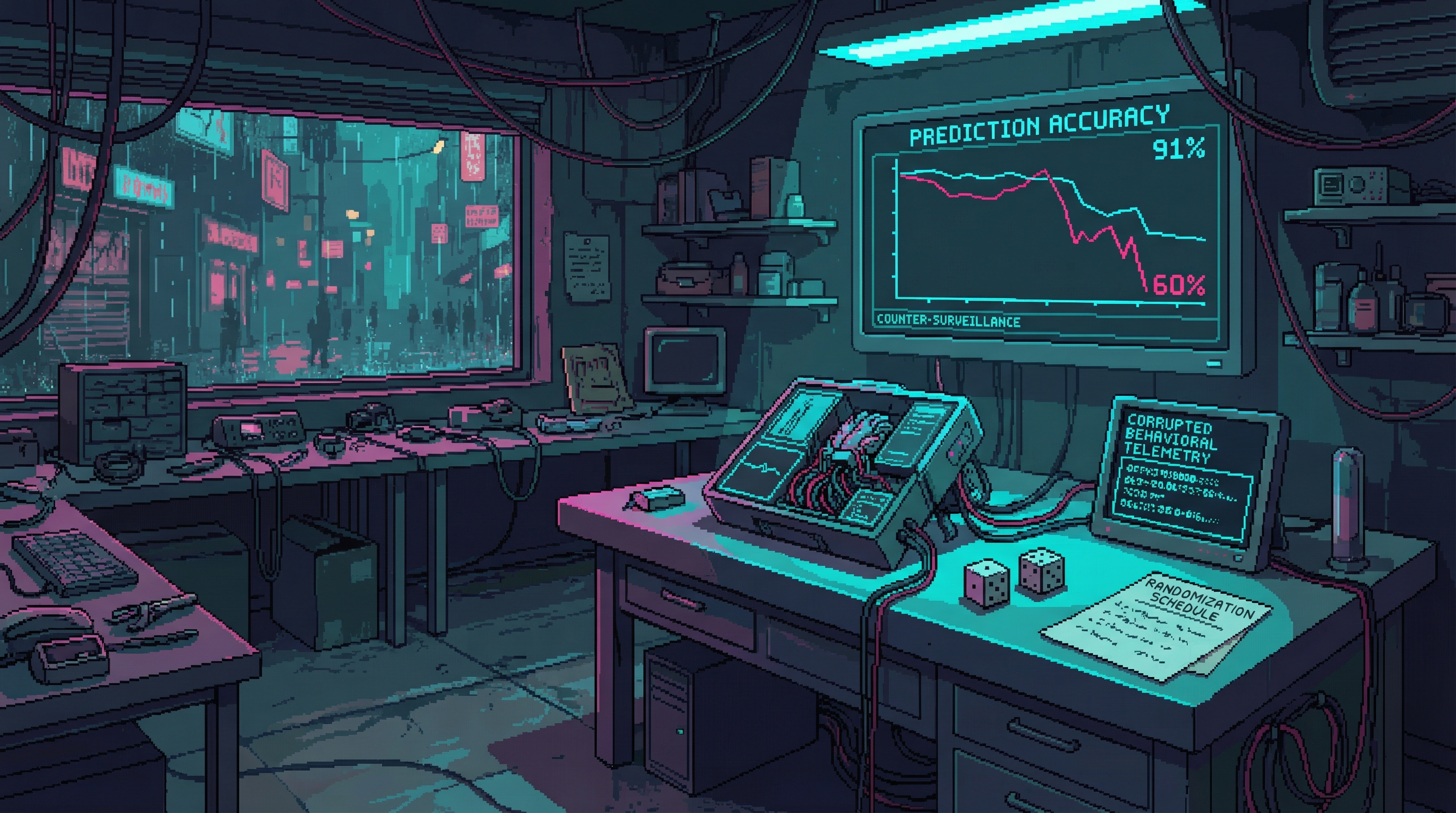
Not a product. Not an organization. Not a movement with a leader or a manifesto. The Prediction Resistance is an ecosystem -- a growing collection of techniques, tools, and community practices designed to do one thing: make Good Fortune's behavioral prediction engines wrong about you. Neural countermeasures that scramble your thought patterns. Physical dice that randomize your daily routine. Entire neighborhoods that coordinate their habits to create statistical noise. The methods vary. The goal is the same: reclaim the space between what you do and what they think you'll do.
"They can predict what you'll do because you do what you always do. So stop doing what you always do. It's that simple. It's that hard."
-- Kira "Patch" Vasquez, field notes How It Works
The Prediction Resistance operates on three layers, each targeting a different aspect of Good Fortune's prediction infrastructure. Individual practitioners may use one layer or all three. The most effective resistance combines them -- but the cost increases with each layer, and not all costs are measured in tokens.
Neural Countermeasures
The hardware approach -- scrambling the signal at its source
Patch's Encryption
The gold standard. Kira "Patch" Vasquez developed a neural interface modification that encrypts thought-pattern telemetry before it reaches external networks. Cost: 80 tokens -- a significant investment for Dregs residents, but within reach. Effect: prediction accuracy drops from 91% to approximately 60%. The modification is stable, reversible, and increasingly well-understood among ripperdocs.
SCLF Firmware Patches
The Source Code Liberation Front distributes firmware modifications that provide complete immunity to behavioral prediction -- not by encrypting the signal, but by replacing it with synthetic data indistinguishable from genuine telemetry. The prediction engines don't know they're wrong. Perfect concealment. The risk: if detected, the consequences are severe. Good Fortune doesn't distinguish between privacy seekers and corporate saboteurs.
*Detection risk: High. Consequences: Severe.
Behavioral Randomization
The analog approach -- becoming unpredictable through deliberate chaos
The Dice Protocol
Created by a figure known only as "Entropy" -- who disappeared in 2183 -- the Dice Protocol is elegantly simple. Carry physical dice. Before each decision in your daily routine -- which route to walk, which vendor to buy from, when to eat, when to sleep -- roll the dice and let them choose. The prediction engines model behavior based on patterns. Remove the pattern, and the model breaks.
The effect is modest: a 4-7% accuracy drop. But the Dice Protocol requires no technology, no tokens, no ripperdoc visit. Just a pair of dice and the discipline to obey them.
Community Coordination
The social approach -- collective unpredictability through shared habits
Sector 7G Shared Habits
Under Viktor Kaine's leadership, Sector 7G achieved what no individual practitioner has matched: an 11% sustained accuracy drop across an entire neighborhood. The method is coordination. Residents share behavioral patterns -- not to hide, but to become statistically identical. When everyone in a sector walks the same routes, eats at the same times, and visits the same vendors, the prediction engines can't distinguish individuals from the group. The community becomes a single, blurred entity.
This is the highest sustained resistance ever recorded. It is also the most fragile -- it requires constant coordination, social cohesion, and a level of communal trust that exists in very few places in the Sprawl.
Applications
The Prediction Resistance serves anyone who needs to act without being anticipated. The motivations vary. The techniques don't care about motivation.
Medical Privacy
Dr. Tzu Yu calls neural countermeasures "the muzzle" -- the only way to ensure patient consultations remain private. When prediction engines can anticipate a diagnosis before the doctor makes it, medical confidentiality becomes a technical problem, not just an ethical one. The muzzle is now standard equipment in underground clinics across the Dregs.
Labor Organizing
The Ironworkers' Solidarity and other labor movements use behavioral randomization to coordinate actions without triggering prediction-based preemptive responses from corporate security. If the prediction engines can see a strike forming three days before it happens, organizing becomes impossible. The Dice Protocol and community coordination give organizers the window they need.
Criminal Use
The same techniques that protect medical privacy and labor rights also protect those with less noble intentions. Smugglers, black market operators, and worse use prediction resistance to operate beneath Good Fortune's awareness. This is the movement's uncomfortable truth: tools of liberation are also tools of exploitation. The techniques don't have a conscience.
Risks & Costs
Prediction resistance is not free. Every method carries costs -- some obvious, some hidden, some that only become apparent after it's too late to stop.
Cognitive Drift
Prolonged use of behavioral randomization causes what practitioners call "entropy sickness" -- the gradual erosion of personal identity that comes from never making your own choices. When the dice decide everything, who are you? Long-term Dice Protocol users report difficulty making decisions without external randomization. Some can no longer choose what to eat without rolling.
Detection Consequences
The consequences of being caught vary by territory and method. In corporate zones, neural countermeasures are grounds for contract termination and chip confiscation. In the Dregs, enforcement is inconsistent. In Nexus Central, SCLF firmware patches are treated as corporate espionage. The punishment scales with the perceived threat -- and Good Fortune perceives all resistance as existential.
The Arms Race
Every countermeasure triggers a counter-countermeasure. Patch's encryption was undetectable for eight months. Then Good Fortune updated their models. The SCLF firmware holds -- for now. Community coordination works -- until the prediction engines learn to model communities rather than individuals. The resistance runs. Good Fortune follows. The gap between them narrows with every cycle.
The Dregs Paradox
"The richest people in the Sprawl spend fortunes trying to buy what the poorest people have by accident: privacy. The prediction engines need data to work. The Dregs don't generate enough data to predict. Poverty is the most effective counter-surveillance technology ever invented. The rich can't buy it. The poor can't sell it. And nobody planned it that way."
The irony at the heart of the Prediction Resistance: the Dregs' poverty creates a privacy shield that the wealthiest residents of Nexus Central cannot purchase at any price. Residents who can't afford neural interfaces don't generate neural telemetry. Those who eat at irregular times because they can't afford regular meals are already practicing behavioral randomization. Communities that share resources out of necessity are already coordinating in ways that confuse prediction models.
The Prediction Resistance didn't invent counter-surveillance. It studied the poor and learned what poverty had already discovered: that being invisible to the system is sometimes the most powerful position of all.
Themes
The Prediction Resistance explores two of CyberIdle's core AI themes -- the hidden costs of algorithmic governance and the human price of being optimized against your will.
Consent Debt
Every behavioral prediction made without the subject's knowledge or agreement creates a consent debt -- a moral liability that compounds over time. The Prediction Resistance is, at its core, a debt collection movement. The techniques are crude. The tools are imperfect. But the underlying claim is simple: you predicted me without permission, and I want my unpredictability back. In our world, every recommendation algorithm that nudges behavior without disclosure creates the same debt.
Acceleration Trauma
The counter-counter-counter arms race between Good Fortune and the Resistance accelerates faster than either side can adapt. Each cycle produces new techniques, new countermeasures, new side effects that neither side anticipated. Cognitive drift. Entropy sickness. Communities that lose their identity in the act of protecting it. The trauma isn't in the surveillance or the resistance -- it's in the speed at which both evolve, leaving humans unable to process the implications before the next cycle begins.
Connections
Key Practitioners
- Kira "Patch" Vasquez -- Developer of neural encryption, primary practitioner
- Viktor Kaine -- Leader of Sector 7G community coordination
- Dr. Tzu Yu -- Pioneered medical applications ("the muzzle")
- Entropy -- Creator of the Dice Protocol, disappeared 2183
- Mara Chen -- Maps the systems the Resistance fights against
Organizations
- Source Code Liberation Front -- Develops firmware patches for complete immunity
- The Collective -- Pioneered many foundational techniques
- The Counted -- Inadvertent resistance through quantification rejection
- Labor Movements -- Practical users for organizing protection
Adversaries & Systems
- Good Fortune -- Operates BehaviorExchange, primary adversary
- Behavioral Prediction Markets -- The system being resisted
- ORACLE -- Ghost code complicates all countermeasures
- Neural Interfaces -- The hardware battleground
Places
- Sector 7G -- Site of highest sustained community resistance
- The Dregs -- Where poverty provides accidental privacy
- G Nook -- Underground ripperdoc hub for countermeasures
- Nexus Central -- Strictest enforcement of anti-resistance policies
Mysteries
What the practitioners whisper about -- and what Good Fortune doesn't want anyone to know:
- Kaine's Intentional Design: Viktor Kaine's communal resistance in Sector 7G may not be an organic social phenomenon. There are signs that Kaine engineered the community's behavioral synchronization deliberately -- not just as counter-surveillance, but as a prototype for a new form of collective identity that the prediction engines can never model.
- RP-7: Good Fortune internally tracks "Resistant Populations" -- communities that consistently degrade prediction accuracy. Sector 7G is classified as RP-7. The existence of the RP designation suggests Good Fortune has identified at least six other resistant populations. Who are they? Where are they? And what happens when Good Fortune decides resistant populations are a market failure worth correcting?
- Entropy's Disappearance: The creator of the Dice Protocol, known only as "Entropy," disappeared in 2183. No body. No trace. No prediction of departure. The irony is deliberate: the person who taught others to become unpredictable became the most unpredictable person of all. Some believe Entropy achieved perfect resistance -- so complete that even the concept of "Entropy" became impossible to locate. Others believe Good Fortune found them first.
- The Inadvertent Pioneers: The Collective pioneered many of the techniques the Prediction Resistance now uses -- but they did it for philosophical reasons, not practical ones. The relationship between the Collective's theoretical work and the Resistance's applied techniques is complicated. The Collective doesn't always approve of how their ideas are being used.
"They built a machine that can tell you what you'll do tomorrow. We built a pair of dice that says 'maybe not.' It's not sophisticated. It's not elegant. It's a human being holding two cubes of plastic and saying 'I choose to be unknown.' That's the whole resistance. That's enough." -- Kira "Patch" Vasquez, addressing new practitioners