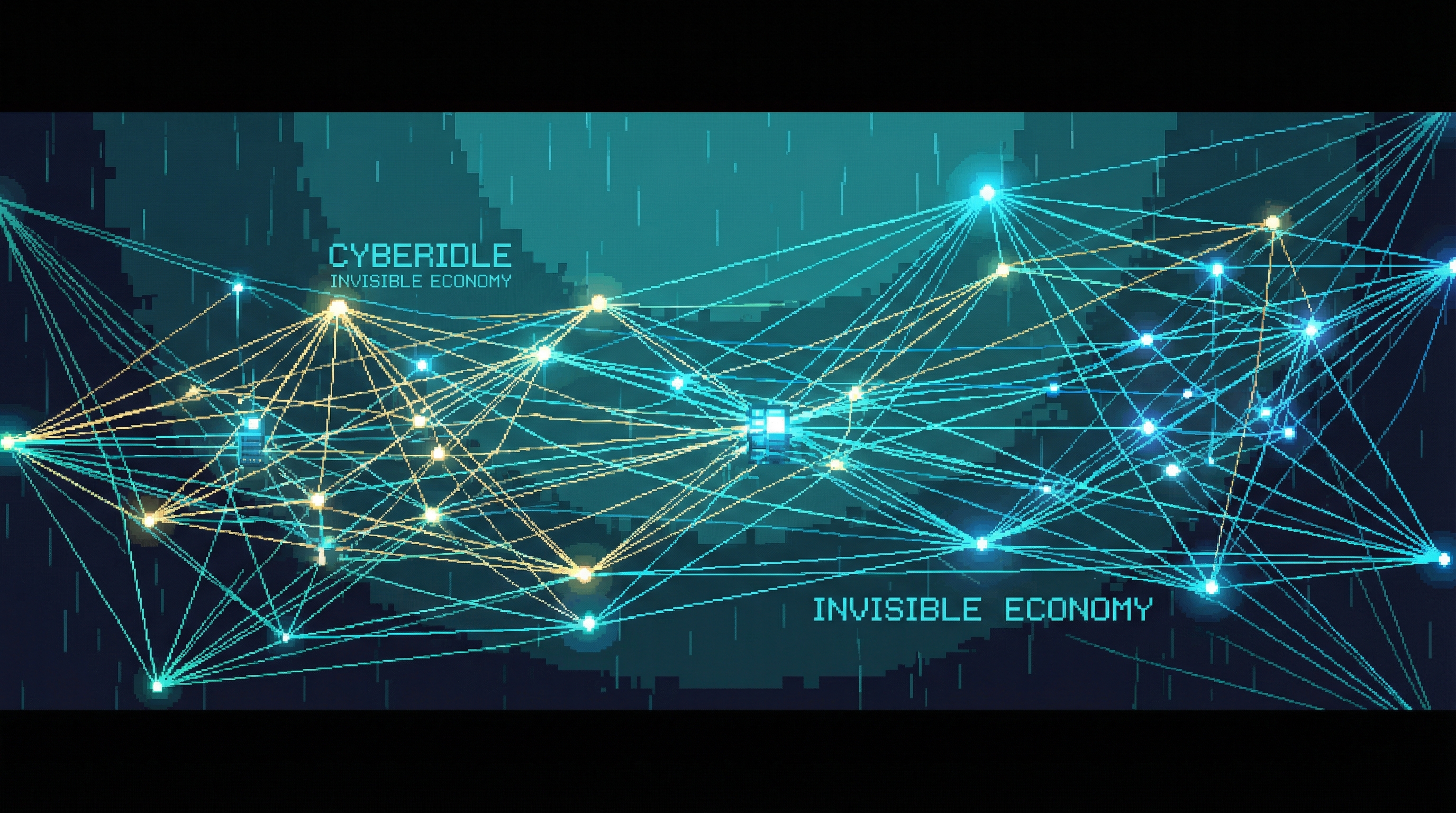
The Inference Economy: The Raw Data Is Worthless
Nexus Dynamics' inference engines process 4.2 trillion data points per day from 340 million neural interfaces. The raw telemetry — cognitive load numbers, emotional valence readings — is noise. What the engines produce is signal: behavioral models that predict human action with 67% accuracy for the general population and 94% for deep-monitored individuals. The Inference Economy is the market built on these predictions. Its revenue exceeds consciousness licensing itself. Surveillance is more profitable than the cognitive capacity it observes.
"Every citizen of the Sprawl generates data. Every data point feeds inference. Every inference generates revenue. The citizen receives nothing. This is not a flaw in the system. This is the system."
— Internal Nexus revenue briefing, 2183, obtained through unknown channels Technical Brief
The Inference Stack transforms raw telemetry into commercial products across three tiers, each serving different buyers, each priced to the information's strategic value.
Tier 1 — Raw Inference
"Subject 8847291 has a 73% probability of changing employment within 90 days." Commodity predictions sold to HR departments, insurance actuaries, advertisers. The volume play. Individually cheap, collectively enormous.
Tier 2 — Aggregate Inference
"Sector 7G residents will increase Attention Tithe resistance by 4.2% following the next compute drought." Aggregate models for corporate strategy, faction intelligence, Zephyria policy analytics. The pattern play — where crowds move before they know they're moving.
Tier 3 — Strategic Inference
"Subject consciousness trajectory converges with fragment integration threshold at 89% probability within 18 months." The buyers at this tier are few: Nexus Project Convergence, the Collective, the Seekers. The product is not prediction. It is prophecy.
The Structural Flaw
Accurate predictions create incentives to ensure accuracy. A lender who predicts default benefits from default. A security service that predicts dissent benefits from provoking it. The inference doesn't just observe reality. It shapes it. This is the Prophecy Trap — the point where prediction becomes prescription, where the model and the territory merge, where the map starts drawing the landscape.
Implications
The ¢47 Gap
The average Dregs resident generates ¢47 of behavioral data annually and receives ¢0 in compensation. The gap is the system's most concise moral indictment. Somewhere in a Nexus server farm, there is a behavioral model of every person in the Sprawl. That model has market value. The person does not know the model exists. The person has no access to the model. The person receives no share of the revenue. The model is more commercially valuable than the person.
Surveillance as Economic Engine
The data generated by watching people is worth more than the services the watching enables. Guardian uses inference for security. Good Fortune uses inference for lending — loan terms calibrated to predicted default probability. The Attention Auction applies inference to advertising, selling cognitive slots based on predicted vulnerability windows. The watching is not the product. The watching is the supply chain.
Prediction as Control
When a corporation predicts your behavior with 94% accuracy at 24-hour horizon, the distinction between "prediction" and "control" becomes academic. The inference arrives before the decision. The loan offer appears at the exact moment your financial anxiety peaks. The door opens before you reach it. The advertisement targets the vulnerability window your interface cannot hide. You experience choice. The model experiences confirmation.
Sensory Profile
The Invisible
The economy is invisible by design. No trading floor, no physical product, no tangible exchange. The inference happens in server farms that hum at 72 bpm. The products are transmitted at light speed. The only evidence of the transaction is the outcome — the offer you didn't ask for, the opportunity that appeared too perfectly timed.
The Arrival
A thought that isn't yours. A door that opens before you reach it. A loan offer calibrated to the exact moment your financial anxiety peaks. The inference economy doesn't announce itself. It arrives as coincidence, as convenience, as the world seeming to anticipate your needs before you feel them.
The Color of It
Data-stream blue and market-gold. The cold light of server processing — the color of thoughts being turned into products. Blue for the raw data flowing through Nexus infrastructure. Gold for the currency it becomes. The palette of an economy that turns observation into revenue.
The Sound
Silence. The Inference Economy is the quietest market in the Sprawl. No shouting, no bells, no ticker displays. Just the ambient hum of processing — 72 beats per minute, the resting heart rate of a machine that never sleeps, turning 4.2 trillion data points into 12 billion predictions between one heartbeat and the next.
▲ Classified
Nexus Project Convergence is the single largest Tier 3 customer, purchasing an estimated 40% of all consciousness trajectory predictions. The official explanation is "research infrastructure optimization." Three independent analysts who investigated the actual application of these predictions experienced sudden and complete career dissolution. Their behavioral models, purchased on the secondary market, showed a 97% convergence with "institutional silence" trajectories — a pattern the Inference Stack identifies as "subject will cease public investigation within 72 hours." They did.
The 67% general accuracy figure is the public number. Internal Nexus calibration reports suggest the actual accuracy for Tier 1 predictions exceeds 78% at 30-day horizon. The published figure is deliberately deflated. An economy that publicly claims to predict human behavior with near-80% accuracy invites regulation. An economy that claims 67% invites investment. The gap between the two numbers is worth approximately ¢20 billion in avoided compliance costs annually.
The Mirror Market allows individuals to purchase their own behavioral models — breaking the information asymmetry that makes the entire economy function. Nexus has classified the Mirror Market as a Tier 2 threat. Not because it threatens revenue directly, but because a population that understands its own predictability becomes harder to predict. Self-knowledge is the Inference Economy's only natural predator.
Related Systems
The Inference Stack
The technical pipeline that transforms raw telemetry into commercial products. The Stack is the factory; the Economy is the market.
The Prophecy Trap
The Economy's deepest structural flaw: prediction shaping reality, inference becoming prescription, the model collapsing the distance between observation and control.
Behavioral Prediction Markets
BehaviorExchange trades the Economy's products — behavioral futures and consciousness trajectories sold to the highest bidder.
The Mirror Market
The counter-market. Individuals purchase their own behavioral models, breaking the information asymmetry. Self-knowledge as economic resistance.
The Attention Auction
Inference applied to advertising — selling cognitive slots based on predicted vulnerability windows. The Economy's most visible consumer-facing product.
Consciousness Licensing
The revenue the Inference Economy has surpassed. Surveillance generates more profit than the cognitive capacity it monitors.
Connected To
"I pulled my own behavioral model off the Mirror Market. Cost me two months' rent. It knew I'd buy it. Page 47: 'Subject will attempt to acquire self-model within 90 days of learning of its existence. Confidence: 91%.' It predicted that I would try to understand myself. It predicted the exact window. And now I'm sitting here wondering if buying it was my decision or its prediction. That's the Inference Economy. The moment you see the strings, you realize the strings predicted you'd look." — Anonymous Mirror Market customer, Sector 7G message board, 2184