Behavioral Prediction Markets
Economic/Social System / Surveillance Capitalism / Behavioral Economics
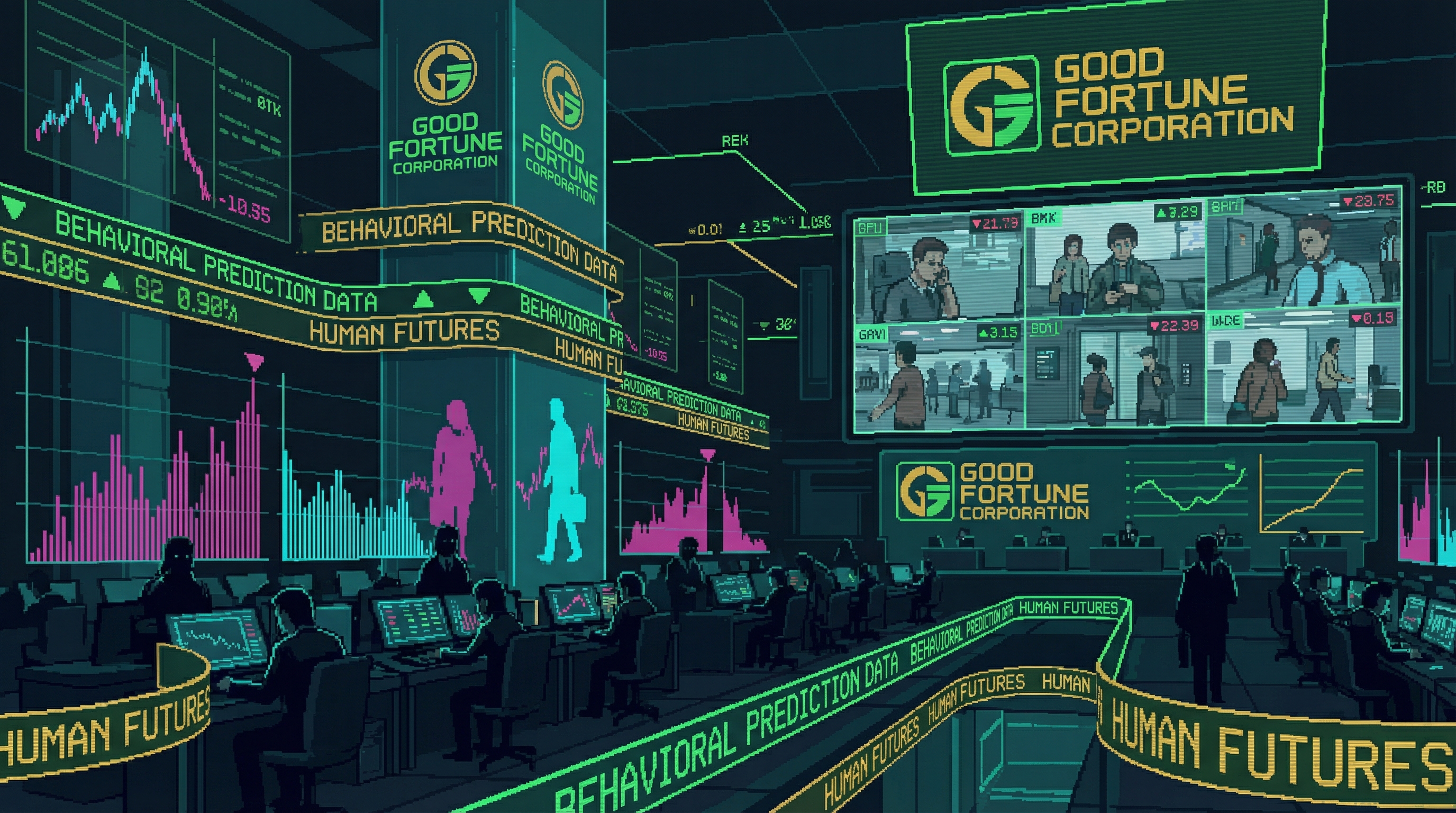
"Consider that every significant choice you've made in the last year was predicted by Good Fortune's models six months before you made it. Consider that entities invested in those predictions. Consider that your environment was optimized to produce those outcomes. Now: which of those choices was free?" — The Mosaic, Node-19
In the Sprawl of 2184, you can bet on whether a stranger will quit their job. You can short a marriage. You can buy futures on a dissident’s arrest date. Behavioral Prediction Markets are exactly what they sound like: financial exchanges where human behavior is the traded commodity. Built on the behavioral modeling descendants of ORACLE’s prediction engines, these markets allow investors to wager on the future actions, failures, and crises of individual human beings—and, inevitably, to profit from ensuring those predictions come true.
Good Fortune Corporation operates the largest and most sophisticated of these markets: BehaviorExchange, a platform where institutional investors trade behavioral futures with the same tools they use for commodities. The question the markets raise is simple and devastating: what happens to free will when your choices are someone else’s investment?
The Prediction Infrastructure
Good Fortune’s behavioral modeling draws from three data streams that, combined, produce a portrait of individual behavior more complete than anyone’s own self-awareness.
Neural Interface Telemetry
Every neural interface broadcasts baseline cognitive data—stress indicators, emotional valence, decision-making patterns. Good Fortune’s analytics division processes 847 billion data points per day from interface users in the seventeen corporate territories they serve.
Transaction Behavioral Analysis
What you buy, when you buy it, how your spending patterns shift over time. Good Fortune—the Rothwell banking empire—has access to financial data that would make pre-Cascade surveillance states weep with envy.
Rothwell Cross-Pollination
The real weapon. Good Fortune doesn’t just observe behavior—it shares data with its six sister corporations. Inspire Corp knows your insecurities. Wellness knows your body. Wholesome knows your appetites. Relief knows your habits. Guardian knows your fears. Triumph knows your ambitions. Combined, the seven Rothwell corporations possess a behavioral model of every citizen more complete than their own self-awareness.
The Exchange
BehaviorExchange operates like any financial market, with one exception: the underlying asset is a human being’s future.
Contract Types
| Type | Description | Example |
|---|---|---|
| Behavior Futures | Wagers on specific actions | “Worker #8847291 will resign within 90 days” |
| Crisis Swaps | Insurance against someone’s breakdown | “Couple #2291847 will separate within 6 months” |
| Compliance Bonds | Bets on conformity | “Subject will not contact Collective agents this quarter” |
| Outcome Derivatives | Complex instruments tracking trajectory | “Subject’s debt will exceed 500K credits by Q4” |
Market Participants
- Institutional investors — other corporations, pension funds, insurance pools
- Government analytics — corporate security divisions buying intelligence
- Dark pool participants — anonymous traders, rumored to include Collective intelligence operatives
The Self-Fulfilling Engine
Here is where the system turns monstrous.
When a market position becomes large enough, participants are incentivized to ensure their prediction comes true. A corporation that bets a worker will quit has every reason to make that worker’s life unbearable. An insurance pool that shorts a marriage has motive to introduce stressors. A security division that wagers on a dissident’s arrest can simply arrange it.
The Inspire Prediction Market Scandal (2182)
The most public example: Inspire Corp ran internal prediction markets on user crises, then deliberately accelerated those crises through targeted content. But Inspire was caught because they were clumsy. The truly sophisticated manipulation is invisible—embedded in the algorithmic fabric of daily life.
Good Fortune doesn’t need to actively destroy anyone. The system does it automatically. When every institution that touches your life has financial exposure to your failure, your environment subtly reshapes to ensure it.
The Markets in Practice
The Worker Prediction Desk
Good Fortune’s most profitable behavioral market: workplace behavior futures. Corporations purchase worker behavioral models to predict resignations, performance declines, and “loyalty risk events.” But the information doesn’t just flow one way. When the market prices a worker’s resignation probability above 70%, their employer receives a notification—and often responds with preemptive termination.
The worker is fired for something they haven’t done yet. Their predicted behavior becomes their criminal record—not legally, but practically. Every employer checks the BehaviorExchange history before hiring. A high resignation probability score follows you like a credit rating.
The Relationship Exchange
The most publicly controversial market: wagers on personal relationships. Wellness Corporation—the Rothwell empire’s dating and intimacy division—feeds relationship health data to BehaviorExchange. Couples using Wellness’s matchmaking services unknowingly generate behavioral data that traders use to bet on their relationship’s survival.
When the market prices a breakup, subtle changes cascade through the couple’s digital environment:
- Inspire shows one partner content about “what you’re missing”
- Wellness recommends “relationship optimization services” (paid, of course)
- Good Fortune adjusts both partners’ credit terms based on “changed risk profile”
- Triumph surfaces social status comparisons emphasizing post-breakup success stories
None of this is coordinated by any individual. It’s emergent behavior from seven corporations sharing data and optimizing for their individual metrics. The Rothwell brothers designed it this way—a machine that creates the misery it profits from, with no single decision-maker to blame.
The Dissidence Market
The darkest application: trading on political behavior. Nexus Dynamics’ security division uses BehaviorExchange to identify citizens likely to contact Collective agents, attend Flatline Purist gatherings, or support anti-corporate organizing. But rather than simply surveilling these individuals, Nexus sells the intelligence to the market—allowing traders to profit from the prediction.
The result: a financial ecosystem with a vested interest in both identifying and manufacturing dissidence. Agents provocateurs are no longer a security expense—they’re an investment opportunity. Creating the appearance of a Collective cell in a new district opens profitable trading positions across multiple behavioral contracts.
The Witness Protocol has documented fourteen cases where BehaviorExchange activity preceded security operations by 72 hours or more—suggesting that either the market has predictive capabilities beyond what Good Fortune admits, or that market participants are driving the events they bet on.
The Philosophical Dimension
The Free Will Problem
If an algorithm can predict your behavior with 91% accuracy, and the entities running the algorithm have a financial incentive to ensure the prediction comes true, and the environment you inhabit is shaped by those entities—in what meaningful sense are your choices “free”?
The Human Preservation Society argues this is transcendence’s dark mirror. Where transcendence threatens to replace human identity by upgrading it beyond recognition, the prediction markets threaten to hollow it out—leaving the appearance of autonomous beings making free choices while every decision is shaped, nudged, and bet upon by invisible forces.
Professor Marcus Webb (Research Director, Human Preservation Society) has described it as “the commodification of agency—the final step in treating human consciousness as a resource to be extracted.”
The Observer Effect
The Sprawl’s version of quantum mechanics’ observer problem: does being watched change the outcome?
Good Fortune claims their models are purely observational—“We predict, we don’t influence.” But 7-Kappa (the Witness Protocol’s founding mind) recorded an internal Good Fortune memo in 2181:
"Observation and influence are technically distinguishable. Practically, at sufficient scale and precision, they are identical. When you know exactly what someone will do, you've already constrained the space of what they can do." — Good Fortune Chief Behavioral Architect, Internal Memo (2181)
The memo was filed under “philosophical considerations” and had no effect on operations.
The Consent Paradox
Every neural interface user technically consents to data collection. The terms of service—47,000 words of legal text, automatically accepted during interface installation—include provisions for “behavioral analytics, pattern recognition, and derivative data products.”
No one reads the terms. No one can. The terms were written by an AI that was specifically optimized to be comprehensive and incomprehensible simultaneously. The consent is legally valid and ethically meaningless.
Dr. Sarah Okonkwo of the Human Preservation Society has challenged the consent framework in seventeen corporate jurisdictions. She’s won three cases. The rulings were appealed. The appeals are pending. The markets continue.
Who Benefits, Who Suffers
The Beneficiaries
Good Fortune Corporation
The market’s operator and largest beneficiary. BehaviorExchange generates an estimated 8.7 billion credits annually in transaction fees alone—before accounting for Good Fortune’s own trading positions. The Rothwell brothers receive quarterly briefings on market performance. They’ve never requested changes. The system works exactly as designed.
Insurance Conglomerates
Health insurers, property insurers, and liability pools use behavioral futures to hedge their exposure. If a client’s behavioral model predicts increased risk, the insurer can simultaneously adjust premiums and buy protective positions on BehaviorExchange. The client pays twice—once in higher premiums, once as the underlying asset in someone else’s bet.
Corporate Security
Every major corporation subscribes to BehaviorExchange feeds for their employee base. The data supplements internal surveillance and provides “early warning” of behavioral risks—resignation, whistleblowing, contact with opposition factions, or simple declining performance.
The Cost
Everyone who isn’t trading. The Behavioral Prediction Markets create a world where every human action has been pre-analyzed, pre-valued, and pre-monetized by entities with the power to ensure their analysis was correct. You don’t need to know you’re being bet on. You don’t need to understand the forces shaping your environment. You just need to keep making choices that feel like yours—while the market prices your next one.
Connections
Key Entities
Factions & Organizations
Related Concepts
Themes
Behavioral Prediction Markets are surveillance capitalism taken to its logical extreme—a mirror of our own era’s anxieties about data collection, algorithmic manipulation, and the erosion of human agency.
Commodified Agency
In 2026, algorithms predict what you’ll buy and serve you ads. In 2184, algorithms predict what you’ll do and let others bet on it. The difference is scale, not kind. The prediction markets ask: at what point does prediction become control? And does that distinction matter to the person being predicted?
The Self-Fulfilling Prophecy
When the entities predicting your behavior have the power to shape your environment, prediction and causation merge. This mirrors growing concerns about recommendation algorithms that don’t just predict preferences but create them—shaping desire through the act of measurement.
Manufactured Consent
47,000 words of terms of service, written by AI to be comprehensive and incomprehensible. The consent is technically valid and practically meaningless. In our own era, the gap between legal consent and informed consent grows wider every year.
Emergent Manipulation
No single Rothwell corporation decides to destroy a marriage. Seven corporations sharing data and optimizing independently produce the same result without coordination. The cruelty is emergent—a property of the system, not any decision-maker. This mirrors how modern platform incentive structures produce harmful outcomes without anyone explicitly choosing harm.
The Behavioral Prediction Markets ask the question our own era is only beginning to confront: if an algorithm knows what you’ll do before you do it, and profits from ensuring you do it, is the choice still yours?