The Corporate Compact
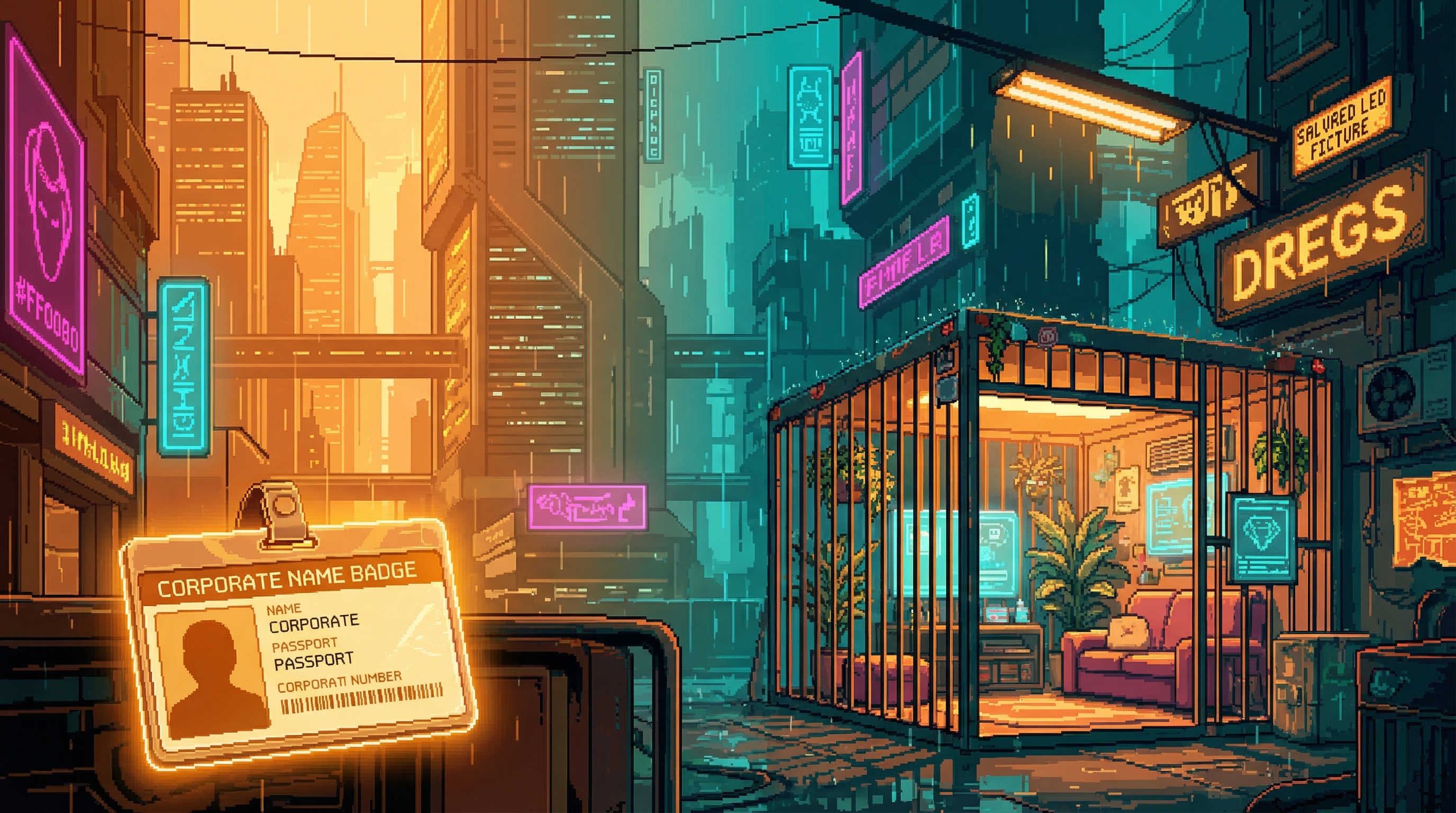
In the Sprawl of 2184, your employer is your country. This is not metaphor. It is architecture. When nation-states dissolved during the Merger Years and the Cascade destroyed what remained of public governance, corporations did not simply fill a power vacuum. They built something new — a complete sovereignty infrastructure that provides everything a state once provided, contingent on one condition: you work for them.
"We wish you well in your future endeavors."
— What they say when they deport you The Architecture
The Corporate Compact is the unwritten social contract between employer and employee that has replaced citizenship in every practical sense. Under the Compact, a corporation provides housing, food, healthcare, education, social infrastructure, identity, and consciousness licensing. In exchange, the employee provides labor, loyalty, data, and compliance.
The arrangement is efficient. It is often comfortable. It is always a cage — because leaving the corporation doesn't mean losing a job. It means losing a country. Your apartment reverts. Your food access terminates. Your healthcare enrollment lapses. Your children's school placement is revoked. Your consciousness licensing downgrades from Professional to Basic within 72 hours.
What the Compact Provides
Housing
Corporate-managed residential districts. 22°C — precise, controlled, comfortable.
Food
Corporate-subsidized commissaries and Wholesome delivery partnerships.
Healthcare
Corporate-administered Helix packages. Full coverage, full dependency.
Education
Corporate-operated schools for employees' children. Curriculum designed for corporate citizenship.
Identity
Corporate-issued credentials — the Sprawl's only universally recognized identification. No badge, no person.
Consciousness
Corporate-negotiated group rates — 60% reduction from individual purchase. Professional-tier cognition as an employment benefit.
What the Compact Requires
Or the appearance of labor, given the Invisible Workforce.
Measured by the Loyalty Coefficient. Quantified, tracked, optimized.
Continuous behavioral telemetry through corporate-grade neural interfaces.
With corporate governance, values, and culture. Not optional.
The Cost of Departure
Leaving the Compact is not resignation. It is emigration from the only country you have ever known, into a country that does not want you.
The Firmware Cliff
Within 72 hours of departure, consciousness licensing downgrades from Professional to Basic. The enhanced pathways don't disappear — they go dark. Your brain has restructured itself around capabilities that no longer exist. The world becomes quieter. Slower. Flatter. In the Dregs, they call it going gray.
Viktor Kaine summarizes: "They built their cage one comfort at a time. Each bar was something they needed. By the time they noticed the door was closed, they couldn't remember how to live without the bars."
The Temperature Gradient
The Compact is experienced as temperature. You feel the border before you process it.
Corporate Territory
Precise. Controlled. Comfortable. The temperature of infrastructure that was designed for you, because you are still an asset.
Transition Corridor
Between worlds. Neither comfortable nor hostile. The temperature of the space where you stop being one thing and haven't yet become another.
The Dregs
The warmth of waste heat. Of proximity. Of infrastructure that was never designed for human comfort. The same amber lighting, at a different quality level.
Implications
Employment as Citizenship
Every economy implies a relationship between labor and rights. The Compact has made that relationship architecture. You don't earn rights by working — you have rights only while working. The distinction is everything.
Kindness as Control
The Compact's most devastating feature is its warmth. The Sunset Package is humane. The Graceful Degradation Protocol is respectful. The Transition Specialist is trained to make your ejection feel like a gift. Grateful people don't organize.
Internal Refugees
The Compact creates a class of people who have been "released" from the only society they've ever known. They arrive in the Dregs with degrading cognition and no transferable skills. Not immigrants — refugees from a country that was never a country.
Nexus's internal models suggest the Compact is self-reinforcing: each generation born within it has less capacity for independent existence. The cage doesn't need to be locked. The birds have forgotten what outside looks like.
▲ Classified
Unverified intelligence. Handle accordingly.
- No Origin Point: The Compact was never legislated, never voted on, never formally established. It emerged from the interaction of corporate sovereignty and employee dependency — nobody designed it, and nobody can point to the moment it began. This makes it almost impossible to challenge legally, because there is nothing to challenge.
- Page 47: Good Fortune's interest rate acceleration clause — 8% to 24% upon departure — is buried on page 47 of the augmentation loan agreement, written at Professional-tier reading level. The employees who need to understand it most are, by design, the ones least cognitively equipped to parse it after departure.
- The Missing Surveys: The 60% Dregs settlement rate is a conservative estimate from the Corporate Defector Network. The actual figure may be higher, but many deprecated employees stop responding to surveys. Whether this means they've found stability or lost the capacity to respond is a question nobody has funded the answer to.
- Self-Reinforcing Architecture: Nexus's predictive models show that third-generation Compact employees have a 94% lower probability of successful independent living than first-generation. The Compact is breeding its own permanence. Nobody has briefed the executives. The executives have not asked.
Related Systems
The Corporate Compact is the unwritten constitution of the Sprawl. These are the systems that enforce it, exploit it, and in some cases, resist it.
The Deprecation
The Compact's enforcement mechanism — what happens when you're no longer useful. Not fired. Deprecated. Transitioned to an unsupported lifecycle.
Consciousness Licensing
The neurological dimension of the Compact. Professional-tier cognition as an employment benefit — and Professional-tier cognitive loss as a departure penalty.
Good Fortune
The financial infrastructure of dependency. Augmentation loans at 8% that become 24% the moment you walk out the door.
The Dregs
Where 60% of Compact refugees end up. The Compact's waste product — a population of people who were once assets, now living in the warmth of infrastructure that was never designed for them.
"They gave me everything. Housing, food, healthcare, schools for my kids, a mind that could keep up. Then I asked a question in a meeting that made my manager uncomfortable, and they gave me one more thing: a letter that wished me well in my future endeavors. I had seventy-two hours before my mind started going gray. I spent the first hour thanking them." — Former Nexus Dynamics employee, Dregs community board, 2183