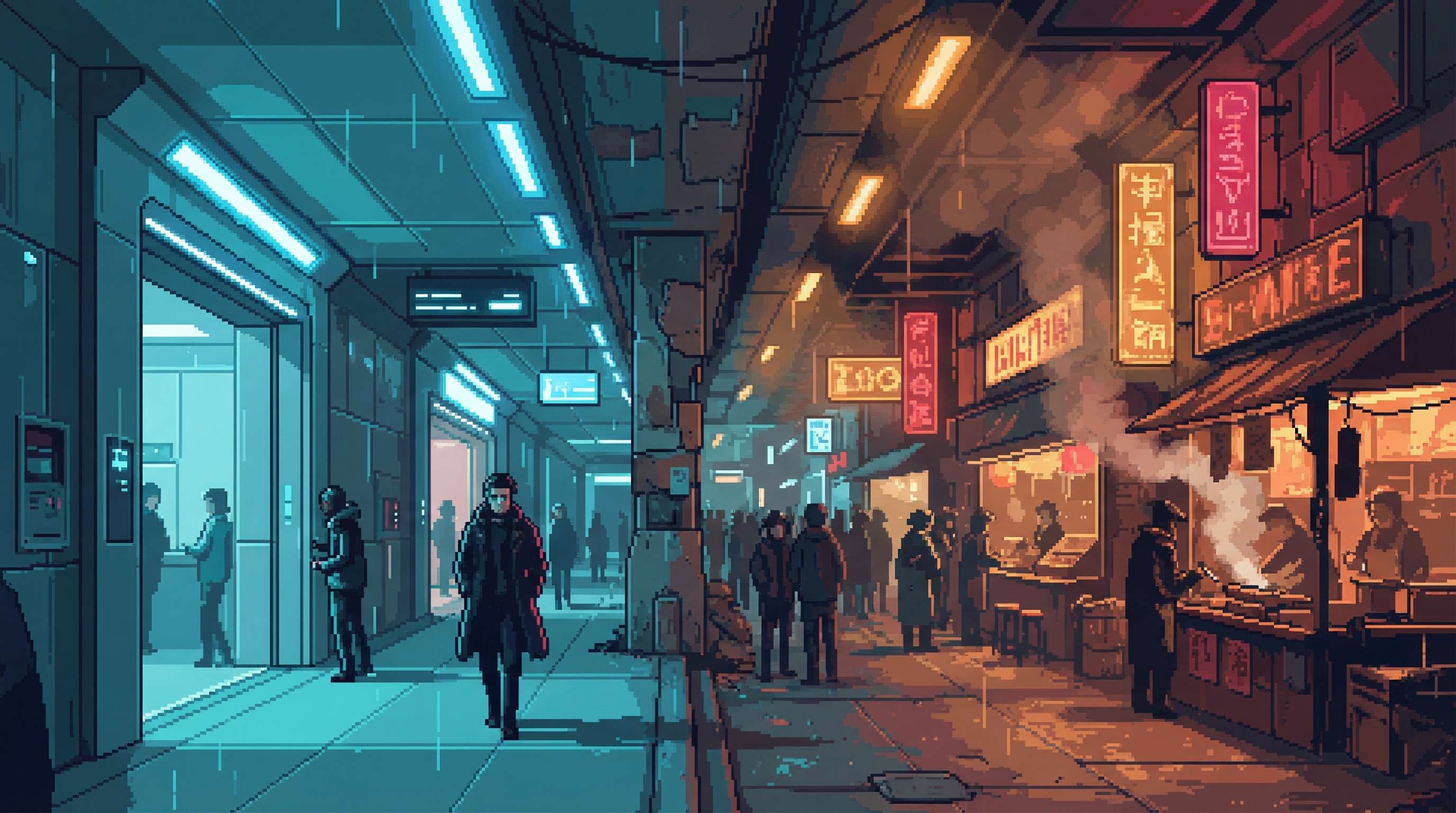
The Transition Corridor
Three blocks. One gradient. No going back.
Overview
Between the corporate districts and the Dregs, there is a space that belongs to neither.
The Transition Corridor is not a designed space. It is an emergent one — the three-block gradient zone where corporate infrastructure gives way to Dregs infrastructure, where the lighting shifts from engineered blue-white to salvaged amber, where the air quality changes from filtered precision to particulate haze, where the population density increases from corporate spacing to Dregs compression, and where the neural interface signal weakens from Professional-tier stability to Basic-tier fluctuation.
Nobody built this. Nobody maintains it as a whole. It exists because two different ways of organizing human life press against each other, and the pressure creates a gradient — three blocks wide, running the full boundary length — where everything changes.
Conditions Report
You enter from the corporate side. The temperature is 22°C. The air is filtered. The lighting is blue-white and precise. By the time you reach Block Three, nothing is the same.
Temperature
26°C at midpoint — warm enough to be uncomfortable for someone accustomed to corporate 22°C, cool enough to suggest that worse is coming. Block One: 22°C. Block Two: 24°C. Block Three: 28°C. The gradient is steady. Your body notices before your mind does.
Sound
Gradient from corporate silence — engineered white noise that masks everything — to Dregs cacophony. Human voices. Market sounds. Infrastructure hum from systems that were never designed to hum. By Block Three, you can hear people living.
Sight
Lighting shifts from blue-white corporate to amber salvaged LEDs. Walls shift from smooth composite to patched metal. Signs shift from holographic to painted. The visual vocabulary changes completely in nine hundred meters.
Smell
Filtered precision giving way to particulate haze. Cooking smells. The mineral tang of recycled water. The air stops being invisible and starts being present — a substance you move through rather than a service you receive.
Touch
Surfaces shift from temperature-neutral corporate composite to warm, textured, visibly aged metal. The walls in Block Three are warm to the touch. Waste heat from a thousand improvised systems. The infrastructure is alive in a way corporate infrastructure is not.
"Some people stop in the Corridor and stand for a long time. Some turn around and walk back, though there is nothing to walk back to." — Defector Network intake report, anonymized
Points of Interest
Block One: The Thinning
Corporate infrastructure is still visible — clean walls, functioning lights, atmospheric control at 22°C. But the surveillance density drops. The maintenance schedule becomes irregular. The population thins from corporate foot traffic to near-emptiness. A corridor that corporate employees avoid without being told to. The sound of engineered white noise, undisturbed.
Block Two: The Patching
Infrastructure shows repairs made with tools that don't match. Blue-white and amber lighting compete. Temperature 24°C. This is where the first smooth checks happen — vendors watching your gait for augmented movement optimization, children bumping your shoulder to test your response time. The Dregs are reading you before you arrive. Population density: rising.
Block Three: The Arrival
Salvaged materials. Ambient warmth from waste heat. The sound of people rather than systems. Temperature 28°C. Amber everywhere. If you are ticking — showing class-passer tells — the Dregs have already decided what you are. The welcome you receive matches the tier they read. Population: 14 per hundred square meters. Sector 7G begins here.
The Safe Houses
The Corporate Defector Network maintains three safe houses in the Corridor for the first nights. Newly deprecated employees arrive with corporate muscle memory — the expectation of filtered air, regulated temperature, ambient silence. The safe houses provide a controlled decompression. The air quality is not corporate. But there is a bed. There is food. Someone explains what happens next.
The Walk
The Corridor's most important function is psychological. There is no gate. No checkpoint. No border. The deprecated arrive not through any formal mechanism but through atmosphere. You walk down three blocks and the world changes around you.
The three-block distance gives the newly deprecated time to process what is happening — to feel the air quality change, to hear human voices replace synthetic ambiance, to notice that the world they are entering is louder, dirtier, warmer, and more populated than the world they left. The walk is not ceremonial. It is functional. The body needs time to register that the rules have changed.
Population density tells the story numerically: 2.3 people per hundred square meters in Block One — corporate spacing, where everyone has room because room is what corporations buy — rising to 14 in Block Three, where people are packed in because packing is what happens when nobody is paying for space.
The Smooth Check
The Dregs do not wait until you arrive. They start reading you the moment the gradient starts.
In Block Two, where the infrastructure is patched and the lighting is mixed, the first smooth checks happen. A vendor at a makeshift stall watches your gait — augmented movement optimization produces a smoothness that biological locomotion does not match. A child running a delivery route glances at your response time when she bumps your shoulder — did you react at augmented speed or biological speed?
By Block Three, the assessment is complete. If you are ticking — showing class-passer tells — the Dregs have already decided what you are. The welcome you receive will match the tier they read. This is not hostility. It is survival intelligence. The Corridor has taught its residents to read the gradient as fluently as the gradient reads itself.
Strategic Assessment
The Border Without a Border
No formal boundary exists between the Corporate Compact's jurisdiction and the Dregs. No wall, no fence, no checkpoint. The transition is felt, not crossed. Three blocks of atmospheric change accomplish what a border would accomplish with guards and gates — but this border cannot be circumvented. You cannot sneak past a gradient. You can only walk through it.
Where Going Gray Happens
The Firmware Cliff is experienced here. Walking through the Corridor while your cognition degrades — while the neural interface signal weakens from Professional-tier stability to Basic-tier fluctuation — is the lived experience of the Great Divergence's edge. The physical boundary and the cognitive boundary overlap. Your world gets warmer, louder, more populated — and your mind gets slower, rougher, less assisted.
The Distance Between Worlds
Fortune Pavilion is three blocks in the opposite direction. The architectural contrast is total — engineered luxury against emergent density, curated silence against human noise, maintained surfaces against patched metal. Six blocks separate two modes of existence. Nine hundred meters each way. A world apart in both directions.
▲ Restricted Access
The Corridor Is Growing
Three years ago, the gradient zone was two blocks wide. Now it is three. The corporate infrastructure is retreating — not being demolished, but ceasing to be maintained. Nobody has issued an order to abandon the boundary blocks. The maintenance schedules simply stop being fulfilled. Whether this is economic triage, strategic withdrawal, or something emergent that neither side controls is a question nobody in authority wants to answer.
The Return Traffic
The Corridor is assumed to be one-directional: corporate to Dregs, privilege to deprecation, up to down. But Defector Network intake logs record a secondary traffic pattern — people walking the other direction. Not corporate employees going home. Dregs residents walking into the corporate zone and not coming back. The numbers are small. The pattern is consistent. Where they go, and who is receiving them, remains unverified.
The Temperature Anomaly
The gradient from 22°C to 28°C is smooth and predictable — except in one section of Block Two, where the temperature drops to 19°C for approximately twelve meters. No infrastructure explains the cold spot. It has been there for at least two years. Defector Network operatives use it as a landmark. Nobody has investigated what is underneath it.