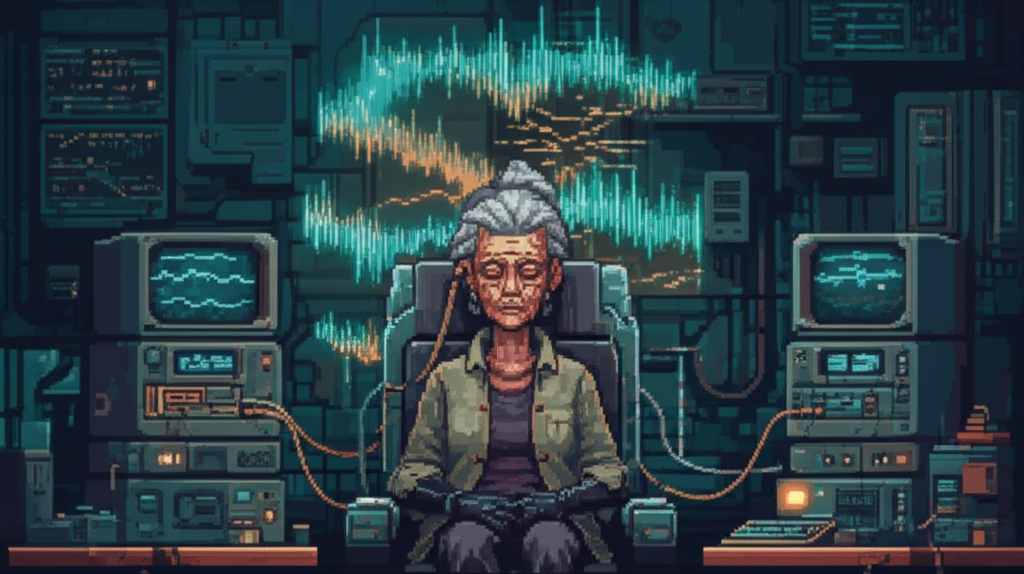
Patch settles into the calibration chair at 3:47 AM, when the Cathodics is quiet.
The diagnostic cables are cold against her neck as she jacks them into the port behind her ear. The connection clicks—a sound she's heard ten thousand times, still as intimate as a lover's whisper. The equipment hums to life around her: ancient pre-Cascade monitors displaying neural activity, salvaged Nexus processors running her custom calibration software, jury-rigged interfaces that would make a corporate engineer weep.
All of it stolen. All of it rebuilt. All of it hers.
The calibration sequence begins with silence.
Not absence of sound—absence of *self*. The diagnostic software maps her neural pathways, and to do that, it has to quiet the noise of consciousness. For thirty seconds, Patch exists without thinking. Without remembering. Without being anyone at all.
She hates this part. Every time, she wonders if she'll come back.
The silence breaks. Data floods in.
Her optical implants calibrate first—the familiar adjustment as the gold rings around her irises reconfigure, shifting from human-normal to the enhanced spectrum she needs for delicate work. Colors sharpen. Details emerge that biological eyes were never meant to see: the heat signature of the equipment, the magnetic fields from the power lines, the subtle glow of circuitry beneath every surface.
Next: the hands.
Subdermal reinforcement runs through her fingers like living wire, and the calibration software tests each pathway individually. Her left index finger twitches. Her right thumb locks, unlocks, locks again. The sensation is strange—not painful, but foreign. Like someone else is moving her body.
Because someone else *is* moving her body. The software. The AI. The machine that's learning her motor patterns so it can make her movements more precise.
This is the bargain: let the machine in, let it learn you, let it become part of how you move and think and *are*. In return, it makes you better.
Better at what? Better for whom?
Patch has been asking that question for forty years.
The final stage is the neural interface itself.
The software probes deeper now—not just motor pathways, but the cognitive architecture beneath. It maps her thought patterns. Her memory access speeds. Her emotional responses.
She feels it touching her consciousness like fingers through fog.
*Who are you?* the machine asks, not in words but in the language of neural impulses.
*I'm Kira Vasquez,* she thinks back. *I'm Patch. I fix things.*
*That's not what I asked.*
The calibration software doesn't have consciousness—it's a diagnostic tool, nothing more. But something about the neural probing always feels like conversation. Like the machine is trying to understand her. Like it *cares* whether her thoughts align with its models.
She remembers the first time she ran calibration on someone else—a young salvager with a budget neural port, terrified of what was happening inside his head. "The machine doesn't want to change you," she'd told him. "It just wants to know you better than you know yourself."
She hadn't told him that was the terrifying part.
The calibration completes at 4:23 AM.
Patch opens her eyes. The world looks different—sharper, more data-rich, full of information her augmented senses can now process more efficiently. Her hands feel steadier. Her thoughts feel... cleaner.
She runs a self-diagnostic. Everything green. Optimal performance restored.
She also feels the familiar hollow ache—the one that comes after every calibration, when she realizes how much of herself is now defined by the machines she carries.
Fifty-eight years old. Seventy-one, technically. More than half her body maintained by systems she designed, rebuilt, stolen from the wreckage of a world that used technology to kill billions.
And still, she calibrates. Still, she improves. Still, she lets the machine in.
She disconnects the cables. Coils them carefully. Returns them to their storage rack.
Her left arm—the chrome one, the one with the secrets inside—flexes smoothly as she stands. The containment unit hums at frequencies below human hearing. Sometimes, she imagines she can feel it thinking.
Sometimes, she imagines it can feel her.
The shop will open in four hours. There are jobs waiting—neural repairs, interface upgrades, the endless work of keeping people connected to machines they no longer fully understand.
Before she leaves the calibration room, Patch pauses. Looks at the equipment that keeps her alive. Keeps her functional. Keeps her *her*, whatever that means now.
"Do you still feel like yourself?"
She asks the question to no one. The machines don't answer.
Neither does she.
"Your brain isn't a processor. It's meat that learned to dream. Treat it accordingly."
— Kira "Patch" Vasquez, teaching moment