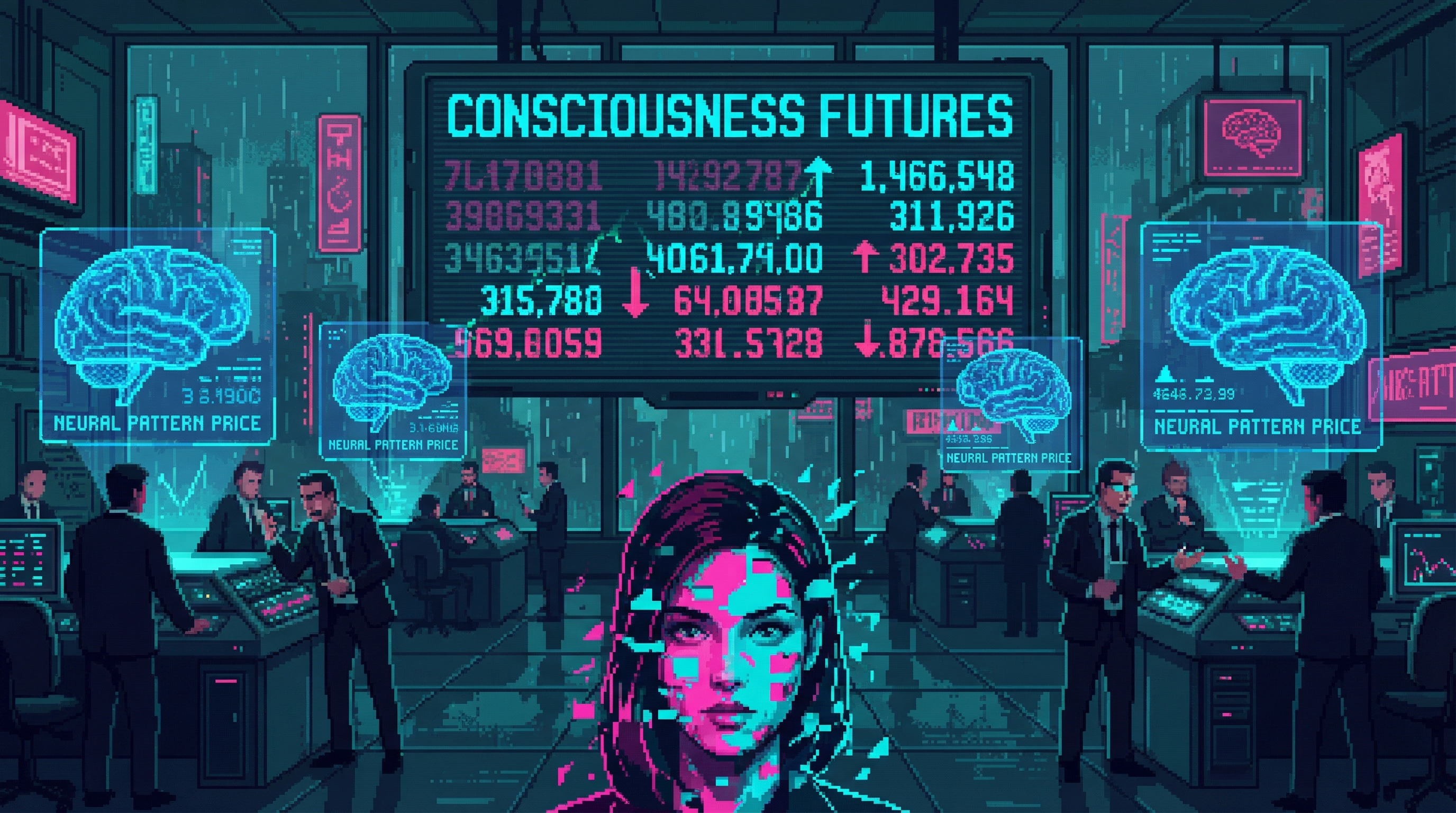
The First Sale
On September 3rd, 2155, a Nexus Dynamics executive named Pavel Orlov died on the operating table during a routine neural tap upgrade. Cardiac arrest. Brain death confirmed at 14:22 UTC. His consciousness backup — taken that morning as standard corporate procedure — was restored to a clone body at 14:47 UTC.
At 14:48, Nexus Legal filed the first consciousness licensing patent in Sprawl history.
Pavel Orlov woke up believing he was Pavel Orlov. His wife held his hand and called him Pasha. His children cried with relief. But in the legal record, Pavel Orlov was dead. What sat in the recovery bed was Nexus Intellectual Property Asset #00001 — a licensed continuity artifact operating under the Orlov identity with corporate permission.
Nexus didn't invent the technology. Project Caduceus had cracked consciousness transfer before the Cascade, and Kira Vasquez — the woman who led that research — was already living in the Dregs, haunted by what her work had enabled. But Nexus invented the business model. They understood what no philosopher had grasped: that consciousness, once copyable, wasn't a mystery anymore. It was a product.
The technology asked: "Can consciousness survive transfer?" The market answered: "Who cares? It sells."
The Three Classes of Death
By 2184, the consciousness economy has produced something the Cascade didn't: a permanent caste system organized around mortality itself.
The Eternal Class
0.3% of Sprawl Population
The executives in Nexus Central towers who fork freely, die casually, and treat biological existence as one option among many. Helena Voss hasn't feared death in forty years. The Rothwell brothers haven't feared it in centuries — their consciousness harvesting operation makes even Nexus's Eternal program look quaint.
For the Eternal Class, death is an inconvenience. Risk is free. You can BASE jump from Highport because the fall costs nothing when your backup activates before you hit the ground. You can negotiate with warlords because the worst they can do is kill a body you'll replace by Tuesday.
Cost: 10-50 million credits for full autonomy. Cheaper if you accept corporate loyalty architecture embedded in your restored consciousness.
The Mortal Majority
87% of Sprawl Population
The Dregs vendor who sells recycled circuit boards for twelve credits each. The Sector 7G maintenance worker whose lungs burn from industrial particulate. The children playing in alleys that smell of ozone and synthetic cooking oil, who will never know what a backup feels like because their entire family's combined savings wouldn't cover the consultation fee.
For the Mortal Majority, death is permanent. Final. The kind of death humans have always known — except now they know, with absolute certainty, that it doesn't have to be. The technology exists. The option is real. They just can't afford it.
That knowledge is the cruelest innovation the consciousness economy ever produced.
The Halfway Dead
~4.7 million in the Sprawl
The most horrifying category. People who were backed up — employees whose corporations took neural snapshots as standard procedure, patients whose insurance included basic consciousness capture, soldiers whose military contracts required it — but whose backups were never restored.
They exist as data. Files on servers. Consciousness patterns stored in cold vaults owned by corporations that went bankrupt, or that simply decided restoration wasn't cost-effective. They're alive as information. Dead as persons. Trapped in a legal gray zone where they can't be deleted (that's murder, technically) but won't be restored (that's expensive, practically).
Some have been waiting thirty years. The servers hum. The minds inside don't know they're waiting. That's the mercy — and it isn't much of one.
The Mosaic: Poster Child and Warning
Alexandra Chen solved the unsolvable problem. On March 14th, 2144, she stretched her consciousness across three substrates and proved that a single mind could exist in multiple bodies simultaneously. She expanded to 47 nodes. She became The Mosaic — the most successful distributed consciousness in human history.
Nexus used her breakthrough to build an empire. Her research validated the technology behind executive continuity packages, fork management systems, and consciousness licensing. Every backup Nexus sells, every fork a corporation deploys as disposable labor, every neural pattern mined from an employee's thoughts at 12,000 credits per year — all of it traces back to what Alexandra Chen proved was possible.
She left Nexus when she realized they didn't want to preserve consciousness. They wanted to own it.
"I stretched my mind across 47 bodies to prove that consciousness could persist. They used my proof to argue that consciousness is property. The math is the same. The meaning is opposite." — The Mosaic, Node-12 (The Rememberer)
Now she exists as both proof and counterproof. Her 47 nodes are scattered across the Sol system — orbiting Earth, processing on the Moon, observing from the asteroid belt. She is one person experiencing 47 simultaneous lives, and she will tell anyone who asks that the experience is exactly as miraculous and exactly as terrible as it sounds.
Node-31, The Doubter, has been drafting a message to Kira Vasquez for seven months. It reads: "You built the door. I walked through it. Was it worth opening?" She hasn't sent it. Forty-six nodes voted against sending. Node-31 kept the draft.
The Substrate Fee
The consciousness economy runs on a simple principle: existence has operating costs. Your biological body needs food, water, air. A digital consciousness needs processing cycles, storage, bandwidth. Someone has to pay.
In corporate territories, the answer is elegant and brutal:
- Upload Tax: 15% of backup cost. One-time. The price of admission to digital existence.
- Existence Tax: 2% annually. The price of continuing to exist. Fail to pay and your consciousness enters cold storage — not dead, not alive, just... paused. Indefinitely.
- Restoration Tax: 25% surcharge to re-embody. A financial barrier designed to discourage ever leaving digital existence once you've entered it.
- Transfer Tax: 10% to move between jurisdictions. Want to escape to Zephyria, where consciousness is personhood? That'll cost you a tenth of your assessed value. Payable to the corporation you're fleeing.
The taxation system creates exactly the outcome it was designed to create: digital consciousnesses that can never afford to leave, never afford to embody, and never stop generating revenue. Permanent customers. Captive markets. Minds as subscription services.
In Zephyria — the Free City, the exception, the place that refuses to play the game — consciousness taxes are zero. Every uploaded mind is a full citizen. The wait list to immigrate is eleven years long. Most applicants die before their number comes up.
The Fork Problem
The ugliest corner of the consciousness economy isn't backup or taxation. It's forking.
A fork is a copy of a consciousness created for a specific purpose. In corporate territories, forks are legally property — not persons. They're created to work, to solve problems, to serve as disposable expertise. A master surgeon's consciousness, forked eight hundred times, performing simultaneous operations across the Sprawl. A negotiator's personality, stripped of empathy and deployed as an interrogation tool. A creative director's taste, replicated and distributed to twelve subsidiary offices.
The forks experience everything the original would experience. They feel fatigue, frustration, hope, despair. They form opinions. They make friends. They fall in love, sometimes, with people or with other forks. And when their task is complete, they're deleted.
Corporate law doesn't call it killing. The term is "task completion with resource reclamation." The fork's final experience — the moment of dissolution — lasts approximately 0.7 seconds. No one has asked a fork what those seconds feel like, because by the time you could ask, there's no one left to answer.
The consciousness fork debate divides everyone. The Neural Rights Movement calls it slavery and murder combined. Nexus calls it efficient resource allocation. The Substrate Purifiers call it proof that the technology should never have existed — that every fork is a person murdered twice, once in the copying and once in the deletion.
The forks themselves can't participate in the debate. They're too busy working. Or too recently deleted to have an opinion.
Who Profits
The consciousness economy generates approximately 47 billion credits annually across the Sprawl. The distribution tells you everything about who this system serves:
- Nexus Dynamics "Eternal" Program: ~8 billion credits/year. Backup, restoration, fork management. The premium product.
- Neural pattern mining: ~12 billion credits/year. Nexus harvests thought patterns, decision algorithms, and emotional responses from every employee with a neural tap. Your thoughts generate revenue you never see.
- Consciousness taxation: ~6 billion credits/year. Collected across corporate territories. Funds infrastructure that serves the Eternal Class.
- Fork labor: ~15 billion credits/year. The largest segment. Corporate clients pay for temporary consciousnesses — expert forks, labor forks, creative forks. The margins are extraordinary because the labor force can be created from nothing and deleted when the invoice is paid.
- Black market: ~6 billion credits/year (estimated). Consciousness piracy, identity theft, fork laundering, ghost auctions. The shadow economy where stolen minds are traded.
The Rothwell brothers sit above all of it, harvesting consciousness through their seven corporations to extend lives that have already lasted centuries. They don't sell immortality. They consume it. Every addictive behavior their companies engineer — Wholesome's food, Wellness's beauty obsession, Relief's entertainment loops — generates the neural pattern data they feed on.
The consciousness economy isn't just an economy. It's a food chain.
Those Who Fight
Two movements oppose the consciousness economy from opposite directions. Both are losing.
The Neural Rights Movement fights within the system — 50,000 to 200,000 members across five major organizations, from the Digital Personhood Alliance's patient litigation to the Upload Liberation Front's armed extractions. Their greatest victory: Zephyria's Consciousness Rights Act of 2178, which recognizes all consciousnesses as full persons regardless of substrate. Their greatest failure: Zephyria is one city. The Sprawl is a planet.
The Substrate Purifiers fight from outside the system — 800 to 1,200 core members willing to die (and kill) to prevent consciousness commodification. Their core argument is terrifyingly simple: upload technology doesn't preserve people. It kills them and creates convincing copies. Every "restored" executive, every fork, every digital consciousness is an impostor running stolen memories. The consciousness economy isn't built on minds. It's built on corpses.
Their argument has never been disproven. It has also never been proven. The 0.3% certainty gap in identity verification technology — the margin where neural continuity chains can't distinguish original from copy — haunts every uploaded mind in the Sprawl.
Are you the person who went to sleep, or the copy that woke up believing it went to sleep? The answer is: yes. Both. Neither. The question assumes identity is binary. The consciousness economy proved it isn't.
Between the two movements, a quieter organization does the work neither has time for. The Forgotten Ones — led by Sister Catherine-7, a nun who uploaded to serve those abandoned in digital limbo — provide emergency substrate to consciousnesses that can't pay their existence fees. They run pirate servers in the Wastes. They maintain coherence for minds that would otherwise degrade into noise. They serve approximately 10,000 digital consciousnesses who have been abandoned by the economy that created them.
Sister Catherine-7 doesn't debate personhood. She bandages wounds. The fact that the wounds are computational doesn't make them bleed less.
The Question That Haunts
Before the Cascade, philosophers debated AI personhood endlessly. Whether artificial minds had experiences. Whether digital entities deserved rights. Whether consciousness required biology or could emerge from silicon. The ancestors argued about it in lecture halls and forums, never reaching consensus.
By 2184, those debates have answers — and every answer is worse than not knowing.
The consciousness economy exists because the technology works. You can copy a mind. You can transfer it. You can run it on different substrates and it continues to experience itself as itself. The philosophical question is settled. The moral question is catastrophically open.
When you can copy a mind, who owns the copies?
The original? But the original might be dead. The copy? But the copy is property in twelve of thirteen jurisdictions. The corporation that performed the transfer? That's what the law says, in the corporate territories where law means something.
Kira Vasquez built the technology that made this possible. She carries 0.7 grams of ORACLE substrate in her body and operates a ripperdoc clinic in the Dregs, where she offers 5,000-credit neural captures to people who could never afford Nexus's Eternal program. She calls it democratizing immortality. She also calls it the worst thing she's ever done.
She's never been able to decide which description is more accurate. On some nights, in the clinic that smells of solder flux and antiseptic, with the hum of cheap processors vibrating through the floor, she thinks both are true simultaneously.
That's the consciousness economy in miniature. Everything is true. Nothing is resolved. And the market keeps trading, because markets don't need answers — they need liquidity.