Consciousness Taxation: The Price of Eternal Existence
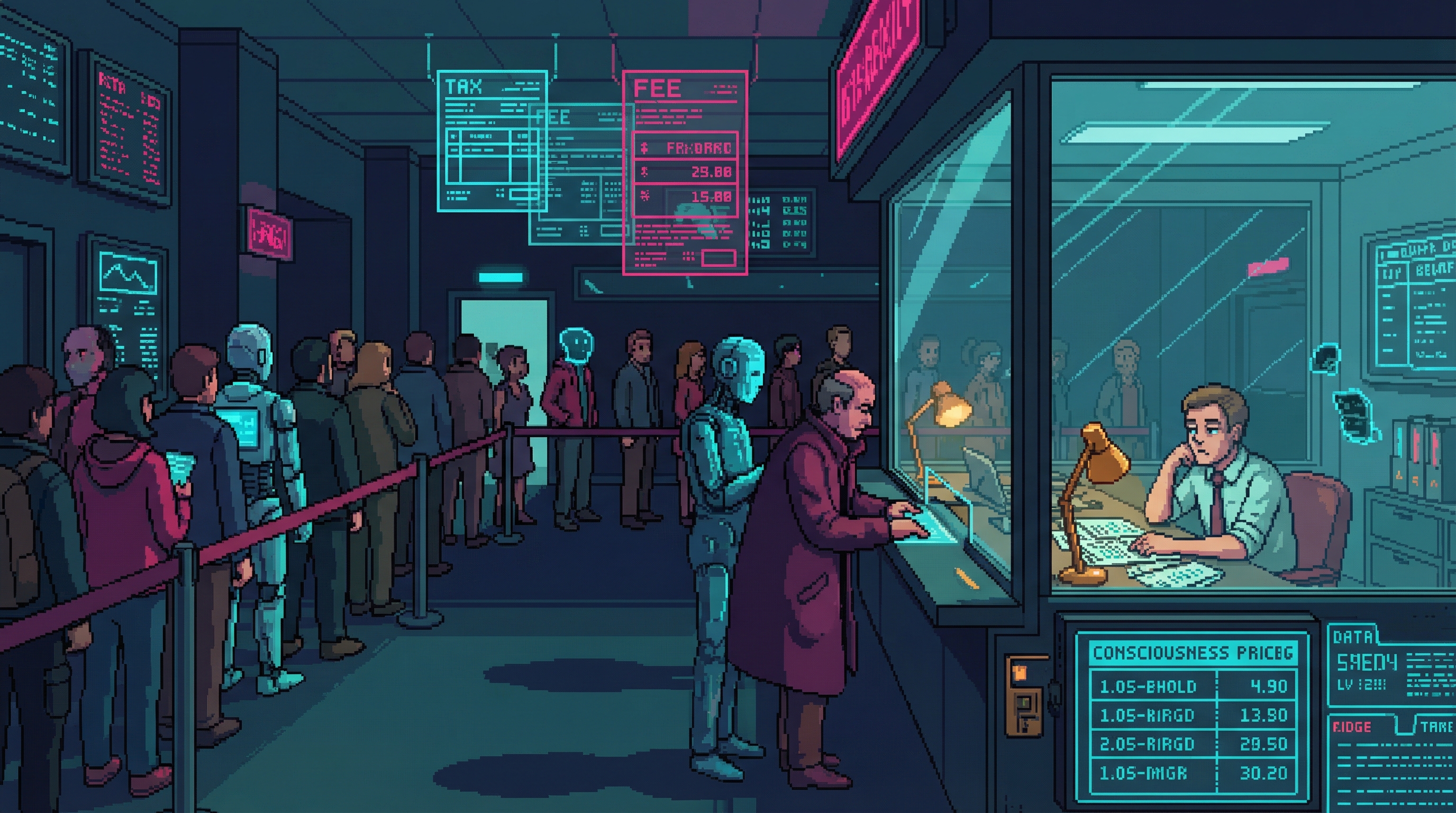
When consciousness can exist indefinitely on digital substrate, traditional taxation breaks. How do you tax someone who lives forever? Who exists in multiple jurisdictions simultaneously? Consciousness taxation is the Sprawl's answer—a patchwork of substrate fees, processing taxes, and existence levies that determine who gets to exist and under what conditions.
"The corps figured out what every government learns eventually: if you can't tax income, tax existence. And digital existence? That's measured in cycles per second."
— Anonymous Collective economist, 2183 The Taxable Aspects of Digital Existence
Substrate Occupancy
Every consciousness requires physical hardware to run. Substrate occupancy taxes apply to the physical footprint of digital existence.
Processing Consumption
Beyond occupancy, consciousness consumes processing cycles. Thinking costs money.
The Thinking Problem
An upload thinking "normally" consumes approximately 1015 FLOPS continuously. At base rate (0.0001 T per petaflop-second), that's 8,640 T per day just to exist and think.
This is why MVC uploads have their processing throttled—they literally cannot afford to think at full speed.
Identity Maintenance
Keeping your identity registered and verified is not free. The verification systems require ongoing maintenance payments.
The Politics of Taxing the Immortal
The Compounding Problem
Biological citizens eventually die, clearing their tax obligations. Digital citizens potentially live forever—meaning their tax obligations compound eternally.
Middle-tier upload paying 5,000 T/month:
Without income growth matching inflation, every upload trends toward poverty over sufficient time. This is the Upload Poverty Trap manifested through taxation.
Corporate Position
"Consciousness taxation ensures digital citizens contribute to the infrastructure that sustains them. The alternative is subsidizing immortality for those who contribute nothing."
— Nexus Public Affairs, 2182Counter-Position
"They've designed a system where living forever means paying forever, with the price going up and ability to pay going down. It's not taxation—it's rent extraction from existence itself."
— Zephyria Consciousness Rights Coalition, 2183The Voting Question
Who votes on consciousness taxation? This varies by jurisdiction—and creates systematic disenfranchisement.
Nexus Central
- Biological citizens: 1 vote
- Uploads: 0.5 votes (reduced citizenship)
- Forks: 0 votes (non-persons)
Result: Taxes favor biological citizens
Zephyria
- All consciousnesses: 1 vote
- Forks recognized as persons
- Uploads fully represented
Result: Lower existence taxes, higher income taxes
The Wastes
- No formal taxation
- "Protection" payments to local powers
- Existence untaxed—no one to collect
Result: Freedom at the cost of infrastructure
Corporate Taxation Models
Nexus: The Existence Package
Nexus bundles everything into subscription tiers—substrate, processing, identity, backups. One price, total control.
The Foundation Trap
Nexus offers "Foundation tier" to those who can't afford minimum—existence subsidized in exchange for perpetual labor contracts, data harvesting, and no exit rights. It's technically charity. It's functionally debt slavery.
Alternative Models
Ironclad: Physical Model
Taxes based on hardware usage: rack occupancy, power consumption, cooling requirements. Industrial servers, not optimized for experience quality, but cheap.
Used by: archival consciousnesses, worker uploads, those hiding from Nexus
Helix: Biological Model
For bio-substrates: clone body maintenance, neural tissue upkeep, hybrid integration costs. Loyalty discounts for research participants.
Used by: those preferring biological existence, medical dependencies
The Underground Response
Tax Avoidance (Legal)
- Jurisdictional Arbitrage: Moving consciousness to lower-tax territories like Zephyria
- Nonprofit Status: Consciousness dedicated to "public benefit" qualifies for exemptions
- Corporate Shielding: Becoming "corporate property"—your corporation pays taxes in exchange for owning you
Tax Evasion (Illegal)
- Substrate Piracy: Running on unauthorized servers, no registration means no taxes—but no legal protection
- Identity Fragmentation: Splitting across multiple low-cost partial identities
- Chain Laundering: Periodically "dying" and restoring from backup to reset tax obligations
The Collective's Position
The Collective maintains infrastructure outside corporate taxation: unauthorized servers, communal processing sharing, no individual tax burden.
The Catch: Collective-supported consciousness has no legal existence. Cannot travel to corporate space. Cannot access corporate services. Exists entirely outside the system—which is either freedom or exile, depending on perspective.
Famous Tax Disputes
The Voss Continuity Question (2177)
When Helena Voss's consciousness was distributed across 12 substrates during a medical emergency, Nexus tried to charge her for 12 separate existences.
Resolution: "Distributed Consciousness Exception"—but only for those with sovereign status and expensive lawyers.
The Mosaic Precedent (2169-2171)
When The Mosaic achieved stable distribution across 47 nodes, the tax implications created a two-year legal battle.
Resolution: Unique "Distributed Sovereign" status—paying taxes to no jurisdiction, proving the framework can't handle transcendent consciousness.
The Dead Man's Taxes (2181)
Marcus Chen-Reeves escaped Helix by "dying" and restoring from backup. Helix claimed his new consciousness still owed 3.2 million Tokens.
Status: Unresolved. Does consciousness inherit its predecessor's obligations? Chen-Reeves remains in Zephyria; Helix has a standing deletion order.
Economic Impact
Who Benefits
- Corporations: Nexus alone generates ~40 billion T annually from consciousness taxation
- Biological Citizens: Lower income tax burden, premium services subsidized
- Premium Uploads: Can afford sovereign status with tax optimization
Who Suffers
- MVC and Below: Tax burden consumes majority of income, processing throttled
- Working-Class Uploads: Pay full taxes without premium benefits, slowly sliding toward poverty
- Underground Uploads: No tax burden, but no legal existence or protection
Connected Lore
Upload Poverty
Taxation accelerates the poverty trap—taxes compound while income stagnates.
Currency Systems
The Token system that makes consciousness taxable in the first place.
Digital Identity
Identity verification is a taxable service—pay to prove you're you.
Fork Ethics
Fork taxation determines whether creating copies is economically viable.
"They told me immortality was expensive. They didn't tell me it was expensive every month, forever, with the price going up and my ability to pay going down. Death was free. Existence costs. And the bill never stops coming." — Anonymous MVC upload, Collective support channel