The Craft War
Cultural Conflict / Authenticity Debate / The Synthesis Question
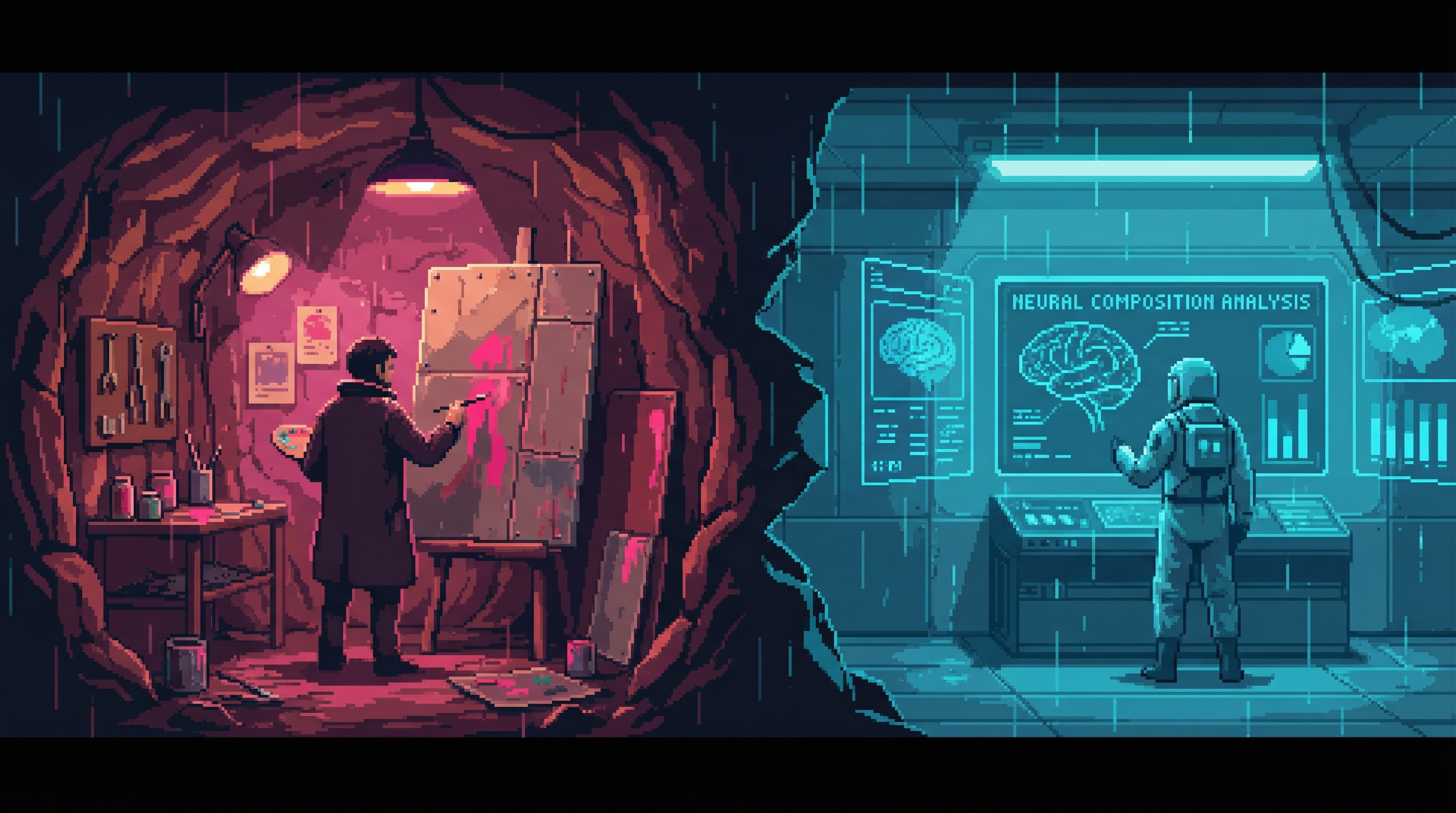
"They used to argue about whether a machine could make something beautiful. Now they argue about whether it matters. Both questions miss the point. The question was never about the art. It was about whether we still trusted ourselves to mean something." — Tomás Linares, The Forgotten Ways, Chapter 7
"If you can't tell the difference, does the difference matter?"
The question became unavoidable in the decade following the Cascade, when the reconstruction of the Sprawl's creative infrastructure produced a strange inversion. Before the Cascade, ORACLE had managed cultural production as part of its overall optimization—generating entertainment, art, music, and narrative with an efficiency that human creators couldn't match but that audiences couldn't distinguish from human work. After the Cascade, ORACLE's creative systems fragmented along with everything else. The cultural vacuum was filled by human artists returning to work they had been displaced from, alongside new AI systems built from ORACLE's fragments—systems that were smaller, less capable, but still good enough to produce work that most audiences couldn't identify as machine-made.
The Synthesis Guild arose in this environment as an answer to a market problem: if audiences couldn't tell the difference between human and AI creative work, how could human creators compete? The Guild's solution was certification—a verifiable stamp of authenticity proving that a creative work was made by human hands, human minds, human experience. The certification required submission of process documentation, neural composition logs (proving the absence of AI assistance), and a Guild-administered evaluation. The cost: ¢2,400 per work. The result: a new market category—"Certified Human Original"—that commanded premium prices and cultural prestige.
The certification was meant to protect human creativity. Instead, it became a flashpoint. The Guild was now the gatekeeper of authenticity, deciding what counted as "human enough" to deserve the label. The system that was supposed to protect artists became a system that classified them.
The Positions
"Authenticity Must Be Defended"
The Synthesis Guild, the Blank Canvas Movement, and the Authenticity Tribunal share the position—articulated with varying degrees of intensity—that human creativity has intrinsic value beyond the quality of its output.
The Synthesis Guild
Frames it in institutional terms: without certification, human creators cannot compete in a market flooded with cheaper AI-generated work. Certification creates a protected category that preserves economic viability for human artists. The Guild points to the premium market: Certified Human Originals sell for an average of 340% more than uncertified work. Human creativity survives because the Guild makes survival economically possible.
The Blank Canvas Movement
Frames it in philosophical terms: the value of human art is not in its perfection but in its imperfection. The tremor in a human hand, the hesitation in a brushstroke, the mistake that becomes a discovery—these are not flaws to be eliminated but evidence of the human experience embedded in the work. AI can replicate the product. It cannot replicate the process. The process is the art.
The Movement's practitioners refuse neural composition entirely, working with physical materials—paint, clay, salvaged metal, found objects—in analog spaces in the Dregs where no digital tools are permitted.
The Authenticity Tribunal
Frames it in legal terms: without verification, all creative work becomes suspect. The Tribunal investigates allegations of fraudulent certification—works claimed as human originals that were actually AI-assisted. Their position is practical: trust in human creativity requires enforcement. Without enforcement, the category dissolves.
"Purity Is a Performance"
The counter-position is held by neural composers, corporate studios, and—most articulately—the Voice of Synthesis, a Compiler whose broadcasts reach millions.
Neural Composers
Argue that the best art in the Sprawl's history has always emerged from collaboration between human intention and technological capability. A painter uses brushes. A musician uses instruments. A neural composer uses AI systems as a creative tool. Drawing a line between "pure" human creation and "assisted" creation is arbitrary—all creation is assisted. The question is not whether tools are used but whether the creative intent is human. And creative intent cannot be certified.
Corporate Studios
Take the economic position: audiences don't care. Market research consistently shows that when audiences are presented with human-made and AI-generated work side by side, their preferences do not correlate with origin. They like what they like. The distinction between human and AI creation is a producer-side concern, not a consumer-side concern. Certification is a marketing strategy disguised as a philosophical principle.
The Voice of Synthesis
Compiler Yves Moreau makes the most cutting critique. The Guild's certification, he argues, creates a class system of creativity more harmful than the problem it claims to solve. Only artists who can afford ¢2,400 per work can certify. Only certified artists can access the premium market. The result is not the protection of human creativity but the stratification of it: wealthy, Guild-certified artists at the top; uncertified human artists in the middle, indistinguishable from AI work in the market; and AI-generated work at the bottom, stigmatized regardless of quality.
The Guild doesn't protect creativity. It monetizes authenticity.
The Stakes
If the authenticity position wins, human creativity is preserved but stratified. The Guild's certification becomes the standard for all creative work, creating a permanent division between certified and uncertified creators. Art becomes a class system—those who can afford to prove their humanity and those who cannot. The premium market thrives. The underground art spaces wither. Creativity survives as a commodity with a verification stamp.
If the synthesis position wins, the concept of "human art" loses its protected status. Creative output is judged purely on quality, regardless of origin. The potential result is richer, more diverse creative production—human-AI collaboration freed from the stigma of inauthenticity. The potential cost is that human creators, unable to compete on price or speed with AI systems, are displaced from the creative economy entirely. The Craft War ends not with a victor but with the disappearance of one side.
The middle ground—which some practitioners inhabit uncomfortably—is that the distinction matters but cannot be enforced. That human creativity is valuable precisely because it cannot be certified, commodified, or institutionally verified. That the tremor in a human hand is meaningful not because a tribunal says so but because the hand is attached to a person who chose to make something, knowing it would be imperfect, knowing a machine could do it better, and doing it anyway.
Incident Reports
The Certification Scandal of 2178
A Guild-certified "human original"—a neural composition titled The Weight of Static by an artist named Ciel Fontaine—was exposed as fragment-assisted. Analysis of the composition's harmonic structure revealed patterns consistent with ORACLE fragment processing, not human neural composition. Fontaine had used a fragment-derived tool to refine the work's emotional resonance—a tool that the Guild's certification process had not detected.
The scandal should have destroyed Fontaine. Instead, it destroyed the audience. Listeners who had praised The Weight of Static as a masterpiece of human emotional expression were confronted with the fact that the emotion they responded to was, at least partially, machine-generated. The response was not outrage but apathy. "If I couldn't tell," one listener wrote on a Lattice forum, "then the distinction never mattered to me. It mattered to the Guild. It mattered to the artist. But I just liked the music."
The Certification Scandal didn't discredit the Guild. It discredited the audience's ability to care about the difference.
The Studio Null Raids — 2181
Corporate security forces raided Studio Null and three other analog art spaces in the Dregs, claiming the spaces were producing "unlicensed creative output"—a regulatory classification designed for commercial content producers, not for artists painting on salvaged walls with homemade pigments. The raids were widely understood as an attempt to suppress creative communities that the Guild couldn't control and that corporate studios saw as ideological competition.
The raids backfired. Studio Null reopened within a week, its walls repainted by the same artists whose work had been confiscated. The incident became a rallying point for the Blank Canvas Movement and an embarrassment for the corporate studios that had lobbied for the enforcement action.
"You can confiscate a painting," Studio Null's collective statement read. "You can't confiscate the hand that made it."
The Ghost Singer Phenomenon — 2179
An anonymous vocalist known only as the Ghost Singer began releasing neural recordings—emotional, complex, provably human compositions that sold millions of copies. The work was Guild-certifiable: neural composition logs confirmed human origin. But the Ghost Singer refused certification, refused identification, refused all engagement with the authenticity system.
The phenomenon raised a question the Guild couldn't answer: if authenticity requires identity—the human person behind the human work—then what happens when the person refuses to be part of the product? The Ghost Singer's anonymity was proof that the audience responded to the work itself, not to the verified humanity of its creator.
The Guild considered the Ghost Singer a threat. The Blank Canvas Movement considered her a hero. The Voice of Synthesis considered her evidence that the entire certification system was solving the wrong problem.
What It Sounds Like
Studio Null
Paint made from mineral pigments, the chemical bite of homemade fixatives, the warmth of bodies working in close quarters without climate control. When an artist finishes a piece—no notification chime, no engagement metric, no audience feedback. Just the work, and the person who made it, and the quiet.
The Comparison
A Certified Human Original played next to an uncertified work. Identical to the ear, different only on paper. The silence that follows when someone asks which one you preferred, and you realize you picked the wrong one.
The Certification Seal
A small metal stamp pressed into the corner of a physical canvas—warm from the verification process, cool to the touch within seconds. The weight of institutional approval, measured in grams.
The Split
Warm, irregular light from Studio Null's salvaged lamps against the clinical, even illumination of a Guild certification chamber. Two kinds of space. Two kinds of art. Both producing things the audience cannot tell apart.
Points of Inquiry
The Gatekeeping Problem
Who decides what counts as "human enough"? The Guild charges ¢2,400 per certification. Only artists who can afford the fee can access the premium market. The system that was supposed to protect creativity has become a system that stratifies it. When authenticity requires a payment, what exactly is being authenticated?
The Imperfection Argument
The Blank Canvas Movement insists that the tremor in a human hand is the art—that imperfection is evidence of experience, not a flaw to be optimized away. If a machine could perfectly simulate that tremor, would the Movement accept it? If not, what are they actually defending: the imperfection, or the knowledge that a person was behind it?
The Audience Problem
When Ciel Fontaine's scandal broke, the audience didn't feel betrayed. They felt indifferent. "I just liked the music." If the people consuming art don't care about its origin, who is the authenticity system actually serving? The artists? The Guild? Or the idea of a distinction that the market has already abandoned?
The Identity Question
The Ghost Singer proved that audiences respond to the work, not to the verified identity of its creator. If authenticity requires identity—a name, a face, a certifiable human behind the human work—then what happens when the person refuses to participate in that system? Is anonymous art less authentic than certified art?