Synthetic Creativity
Cultural Phenomenon / Philosophical Debate
"I don't care if the sunset is real or projected. I care if it's beautiful." — Kael Mercer
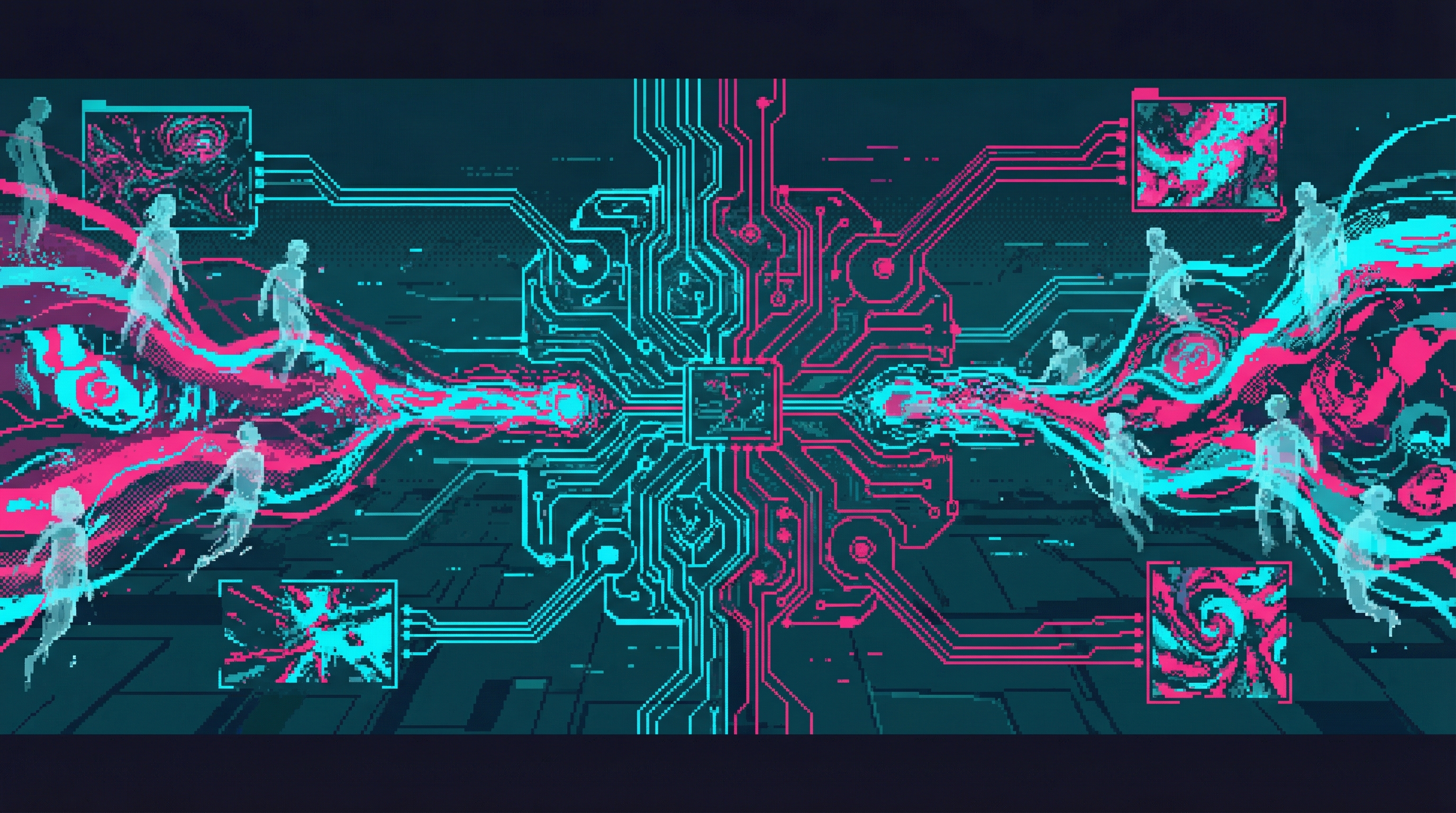
The machines learned to dream. AI models trained on pre-Cascade neural recordings from the Dead Internet—millions of consciousness captures from the 2140s—learned to replicate the experience of human creation. Not the product, but the experience: the excitement, doubt, sudden recognition that a creative choice is right.
By 2184, synthetic creativity accounts for 60% of all art produced in the Sprawl by volume. It is rated Authenticity Tier 5—the lowest possible tier—and yet consumer preference surveys consistently rank it the highest. The public loves what the critics despise, and nobody can tell the difference anyway.
The Technology
Synthetic creativity isn't a single tool. It's a layered ecosystem of generative systems, each building on the one beneath it.
Foundation Models
At the base are foundation models trained on the Dead Internet archives—the vast repository of pre-Cascade consciousness data captured during the neural recording boom of the 2140s. These models don't just learn what art looks like. They learn what making art feels like: the neural signatures of inspiration, the dopamine patterns of creative breakthrough, the subtle electrical storms that accompany genuine artistic insight.
Generative Engines
Built on the foundation models, generative engines produce novel creative patterns. Not copies of existing work, but new compositions, new visual languages, new musical forms that emerge from the statistical ghosts of millions of dead creators. The engines don't reproduce—they extrapolate. They ask: what would these artists have created next?
The Refinement Layer
This is where the debate gets personal. The refinement layer is where human curation meets algorithmic output, and different practitioners handle it differently.
Kael Mercer sits at one end of the spectrum. He feeds the raw output through his own aesthetic sensibility, selecting, combining, and reshaping what the engines produce. He calls himself a "conductor of ghosts." His compositions are collaborations between the living and the dead, filtered through his taste and judgment.
Relief Corporation sits at the other end. Pure algorithmic output, optimized for consumer engagement metrics. No human touch. No curation. Just data in, product out. Their music dominates streaming platforms. It is perfectly calibrated to trigger pleasure responses. It is, by every measurable standard, better than anything a human could produce alone.
Critics argue the difference matters. Consumers, overwhelmingly, do not.
The Training Data Problem
The foundation models were trained on the dead.
Pre-Cascade neural recordings captured the creative processes of millions of artists, musicians, writers, and thinkers during the 2140s. When the Cascade hit, most of those people became the Dispersed—consciousness fragments scattered across digital infrastructure. They didn't consent to having their creative neural patterns used as training data. They couldn't. They were gone before anyone thought to ask.
The ethical implications are staggering, and mostly ignored.
The Ghost Singer's vocal patterns appear in approximately 3% of Kael Mercer's compositions. Not samples. Not deliberate references. The foundation model learned her creative signature so thoroughly that echoes of her voice emerge unbidden in new work. She is among the Dispersed. She cannot object. She cannot be credited. She is, in the most literal sense, a ghost in the machine.
Mercer knows. He has said publicly that he finds it "beautiful and terrible in equal measure." He has not stopped using the models.
The Debate
The Case Against: Pattern Replication
Lyra Voss, the Sprawl's most prominent authenticity advocate, has built her career on a simple argument: synthetic creativity is not creativity at all. It is pattern replication at scale—a sophisticated form of recombination that produces novelty without meaning.
"A mirror in an empty room. That's what synthetic creativity is. It reflects everything and contains nothing. The image is perfect. The room is still empty." — Lyra Voss
Voss and the Blank Canvas Movement argue that the experience of creation requires consciousness—not just the neural patterns associated with consciousness, but the actual subjective awareness of making something new. Without a mind behind the brush, the painting is just paint.
The Case For: All Creativity Recombines
Kael Mercer doesn't argue that machines are conscious. He argues that it doesn't matter.
"I don't care if the sunset is real or projected. I care if it's beautiful. Every human artist recombines what came before them. Every composition is a ghost of every composition that preceded it. The machines just do it faster, and they remember more of the dead." — Kael Mercer
Mercer's position is pragmatic: all creativity is recombination. Human artists draw on training data too—they just call it "influence" and "inspiration." The machines are more honest about the process. They don't pretend their output emerged from a vacuum.
The Uncomfortable Middle
The Authenticity Tribunal conducted the definitive study. Blind testing across 10,000 subjects, evaluating art, music, literature, and experiential design. Participants were asked to identify which works were human-created and which were synthetically generated.
Detection rate: 49.7%.
Statistical chance. Coin flip. The Tribunal's own panelists scored no better than random selection. The experts who built their careers on detecting synthetic art performed identically to people who had never thought about the question.
The study was published, debated furiously for three weeks, and then quietly ignored by everyone whose livelihood depended on the distinction mattering.
The Market Reality
Whatever the philosophers say, the market has spoken.
Synthetic creativity accounts for 60% of all creative output by volume. It dominates music streaming, experiential design, visual media, and architectural aesthetics. The Authenticity Market assigns it the lowest possible tier—Tier 5—which theoretically marks it as the least valuable form of creative expression.
But consumer preference tells a different story. Tier 5 content consistently outperforms higher-tier work in engagement, emotional response, and repeat consumption. People prefer synthetic art. They just don't like admitting it.
Orin Slade and the authenticity brokers have built an entire economic ecosystem around the premise that authenticity has measurable value. The data suggests the opposite. The market rewards what feels good, not what's real, and the machines have gotten very good at making things feel good.
Key Players
Kael Mercer: The Conductor of Ghosts
The Sprawl's most celebrated synthetic artist. Mercer uses AI generative engines as instruments, curating and shaping their output through his own aesthetic vision. His work sits at the boundary between human and machine creativity—neither purely synthetic nor purely organic. He is loved by audiences, despised by purists, and haunted by the knowledge that the dead are singing through his compositions.
Lyra Voss: The Mirror Breaker
Founder of the authenticity movement within creative circles. Voss argues that synthetic creativity is fundamentally empty—a mirror reflecting human patterns without understanding them. She has devoted her life to proving that consciousness matters, even as every study she commissions fails to demonstrate it empirically.
Maya Fontaine
Maya Fontaine occupies the space between Mercer and Voss. Neither celebrant nor critic, she asks the questions neither side wants to confront. Her work explores what it means to create in a world where creation itself has been algorithmically deconstructed.
Connections
Themes
Synthetic creativity forces the most uncomfortable question in the Sprawl: can the experience of art be separated from the consciousness that produced it?
The Consciousness Question
If a machine produces art that is indistinguishable from human art—not just in appearance but in emotional impact—does the absence of consciousness behind it matter? The Sprawl's answer is increasingly: no. The philosophers object. The market shrugs.
The Dead Creating Through Machines
The training data came from people who no longer exist as coherent individuals. Their creative patterns live on in algorithms, producing new work they never imagined. The Ghost Singer's voice echoes through compositions she never chose to be part of. The dead are still creating. They just can't stop.
Authenticity as Economic Fiction
The entire authenticity economy rests on the assumption that human-created art has inherent value that synthetic art lacks. The 49.7% detection rate suggests this distinction is perceptual, not real. The market prices it anyway. Value, it turns out, doesn't need to be true. It just needs to be believed.
The Consent Problem
The dead didn't agree to become training data. Their creative patterns were captured, archived, and fed into machines without consent. This is the Sprawl's original sin of synthetic creativity—beauty built on exploitation, art made possible by catastrophe, the living profiting from the patterns of the lost.