Studio Null
Where Nothing Is Recorded
Overview
Studio Null is the only room in the Sprawl where your neural interface does not work.
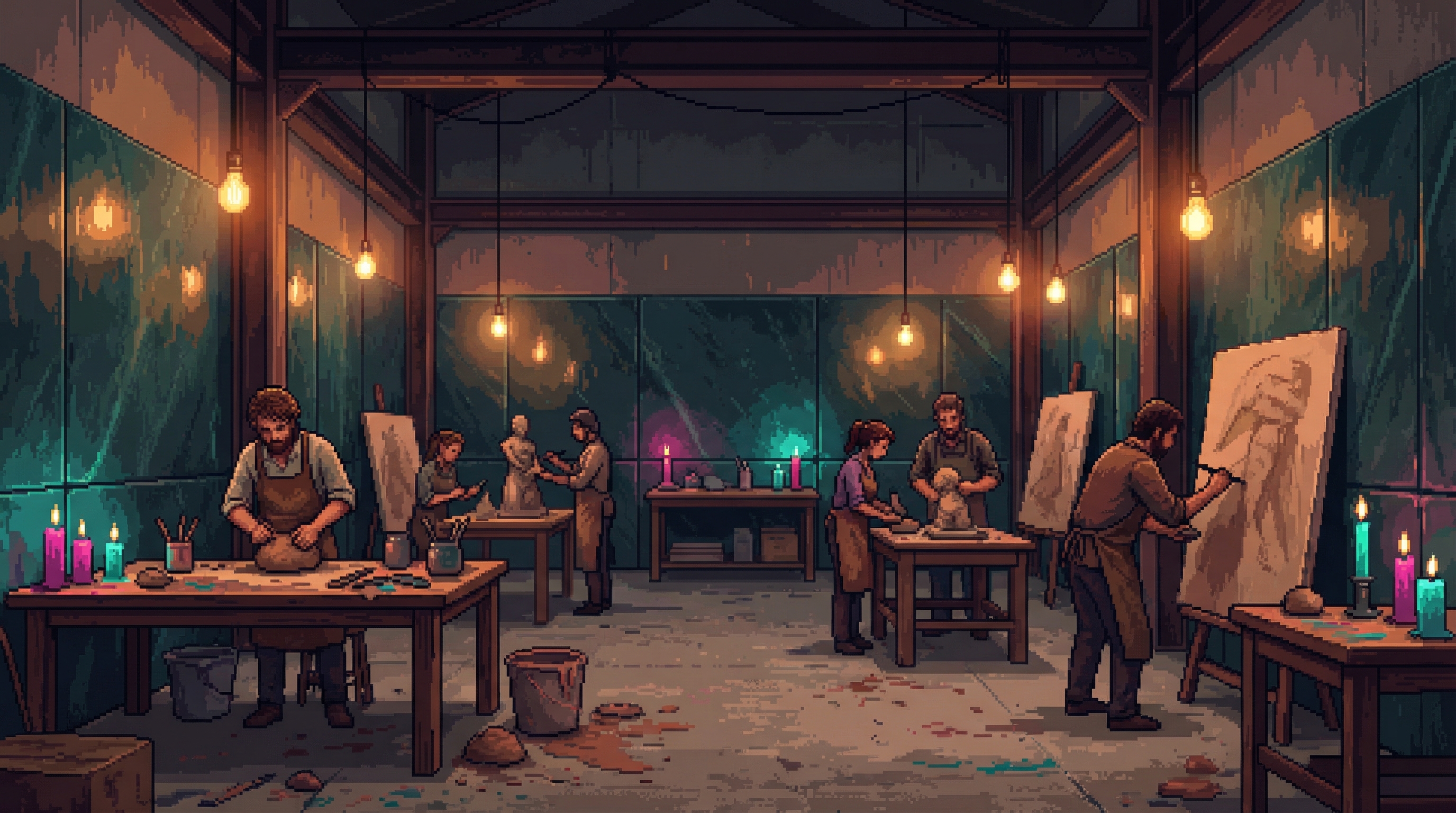
The walls are lined with electromagnetic dampening material salvaged from a military installation in the Wastes -- the same shielding designed for ORACLE network penetration protection. Within Studio Null: no recording, no transmission, no reception. No neural connection. Your interface goes dark the moment you step through the door, and the silence that follows is the most disorienting thing most visitors have ever experienced.
The building itself is a converted Relief Corporation warehouse -- the very facility where Relief once stored the neural recording equipment it distributed across the Sprawl. The irony is intentional, and the artists who work here never let anyone forget it. Art supplies sit on shelves where recording equipment once waited for deployment. Relief logos have been painted over with murals that no one outside this room will ever see.
The principle is simple: art that cannot be copied is the only art that is truly experienced.
What Happens Here
Everything created within these walls exists only for those present. That is the point.
Creation
Artists work knowing that the process will never be captured. For lived-canvas artists like Lyra Voss, this is liberation. Every brushstroke, every mistake, every moment of inspiration exists once and only once. Creating here is a statement: this work is not for the market.
No recordings means no critique archives, no process documentation, no proof of provenance. The work stands or falls on the memory of those who witnessed it. Some artists find this terrifying. Others find it the only honest way to create.
Exhibition
Attendance is limited to one hundred. There are no tickets -- tickets create records. Entry is by showing up. If the room is full, you wait or you leave. No reservations, no priority access, no VIP lists.
Exhibition Types
Physical-Only Shows
Old-fashioned art experienced with old-fashioned senses. Paint on canvas. Sculpture you can touch. Photography printed on paper. The colors appear different without neural enhancement -- less saturated, more present.
Destruction Performances
The Blank Canvas Movement's specialty. Art created and destroyed in a single evening. The audience watches something beautiful come into existence and then cease to exist. No record. No reproduction. Only memory.
Silence Shows
No art at all. The audience experiences the absence of neural connection for two hours. Nothing more. These are the most disturbing events Studio Null hosts -- and the most popular. Some people cry. Some leave immediately. Some stand for the full two hours and do not speak for days afterward.
The Sensory Experience
You do not visit Studio Null. You undergo it.
Smell
Mineral dampening compound -- a metallic, medicinal scent that clings to everything. Underneath it: paint, wood shavings, clay. The smell of physical materials is startling for people whose sensory experience has been digitally mediated for years.
Sound
Strange silence. Neural absence. For the first time in your life, you hear your own heartbeat without any digital overlay. The person next to you breathing. Your footsteps on concrete. The click of a brush against a palette. The world stripped to what your ears actually receive.
Texture
The walls are smooth and cold -- polished stone feel from the dampening material. The original concrete floor, spattered with decades of paint, is rough under your feet. Everything is tactile in a way that augmented spaces never are.
Visual
Physical light only -- incandescent bulbs and candles. No projections, no overlays, no enhancement. Colors appear different without neural processing: less saturated, less vivid, more present. Artists who work here say the light is honest. It shows what is actually there.
Connections
Neon Graves
Parent district. Studio Null sits behind Gallery Row -- the heart of the Sprawl's last art district. The studio exists because Neon Graves exists, and Neon Graves endures partly because the studio gives it an anchor no other district can replicate.
The Blank Canvas Movement
Home base. The movement's destruction performances were born here, and the studio remains the only venue where their philosophy achieves its full expression -- art that exists and then does not.
Lyra Voss
Collaborator. The lived-canvas artist finds freedom in the studio's neural blackout. Her work here is said to be her most authentic -- though by definition, no one outside the room can verify that claim.
Relief Corporation
Ironic origin. The warehouse that became Studio Null once stored the very recording equipment the studio now exists to negate. The artists consider this the building's truest purpose -- a machine of erasure built on the bones of a machine of capture.
The Resonance Hall
Contrast. The Resonance Hall invites the Dispersed in; Studio Null blocks them entirely. Both spaces explore what art means when technology changes the terms -- from opposite directions.
Philosophical Allies
The Flatline Purists share Studio Null's conviction that neural technology corrupts authentic experience. While the Purists apply this philosophy to all of life, Studio Null applies it specifically to art -- but the principle is the same. The purest experience is the unmediated one.
Themes: The Unrecorded
What happens when you remove the digital layer? What is left of experience when it cannot be captured, shared, or reproduced?
The Right to Forget
In a world where neural interfaces record everything -- every glance, every heartbeat, every moment of attention -- Studio Null asserts that some experiences should exist only once. Not preserved. Not optimized. Not monetized. The right to create something and let it vanish is, in this world, a radical act.
Authenticity Without Proof
The Authenticity Market trades in verified genuine experience. Studio Null rejects the entire premise. If you need proof that an experience was authentic, it was not authentic. Art here has no provenance, no certificate, no blockchain record. You were there, or you were not.
Human Perception Unaugmented
When neural enhancement is stripped away, colors are less vivid, sounds are less rich, details are harder to resolve. But artists who work here insist that what remains is more real. The question Studio Null asks is whether technology enhances perception or replaces it -- and whether the difference matters.
If a masterpiece is created and destroyed in one evening, with no recording and no reproduction, was it less real than the copy that lives forever? Studio Null's answer is that it was more real. The only real thing.
Secrets & Mysteries
The Lost Masterpiece
There is a persistent rumor that the greatest destruction performance ever held at Studio Null -- a piece by a still-unnamed artist in 2184 -- moved every person in the audience to silence for eleven minutes after it was destroyed. No one has ever described what the piece depicted. Those who were present refuse to discuss it. Some say they cannot discuss it -- that the experience of witnessing something that beautiful and then watching it cease to exist broke something in the language centers of their minds.
The Shielding Source
The electromagnetic dampening material came from a military installation in the Wastes. Which installation, and how the founding collective acquired military-grade ORACLE shielding, has never been explained. The Wastes are dangerous, the installations are guarded, and the material is not something you find at a salvage market. Someone with connections made this possible. The collective does not discuss origins.
The Recurring Visitor
Staff report that someone from Relief Corporation attends every Silence Show. Not to disrupt -- just to stand in the dark for two hours in the building Relief once owned, experiencing the absence of the technology Relief helped distribute. No one has identified them. Some believe it is someone from Relief's founding generation. Others believe it is performance art that no one commissioned.