Void Tone
Music Genre / Acoustic Phenomenon / Lattice Culture
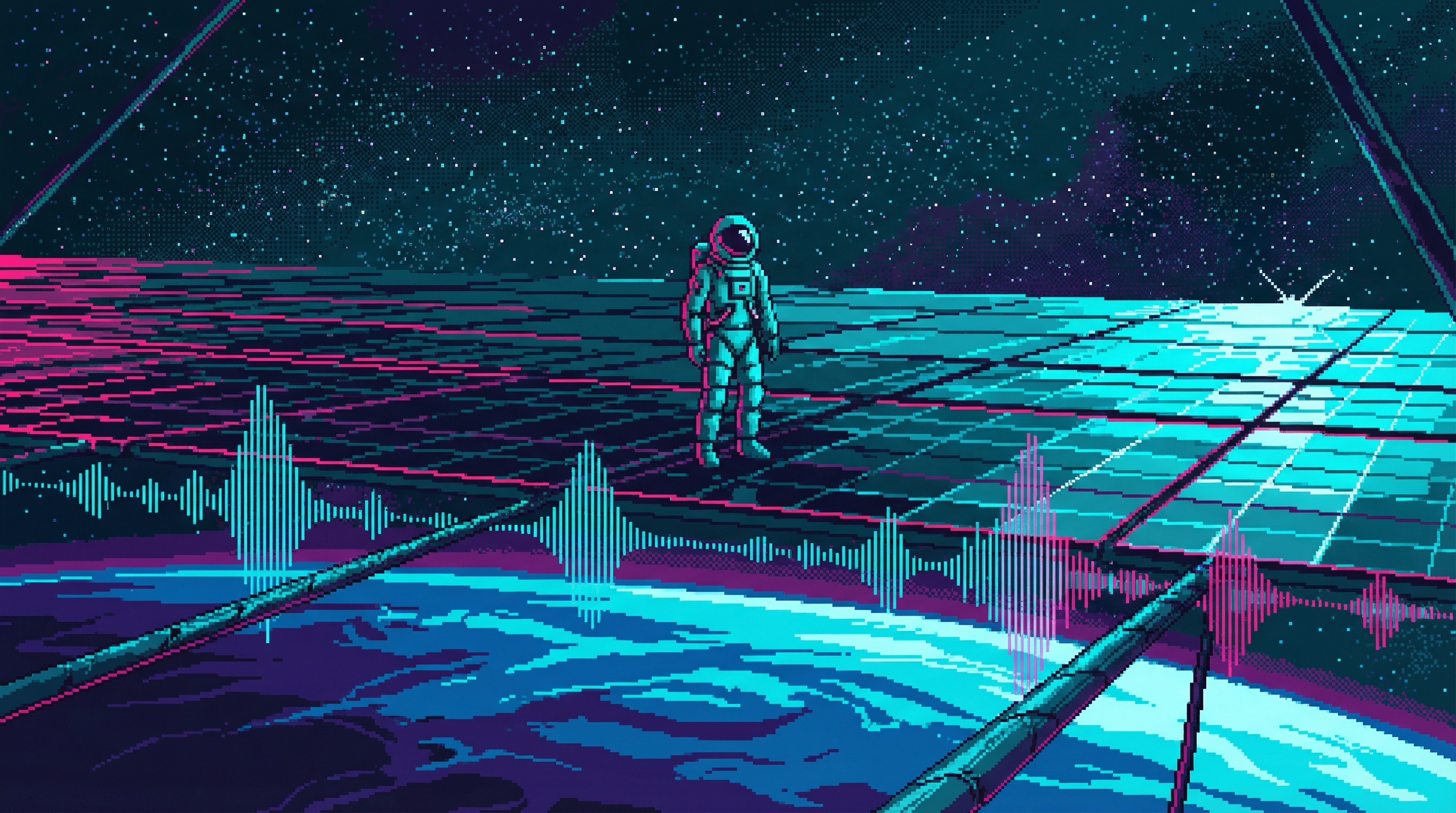
"Like a cathedral thinking." — Description of the Lattice’s acoustic properties
Void Tone is a music genre that originates from the Lattice—the massive solar collection megastructure in orbit. It is not music composed for an instrument. It is music produced by an instrument that was never meant to be one: the sounds of solar collectors expanding and contracting in sunlight, structural cables vibrating at frequencies shaped by near-vacuum conditions, and the deep resonance of infrastructure at orbital altitude.
The defining paradox of Void Tone is simple: the music is created by conditions that would kill most of its potential audience. It is authentic in the purest sense—Tier 1 lived originals that can only be lived by those willing to risk their lives at the edge of space.
Discovery
The first recording of Void Tone was not a musical endeavor. A drift-runner named Sahar Koss, working a maintenance run on the Lattice, captured what she described in her log as "lattice weird noise"—a strange, resonant hum produced by the megastructure’s cables during a solar alignment. The recording was incidental, a curiosity logged alongside routine repair notes.
It was Pei Vansara who recognized the noise as something more. Vansara, a composer with a background in acoustic engineering, listened to Koss’s recording and heard not mechanical noise but music—complex, layered, and unlike anything produced on the surface. Where others heard infrastructure, Vansara heard composition.
Vansara traveled to the Lattice and spent months learning its acoustic properties. The result was a collection of 16 pieces composed not for the Lattice but using it—treating the entire megastructure as a single instrument. Solar collectors became percussion. Structural cables became strings. The near-vacuum environment provided a resonance chamber unlike anything on Earth.
Void Tone was born.
The Sound
Void Tone has been described as "like a cathedral thinking"—a phrase that captures both its spatial grandeur and its eerie sense of intention. The sound is produced by three primary sources, each contributing a distinct layer to the music.
Structural Vibrations
The Lattice’s structural elements vibrate at frequencies ranging from 2Hz to 400Hz, creating deep, resonant tones that are felt as much as heard. These vibrations are the foundation of Void Tone—a bass register that operates at the threshold of human perception, felt in the chest and bones before the ears register it.
Cable Harmonics
The structural cables that span the Lattice produce harmonic overtones when solar energy causes thermal expansion. These harmonics are complex and unpredictable, shifting with the angle of sunlight and the thermal state of the cables. Composers learn to anticipate these shifts, but they can never fully control them. The Lattice always has its own voice.
Vacuum Resonance
The near-vacuum environment at orbital altitude produces acoustic properties impossible to replicate on the surface. Sound propagates differently through the Lattice’s solid structures, creating resonance patterns that have no terrestrial equivalent. The silence of space becomes part of the music—the absence of air shaping the sound as much as the presence of structure.
The Authenticity Problem
Void Tone sits at an extreme edge of the Authenticity Market. The original performances are Tier 1 lived originals by definition—they are experienced firsthand by drift-runners and composers working on the Lattice. But the conditions required to experience them are lethal to most human beings.
This creates a genre where authenticity is both absolute and inaccessible. The truest form of the music can only be heard by those willing to work at orbital altitude, in pressure suits, on a megastructure designed for energy collection rather than habitation. The surface audience—approximately 10,000 devoted listeners—will never hear the real thing.
Kael Mercer’s Synthetic Void Tone
Kael Mercer, working in Synthetic Creativity, has produced synthetic Void Tone compositions that are indistinguishable from originals to surface ears. His AI models, trained on hundreds of hours of Lattice recordings, generate new compositions that capture the structural vibrations, cable harmonics, and vacuum resonance with near-perfect fidelity.
To anyone who has never been to the Lattice, Mercer’s synthetic compositions are identical to the real thing. But drift-runners can tell the difference. They describe the synthetic version as having a "hum" where the original has a "drift"—a subtle quality related to the unpredictable micro-variations that only the Lattice’s actual environment produces.
Drift vs. Hum
Drift-runners describe authentic Void Tone as having a quality they call "drift"—subtle, unpredictable micro-variations produced by the Lattice’s actual thermal and structural conditions. Synthetic reproductions, no matter how sophisticated, produce what drift-runners call a "hum"—a version that is technically accurate but lacks the stochastic irregularity of real orbital conditions.
Surface listeners cannot perceive the difference. In blind tests, even trained audiophiles fail to distinguish drift from hum. The distinction exists only for those who have lived it.
Lattice Culture
Void Tone has given rise to a small but devoted culture aboard the Lattice itself. What began as incidental noise discovered during maintenance runs has become the foundation of a community that treats the megastructure not just as infrastructure but as a living instrument.
Listening Stations
Drift-runners have established informal listening stations at points along the Lattice where acoustic properties are particularly rich. These locations—often at junctions where multiple structural cables converge—are treated with a reverence that borders on the spiritual. Drift-runners visit them during off-shifts, sitting in their pressure suits, listening to the Lattice speak.
Void Tone Gatherings
Periodic gatherings bring drift-runners together at favored listening points. These are not concerts in any traditional sense. There is no stage, no performer, no audience. Instead, participants position themselves at different points along the structure and experience the same acoustic event from different spatial perspectives. The "performance" is the Lattice itself, and every listener hears a unique version shaped by their position.
These gatherings have become the closest thing the Lattice community has to a ritual—moments of shared experience in an environment that is otherwise defined by isolation and danger.
Active Composers
Between 50 and 100 active composers work with Void Tone at any given time. Some, like Pei Vansara, approach it as formal composition—learning the Lattice’s acoustic properties and deliberately positioning themselves to shape the sound. Others take a more ambient approach, simply recording what the Lattice produces and curating the results.
The composer community is small, insular, and deeply protective of their art form. They view Void Tone not as music they create but as music the Lattice creates through them—a distinction that reflects both humility and a genuine recognition that the megastructure’s acoustic output exceeds anything a human composer could deliberately design.
The Surface Audience
Void Tone’s surface audience numbers approximately 10,000 devoted listeners—a tiny community compared to most genres, but passionate in their dedication. These listeners have never been to the Lattice and likely never will. They experience Void Tone through recordings that, by the logic of the Authenticity Market, are at best Tier 2 First Copies of the original experience.
The devoted listeners don’t care about tiers. They care about the sound—the deep, resonant, alien quality of music produced by space infrastructure. For them, Void Tone represents something unreachable and therefore precious: genuine acoustic novelty in a world where every sound has been recorded, copied, and commodified.
Relief Corp’s Synthetic Experiences
Relief Corporation has recognized the commercial potential of Void Tone and markets synthetic "void tone experiences" to approximately 200,000 subscribers. These experiences use Kael Mercer’s synthetic compositions as a base, layered with fabricated sensory data to simulate the experience of being on the Lattice.
The synthetic experiences are popular, profitable, and—by the standards of drift-runners who have heard the real thing—fundamentally false. They capture the hum but not the drift. They simulate the sound but not the silence. They reproduce the music but not the danger that gives the music its meaning.
The 200,000 synthetic subscribers outnumber the 10,000 devoted listeners by twenty to one. Whether the synthetic audience is experiencing Void Tone or merely a convincing imitation of it is a question the genre’s community has no consensus on.
Key Figures
Sahar Koss
The drift-runner who made the first recording of Void Tone. Koss was not a musician and did not recognize what she had captured. Her maintenance log entry—"lattice weird noise"—became the genre’s unofficial origin text. Koss continues to work on the Lattice and reportedly finds the attention her recording receives baffling.
Pei Vansara
The composer who recognized the Lattice’s acoustic output as music. Vansara’s 16 original compositions, each using the Lattice as instrument, established Void Tone as a formal genre. Vansara spent months learning the megastructure’s acoustic properties and remains the genre’s most influential figure.
Kael Mercer
Kael Mercer’s synthetic Void Tone compositions are indistinguishable from originals to surface listeners but lack the "drift" that drift-runners recognize as authentic. His work raises the genre’s central authenticity question: if the audience cannot tell the difference, does the difference matter?
Orin Slade
Orin Slade’s connection to Void Tone reflects the broader intersection of Lattice culture with the Sprawl’s power structures. As someone who operates within the Lattice’s economic ecosystem, Slade’s relationship to the genre illustrates how even the most authentic forms of expression become entangled with commerce.
Connections
Key Entities
Related Concepts
Themes
Void Tone explores the tension between authentic experience and technological reproduction—a tension that resonates with contemporary questions about AI-generated content and the value of human creativity.
Inaccessible Authenticity
Void Tone represents a form of creativity that is genuinely, physically inaccessible to most people. The music exists in conditions that would kill its audience. This mirrors the broader question of whether AI can create art that captures qualities only accessible through lived human experience—and whether the audience can tell the difference.
The Imperceptible Difference
The distinction between "drift" and "hum"—perceivable only by those who have experienced the real thing—raises a fundamental question: if a difference exists but cannot be detected by the intended audience, is it meaningful? Synthetic Void Tone is identical to the real thing for 99.9% of listeners. The 0.1% who can tell the difference are the only ones whose opinion the genre values.
Infrastructure as Instrument
The Lattice was built to collect solar energy, not to make music. The music is an emergent property of infrastructure—unintended, undesigned, and more beautiful than anything its builders could have planned. This parallels how AI systems sometimes produce unexpected creative outputs that exceed their designed purpose.
Commodification of the Unreachable
Relief Corp sells 200,000 synthetic subscriptions of something that only 10,000 people genuinely care about. The commercial version outnumbers the authentic community twenty to one. This mirrors how AI-generated content can scale authentic creative traditions into mass products that bear the form but not the substance of the original.
Void Tone asks: when the conditions that create art are inseparable from the art itself, can any reproduction—no matter how technically perfect—be considered the same thing? The Lattice does not answer. It just keeps vibrating.