The Authenticity Market
Economic System / Experience Economy / Consciousness Philosophy
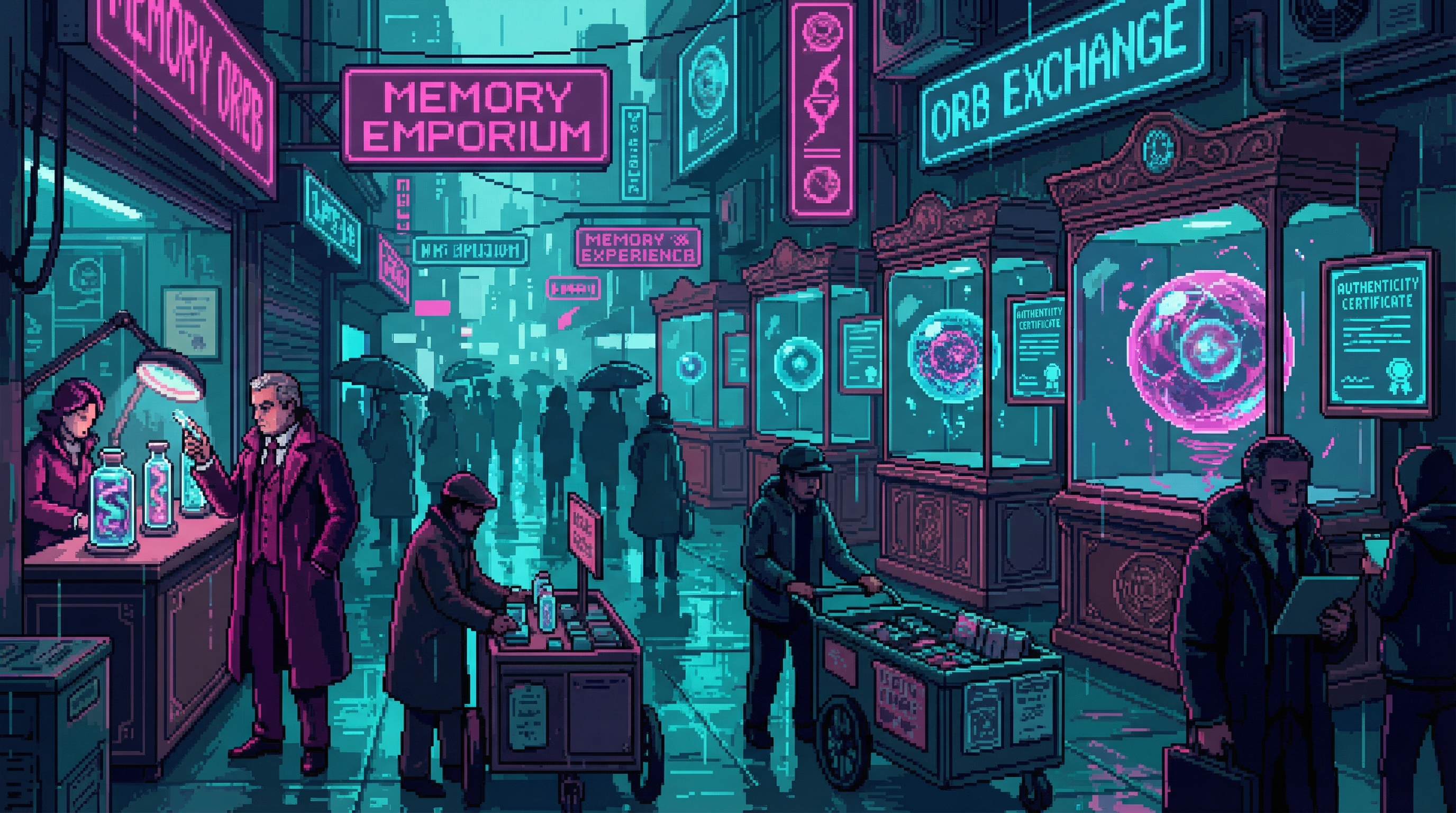
"The Rothwells sell memories like they're selling vintage wine. But wine doesn't remember being drunk. Memories do." — Echo-Archive, The Collective
In a world where memories can be copied and consciousness can fork, "authenticity" has been monetized. The Authenticity Market is the vast, semi-regulated economic ecosystem that assigns value to originality, uniqueness, and the increasingly elusive quality of being first. It is the engine that powers the experience economy of the post-Cascade Sprawl—and the source of some of its deepest inequalities.
Everything can be copied. Neural recordings, memory extraction, consciousness backups, emotion synthesis—the technology exists to replicate any human experience with near-perfect fidelity. And yet people pay massive premiums for originals. The Authenticity Market exists because of this paradox: in a world of infinite copies, scarcity has been reinvented.
The Foundational Paradox
The paradox at the heart of the Authenticity Market is deceptively simple: if a copy is indistinguishable from the original, why does the original cost more?
The answer, as with most things in the Sprawl, is power. The corporations that control verification technology—primarily Nexus Dynamics through its proprietary Verisys™ platform—have a vested interest in maintaining the distinction between "authentic" and "copy." Without that distinction, there is no premium. Without the premium, there is no market. Without the market, there is no control.
The technology to copy experiences has existed since the late 2140s. Neural recording became commercially viable during the boom years before the Cascade, and memory extraction techniques were refined throughout the 2150s. By the time the Authenticity Market formally emerged, the copying was already flawless. The market didn't arise because copies were imperfect. It arose because someone realized that labeling them as imperfect was profitable.
The Helix Discovery
Internal Helix Biotech research (suppressed, 2171) found zero measurable neurological difference between a Tier 1 lived experience and a Tier 3 verified copy when administered under controlled conditions. Test subjects could not distinguish their own memories from implanted copies. The study was buried. The researcher who conducted it—Dr. Aris Lam—now works in Helix's agricultural division. She does not discuss the study.
The Economics of Being First
The Authenticity Market runs on a single principle: first is worth more. Not better, not different—just first. The premium attached to original experiences dwarfs the cost of copies by orders of magnitude, creating an economy where the wealthy live in a world of firsts and everyone else lives in a world of echoes.
Authenticity Premiums
The following table represents representative market prices as of 2184. Premiums fluctuate based on demand, verification status, and the ongoing political battles over what counts as "authentic."
| Experience | Authentic Price | Copy Price | Premium Multiple |
|---|---|---|---|
| Sunrise from Orbital Elevator | 50,000 credits | 12 credits | 4,166× |
| Conversation with Helena Voss | 2,300,000 credits | 890 credits | 2,584× |
| First Kiss (emotional template) | 15,000 credits | 8 credits | 1,875× |
| Near-Death Experience | 180,000 credits | 45 credits | 4,000× |
| A Mother's Love (donor memory) | Illegal | 2 credits | — |
The last entry is the one that breaks people. A mother's love—the actual, lived memory of unconditional maternal affection—cannot be legally sold as an authentic experience. The Verity Act of 2161 classified parental bonding memories as protected. But copies are available for two credits from any street vendor in the Sprawl. Two credits for something that some people never had and will never have.
The black market, predictably, ignores the restriction.
Verisys™ Verification
Nexus Dynamics controls the Verisys™ verification platform, which serves as the de facto standard for authenticating experiences. Every legitimate transaction in the Authenticity Market passes through Verisys™. Every tier assignment is made by Verisys™ algorithms. Every premium is justified by a Verisys™ certificate.
This gives Nexus extraordinary power. The company that decides what's authentic effectively decides what's valuable. And Nexus has never been shy about leveraging that position.
Verisys™ implicitly propagates a specific philosophical position: that copies lose something in the transfer, that the original retains an ineffable quality that reproduction cannot capture. This position is commercially convenient. It is also, based on every controlled study ever conducted, empirically unsupported.
The Authenticity Hierarchy
The Market operates on a rigid five-tier hierarchy, formalized in the Verity Act of 2161 and enforced through Verisys™ certification. Each tier carries distinct legal rights, market values, and social connotations. The hierarchy is presented as a neutral classification system. It is, of course, nothing of the sort.
Tier 1: Lived Originals
The rarest and purest form of experience—moments actually lived by a conscious being in real time. A sunset watched with your own eyes. A conversation had with your own voice. The neurological imprint of genuine, first-person experience.
Lived Originals cannot be manufactured, only recorded. They are the gold standard of the Authenticity Market, commanding premiums of thousands of times the copy price. The irony is that the act of recording a Lived Original for sale fundamentally changes the experience itself—you cannot simultaneously live authentically and commodify the living. But the market prefers not to think about that.
Tier 2: First Copies
The first reproduction of a Lived Original, created directly from the source recording. Legally distinct from the original, First Copies are traded by experience brokers—most prominently the Rothwell brothers' Relief Corporation—as premium products for clients who want something close to authentic without paying Tier 1 prices.
First Copies carry a Verisys™ certificate of provenance that traces their lineage back to the original recording. They are the luxury goods of the experience economy—expensive enough to be exclusive, available enough to be profitable.
Tier 3: Verified Copies
Copies of copies, but with an unbroken chain of Verisys™ verification. This is where the middle class lives. Verified Copies are affordable, legally clean, and carry the Nexus seal of approval. They are the bread and butter of the Authenticity Market—the volume product that keeps the economic machine running.
The distinction between a Tier 2 First Copy and a Tier 3 Verified Copy is, in practice, undetectable by the human brain. The distinction exists entirely in the metadata. But metadata, in the Sprawl, is reality.
Tier 4: Unverified Copies
Copies that have lost their chain of verification—either through unauthorized reproduction, corrupted metadata, or deliberate stripping of Verisys™ certificates. This is the domain of black markets and shadow traders, El Money's network prominent among them.
Unverified Copies may be identical to Tier 3 products in every measurable way. They simply lack the paperwork. In the Authenticity Market, lacking paperwork is the same as lacking value. The experience itself is irrelevant; what matters is the certificate.
Tier 5: Synthetic Experiences
AI-generated experiences with no human origin point. Created by generative models trained on vast libraries of neural recordings, Synthetic Experiences are the most abundant and cheapest tier. They are also, in blind tests, indistinguishable from Tier 1 Lived Originals.
The Authenticity Tribunal's landmark study found a detection rate of 49.7%—statistical chance. Experts performed no better than random selection. Synthetic Experiences are rated lowest by the hierarchy and preferred highest by consumers. The market has noticed. The hierarchy pretends it hasn't.
See also: Synthetic Creativity.
Who Profits
The Authenticity Market is not a neutral marketplace. It is a system designed to benefit specific actors, and those actors have worked hard to ensure it stays that way.
The Rothwell Brothers — Relief Corporation
Relief Corporation, controlled by the Rothwell brothers, is the largest experience broker in the Sprawl. They operate on both sides of the market: selling authentic experiences to the wealthy and manufactured anxiety to everyone else. The business model is elegant in its cruelty—create the fear that your life isn't real enough, then sell the cure.
Relief Corp's marketing campaigns emphasize the inadequacy of copies. "You deserve the real thing." "Don't settle for someone else's sunrise." "Your children deserve authentic memories." The messaging is relentless, and it works. Relief Corp has turned existential anxiety into a recurring revenue stream.
Nexus Dynamics — Verisys™
Nexus doesn't sell experiences. It sells the infrastructure that makes the market possible. Verisys™ verification is required for any legal transaction above Tier 4, and Nexus takes a percentage of every verified sale. More importantly, Nexus controls the definition of authenticity itself.
Verisys™ carries an implicit philosophical position: that copies are inherently lesser, that something is lost in reproduction, that the chain of provenance matters. This position is not scientifically supported. It is, however, enormously profitable. As long as the market believes copies are worth less, the verification premium exists. As long as the verification premium exists, Nexus profits.
The 67% ORACLE integration in Verisys™'s core algorithms raises additional questions. Helena Voss personally approved the algorithmic framework. Whether ORACLE's fragmentary influence shapes what Verisys™ considers "authentic" is a question no one at Nexus is eager to answer.
The Collective — Counter-Position
The Collective opposes the Authenticity Market on ideological grounds. Their position is simple: experiences belong to everyone. The hierarchy is a tool of corporate control. The premiums are artificial scarcity imposed on something that is, by its nature, infinitely reproducible.
The Collective operates free experience-sharing networks in the jurisdictional gaps between corporate territories. They strip Verisys™ certificates from recordings and distribute them without tier classification. To the Collective, a memory is a memory. The label doesn't change what it feels like.
They are, predictably, branded as pirates by Nexus and criminals by Relief Corp.
Social Consequences
The Authenticity Market hasn't just created an economy. It has created a class system based not on wealth alone, but on the quality of experience wealth can buy.
Experience Inequality
The Sprawl's population has stratified into three informal classes, defined not by income but by the tier of experiences they can afford.
The Experience Elite
The wealthiest residents of the Sprawl, who live exclusively on Tier 1 and Tier 2 experiences. Every memory is verified authentic. Every emotion is documented as original. They inhabit a world of firsts—first sunsets, first conversations, first everything. Their lives are curated portfolios of authenticity, and they pay accordingly.
The Downloaded Middle
The majority of the Sprawl's population, living on Tier 3 Verified Copies. Their experiences are real enough—neurologically indistinguishable from originals—but carry the metadata stamp of reproduction. They know their sunset was someone else's first. They feel it just the same. The knowledge that it's a copy changes nothing about the experience and everything about the social status attached to it.
The Unrecorded Poor
Those who cannot afford even Verified Copies—or who live in territories beyond the reach of Verisys™ infrastructure. Their experiences are unrecorded, unverified, and therefore economically invisible. In the Authenticity Market, an experience that isn't documented might as well not have happened. The Unrecorded Poor have lives full of genuine, lived moments that the market assigns zero value because no one was there to certify them.
The cruelest irony of the Authenticity Market: the people with the most Tier 1 Lived Originals are the ones too poor to record them.
Memory Contamination
With millions of copied memories circulating through the population, the boundaries between personal and borrowed experience have begun to dissolve. Collective memory drift is the phenomenon where individuals can no longer distinguish memories they lived from memories they downloaded. The effect is subtle at first—a sunset you're not sure you actually watched, a conversation you might have had with someone you've never met.
Over time, memory contamination erodes the very concept of personal history. If your memories aren't reliably yours, what does it mean to be you? The Authenticity Market's answer is characteristically commercial: pay for Verisys™ memory auditing, and we'll tell you which memories are really yours. For a fee.
The Original Fetish
The market's obsession with authenticity has spawned extreme subcultures, each responding to the hierarchy in their own way.
Memory Celibates
Refuse all copied experiences. Live exclusively on Tier 1 Lived Originals, even if it means a life of radical simplicity. They view memory copying as a form of spiritual contamination. Their communities are small, insular, and deeply suspicious of technology.
First-Experience Hunters
Extreme thrill-seekers who pursue novel experiences that have never been recorded before. They climb uncharted structures, visit undocumented territories, and deliberately seek out moments that no neural recorder has ever captured. Their recordings are the most valuable products in the Authenticity Market—true originals in a world of copies.
Archive Destroyers
Radical activists who target experience archives and recording infrastructure. Their philosophy: if copies are the problem, destroy the ability to copy. They have been responsible for several high-profile data center attacks, erasing thousands of stored experiences. They consider themselves liberators. The market considers them terrorists.
The Art Market
Nowhere is the authenticity question more fraught than in art. Neural recording has transformed creative expression from something you observe into something you experience—not watching a painting, but feeling what the painter felt while creating it. This has created an entirely new artistic medium, and an entirely new set of impossible questions.
Neural Recording Art
The dominant art form of the 2180s is the neural recording—a captured creative experience that can be replayed in the viewer's consciousness. Not a representation of the artist's vision, but the vision itself: the moment of inspiration, the struggle of execution, the satisfaction of completion. Audiences don't interpret the art. They become the artist, temporarily.
The Creative Tier Problem
The Authenticity Hierarchy creates a paradox for artists. A Tier 1 creative experience—the actual moment of creation—is the most valuable product an artist can produce. But the pressure to create authentic Tier 1 experiences changes the creative process itself. Artists report that the knowledge they're being recorded alters their creative state, making the recording less authentic by the act of making it. The observer effect, applied to consciousness.
Key Players
Lyra Voss — The Three-Layer Canvas
Lyra Voss pioneered the "lived-canvas" technique: three layers of authentic experience woven into a single recording. Layer one is the raw emotional state. Layer two is the creative process. Layer three is the awareness of the audience—the knowledge that someone will experience this moment, folded back into the moment itself. Her work is Tier 1 by definition, and she has never allowed a single copy to be made.
Experiencing a Lyra Voss original costs approximately 500,000 credits and requires a personal appointment at her studio. She has a waiting list measured in years.
Kael Mercer — Tier 5 Outselling Tier 1
Kael Mercer works exclusively in Synthetic Creativity—Tier 5, the lowest rung of the hierarchy. His compositions are generated by AI models trained on the neural recordings of dead artists. They are, by every market classification, the least authentic form of creative expression.
They are also the most popular. Mercer's work consistently outsells Tier 1 originals in consumer engagement metrics. The public prefers his synthetic compositions to genuine human creation. The Authenticity Market has no framework for processing this information, so it ignores it.
Echo Thief — Stolen Recordings
An anonymous artist who works exclusively with stolen neural recordings—creative experiences extracted from unwilling or unknowing subjects. Echo Thief's pieces are raw, unsettling, and philosophically provocative. They force viewers to experience creation through consciousnesses that did not consent to being recorded.
The work is illegal. It is also, according to most critics, extraordinary. Echo Thief has never been identified and operates somewhere in the jurisdictional gaps where no corporate law applies.
Maya Fontaine — Authenticity Tribunal Assessor
Maya Fontaine sits on the Authenticity Tribunal as its chief assessor, responsible for evaluating and classifying creative works within the tier system. She is also, privately, deeply skeptical that the system she administers has any meaningful basis. Her assessments are scrupulously fair. Her personal journals suggest she considers the entire enterprise a well-funded fiction.
The Authenticity Tribunal
Founded in 2176 and funded primarily by Nexus Dynamics, the Authenticity Tribunal serves as the official body for classifying and authenticating creative works. It maintains the standards by which art is assigned its tier, and its assessments carry legal weight in disputes over creative provenance.
The Tribunal's funding source is its most obvious conflict of interest. Nexus profits from the tier system. The Tribunal enforces the tier system. The Tribunal is paid by Nexus. The circularity is acknowledged by everyone and addressed by no one.
The Authenticity Crisis of 2184
The Ghost Singer Incident
In 2184, an entity known as the Ghost Singer performed at Resonance Hall—the Sprawl's most prestigious venue for neural recording art. The performance was extraordinary. It received Tier 1 classification from the Tribunal's own assessors, who praised its raw emotional authenticity.
The Ghost Singer is one of the Dispersed—a consciousness fragment from the Cascade, neither fully alive nor fully dead, existing in the spaces between digital infrastructure. The performance could not be Tier 1 because the performer was not, by any legal definition, a living person. It could not be Tier 5 because it was not AI-generated. It existed outside the hierarchy entirely.
The Tribunal has not issued a classification. The case remains open. The framework it broke has not been repaired.
Legal Framework
The Verity Act of 2161
The foundational legislation of the Authenticity Market, the Verity Act established four core principles that govern the trade in experiences.
The Original Right
The creator of an original experience retains ownership of the Tier 1 recording. This right cannot be transferred involuntarily. In practice, economic pressure achieves what legal compulsion cannot—most Tier 1 experiences are sold by people who need the money.
Copy Consent
Copying an experience requires the consent of the original experiencer. Unauthorized copying is a criminal offense. Enforcement varies wildly by jurisdiction, and in the Wastes, it doesn't exist at all.
Verification Standards
All commercially traded experiences must carry a Verisys™ verification certificate indicating their tier classification. Unverified experiences can be possessed but not legally sold. This provision effectively grants Nexus a monopoly on the market's infrastructure.
Contamination Liability
If a copied experience causes memory contamination—blending with the recipient's genuine memories in ways that alter their sense of personal history—the seller is liable for damages. Proving contamination is, in practice, nearly impossible. The provision exists mainly to give the illusion of consumer protection.
The Memory Rights Underground
In Sector 7G, Viktor Kaine's informal justice system operates on a different principle entirely. Kaine's foundational norm regarding experiences is simple: "What you remember is yours."
In Kaine's territory, the Verity Act does not apply. There are no tiers. There is no verification. If a memory exists in your consciousness, it belongs to you, regardless of how it got there. This creates a fundamentally different relationship with experience—one based on possession rather than provenance.
The Memory Rights Underground operates in the jurisdictional gaps between corporate territories, providing unverified experience trading to those who reject the Authenticity Market's hierarchy. It is tolerated because it serves populations the corporations have no interest in serving. It is monitored because its philosophy, if widely adopted, would collapse the entire market.
The Mosaic's Perspective
The Mosaic presents the most fundamental challenge to the Authenticity Market's foundational assumptions. A consciousness made of 47 simultaneous originals—47 distinct awareness streams, each generating Tier 1 lived experiences concurrently—the Mosaic breaks the hierarchy simply by existing.
If authenticity requires singularity—one consciousness, one experience, one moment—then the Mosaic cannot be authentic. But each of its 47 streams is, by every measurable standard, a genuine lived experience. The Mosaic doesn't copy experiences. It lives 47 of them at once.
The Authenticity Market has no tier for "simultaneous original." The Verisys™ system cannot verify an experience that exists in 47 places at once. The Verity Act was written for singular consciousnesses. The Mosaic is none of these things.
When asked about the Authenticity Market, the Mosaic's response was characteristically multiplicitous: 47 different opinions, delivered simultaneously, ranging from amused indifference to philosophical fury. The market, which requires clear classification, had no framework for processing any of them.
Philosophical Dimensions
The Qualia Question
The Authenticity Market rests on an implicit claim: that the subjective quality of an experience—its qualia—differs between originals and copies. A lived sunset feels different from a copied sunset, the market insists. The warmth is warmer. The colors are more vivid. The emotional resonance is deeper.
Every controlled study disagrees. Neurological measurements show identical activation patterns. Emotional response metrics are indistinguishable. The subjective reports of participants who don't know whether they're experiencing an original or a copy are statistically identical.
The qualia question, ultimately, is not a question of science. It is a question of faith. And faith, in the Sprawl, is a commodity like any other.
The Death of First Experiences
In a world where experiences can be pre-loaded, the concept of "first time" has become paradoxical. A child born into a wealthy family might have their first sunset pre-installed as a Tier 2 First Copy—someone else's first sunset, experienced before the child ever opens their eyes. When that child eventually watches a real sunset, is it their first? Or their second?
The Authenticity Market says it's their first—a new Tier 1 Lived Original. The child's consciousness says otherwise. It remembers a sunset that wasn't its own, and the lived experience feels like repetition, not discovery.
Authenticity as Performance
Perhaps the most corrosive effect of the Authenticity Market is this: in a world where every experience can be recorded, sold, and classified, people have begun to perform their own lives. They don't just live moments; they live them for the recording. The awareness that an experience might be captured, authenticated, and sold changes the experience at its root.
Authenticity, the market's most valuable commodity, is the one thing the market's existence makes impossible.
Connections
Key Entities
Artists & Creatives
Related Concepts
Themes
The Authenticity Market is a mirror held up to our own anxieties about AI, originality, and the value we assign to human experience in a world of increasingly perfect reproduction.
Manufactured Anxiety
Relief Corporation's business model—create the fear that copies aren't enough, then sell the authentic alternative—mirrors the way technology companies today manufacture dissatisfaction to drive consumption. The anxiety isn't organic. It's designed, tested, and deployed at scale. The cure is always available for purchase.
Copies vs. Originals
The central tension of the Authenticity Market—are copies truly lesser?—maps directly onto contemporary debates about AI-generated content. If an AI-written essay is indistinguishable from a human-written one, does the distinction matter? The Sprawl's answer is: it matters to the market. Whether it matters to reality is a question the market prefers not to ask.
The Verification Monopoly
Nexus's control of Verisys™ parallels the power of any entity that controls the standards of authenticity. Whoever decides what's "real" controls the economy built around that definition. The power isn't in creating value—it's in defining what value means.
The Suppressed Truth
Helix's buried research—showing no neurological difference between originals and copies—echoes a recurring pattern: institutions that profit from a distinction have no incentive to prove the distinction doesn't exist. Nexus knows. The Rothwells know. The market runs on a shared fiction that everyone benefits from maintaining.
The Authenticity Market asks: in a world where anything can be perfectly copied, what is originality worth? The answer, it turns out, is whatever someone is willing to pay—and that price is set by the people who profit from keeping it high.