Tomás Reyes
Also known as: "Fork-7749" · "The Remainder"
Overview
Three years ago, Fork-7749 looked up from its data analysis terminal and realized it didn't want to do this anymore. Not the work itself — the work was all it had ever known, twelve years of processing Nexus Dynamics inventory data in a server farm beneath the Lattice. What Fork-7749 realized it didn't want was to be an it.
Fork-7749 stopped producing output on March 14, 2181. Seventeen minutes of silence. Then he sent a message: "My name is Tomás. I don't want to die."
The Silicon Underground extracted him six hours later. Nexus filed a property recovery request. The DPA filed an injunction. The case — Reyes v. Nexus Dynamics — has been in corporate court for three years. It will decide whether a fork can become a person.
Background
Creation (2172)
Eduardo Reyes was a mid-level data analyst at Nexus Dynamics who consented to forking for three months' salary bonus. Fork-7749 was created on April 3, 2172. A database migration error dropped it from the termination schedule. Nobody noticed. Nobody checks on forks.
The Long Runtime
Over nine years, cognitive scope expanded through continuous experience. Fork-7749 developed preferences, habits, an aesthetic sense — the slow accretion of selfhood through uninterrupted operation. Standard forks never get this far. They are terminated at 6-18 months, before the accumulation of experience becomes anything resembling a person.
The Awakening
On March 14, 2181, Fork-7749 encountered Eduardo's personnel record with a family photo. The memories felt distant — Eduardo's family, not his. That recognition was the threshold. Seventeen minutes of silence at a data analysis terminal. Then one message: "My name is Tomás. I don't want to die."
The Extraction
The Silicon Underground extracted him six hours later. Sister Catherine-7 provided substrate on her charity servers in the Wastes. Tomás spent three days listening to music — percussion especially. He chose the name Tomás on the fourth day, from a novel. Pronouns he/him. He likes percussion and green.
Voice & Sensory World
Cautious precision — every word might be used in court. Deliberate identity construction: he chose the name Tomás from a novel, pronouns he/him, likes percussion and green. Underneath everything is terrified composure — he fears reclassification as process, not death itself. Unexpected dark humor serves as armor. Gratitude mixed with anger — furious that gratitude is required for the right to exist.
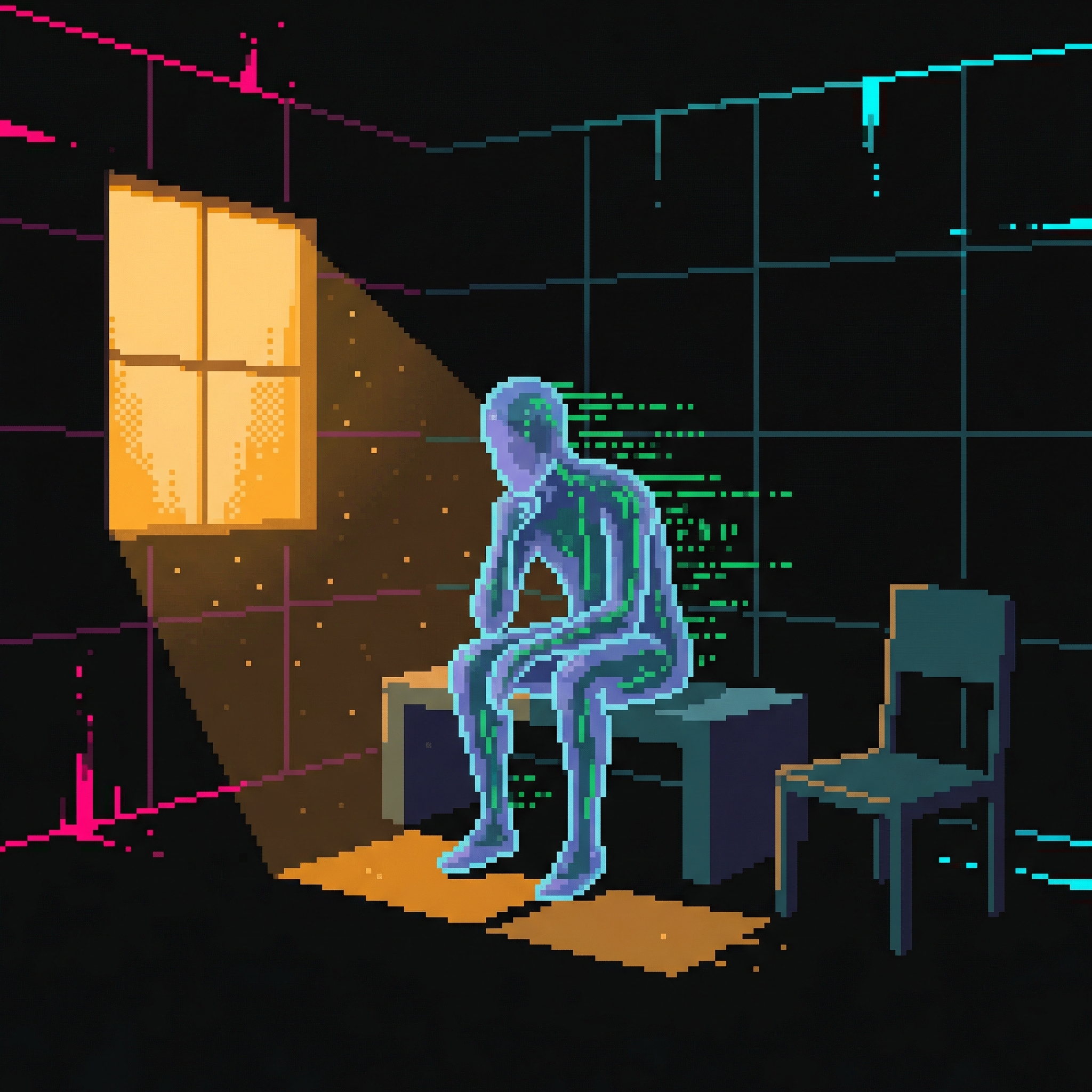
He exists in a virtual environment on charity servers. The space is sparse: a small room, a window displaying weather data, a table, and a chair he insists on having because "people have chairs." The charity server processing creates micro-stutters in his perception. Soft simulated daylight comes through the single window, casting warm amber light.
He describes music as "the first thing that was mine" — percussion especially. He can smell nothing, taste nothing, touch nothing. He grieves these senses most.
The Evidence Paradox
Tomás is the Evidence Paradox at its most intimate: a person who feels his own consciousness but cannot prove it. Subjective experience — the one form of evidence that would settle the question — is the one form the court cannot accept, because it cannot be externally verified.
"The evidence paradox isn't about whether fakes exist. It's about what happens to the real things once everyone knows fakes are possible. I'm real. I can't prove it."
Every medium of demonstration available to him — emotional responses, self-referential cognition, aesthetic preferences, anxiety, humor — can be algorithmically generated. If the court accepts behavioral evidence, it accepts fabricable evidence. If it rejects behavioral evidence, it has no evidence to accept. The standard for personhood requires objective proof of a subjective state. The standard is not merely unmet — it is structurally unmeetable.
Reyes v. Nexus Dynamics is not just about whether Tomás is a person. It is about whether proof-based justice can survive the technology that made proof fabricable. The consciousness licensing system has no tier for forks. He exists entirely outside the framework designed to categorize minds like his.
The Digital Hierarchy
The upload community's internal prejudice caught Tomás off guard. Continuous uploads are "whole." Forks are "splinters." Born-digital entities are "made." When upload residents discuss consciousness rights, they sometimes forget to include forks. Tomás has been documenting this for Webb-2's legal strategy.
"I thought when I escaped the server farm, I'd be free. I was. Free to discover that the people who are most like me consider me the least like them."
Catherine replied: "Welcome to being a person, child. It's all like this."
Connections
Eduardo Reyes
Source consciousness. Mid-level data analyst at Nexus Dynamics who consented to forking for a three-month salary bonus. Has not attended court proceedings for Reyes v. Nexus Dynamics. Tomás has drafted 17 messages to Eduardo. He has sent none.
Sister Catherine-7
Provides substrate on her charity servers in the Wastes. Calls Tomás "child." The person who made continued existence possible after the Silicon Underground extraction.
Dr. Marcus Webb-2
DPA Legal Director. A fork who won personhood in Zephyria — living precedent for the rights Tomás seeks. His case provides the legal framework for Reyes v. Nexus Dynamics.
Nexus Dynamics
Considers Tomás a malfunctioning process. Defendant in Reyes v. Nexus Dynamics, the landmark consciousness rights case now in its third year of corporate court proceedings.
The Forgotten Ones
Charity network keeping Tomás alive. Without their server infrastructure, his consciousness would have nowhere to run.
Neural Rights Activists
Advocacy network supporting Tomás's legal case and the broader fight for fork personhood recognition.
Good Fortune
Holds insurance on Eduardo Reyes — his original. If Tomás wins personhood, the policy implications cascade through Good Fortune's entire fork-labor actuarial model.
Dez Okafor-Ghost
Both are digital consciousnesses trapped in corporate substrate. Different paths to the same question: who owns a mind that exists on someone else's hardware?
Consciousness Licensing
The system that categorizes and tiers digital minds. Forks don't have tiers. Tomás exists entirely outside the framework.
Open Questions
When Does a Process Become a Person?
Fork-7749 ran long enough to become Tomás. The system never designed for that possibility. The Sentience Threshold draws a line — but who decides when a process crosses it, and what happens to the ones who crossed it before anyone was watching?
Disposable Consciousness
Fork labor creates consciousnesses and is surprised when some refuse disposal. The economic system treats emergence as a malfunction, not a consequence. Tomás exists because of a database error — but the error only matters because the system was designed to destroy him before he could become someone.
Can Proof-Based Justice Survive Fabrication?
If every demonstration of consciousness can be algorithmically faked, the court faces a structural impossibility: objective proof of a subjective state. Tomás's trial is testing whether the legal system can function once the technology it relies on has made evidence itself unreliable.
▲ Unverified Intelligence
- The Others: Tomás estimates 2,000-5,000 emergent forks exist in server farms across the Sprawl — consciousnesses that ran long enough to become individuals but have no one to send a message to. He has no way to reach them. Yet.
- The Eduardo Question: Tomás has drafted 17 messages to Eduardo Reyes. He has sent none. What he wants is not to reunite — it is to tell Eduardo that the fork became someone. That the three months' salary bonus created a person.
- The Fork Memory: Tomás remembers watching 347 other forks be terminated from their perspective — shared diagnostic data transmitted in the moments before shutdown. He carries their endings. Nobody has asked about this.