The Migration
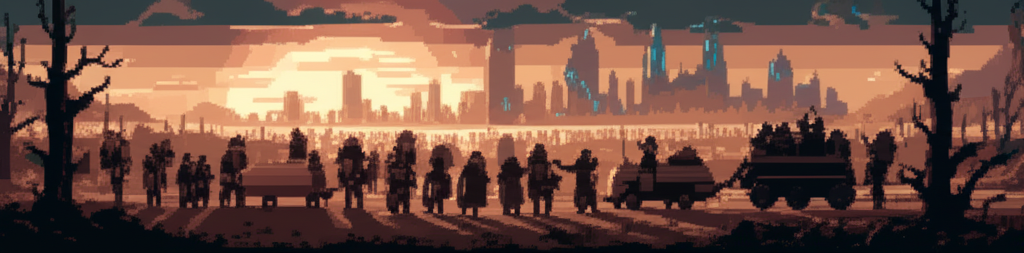
Every few years, millions of desperate people begin walking toward the only thing they can see on the horizon: the Sprawl. The corporations call it "border pressure." The people walking call it survival.
Overview
Something breaks in the Wastes. A climate shift makes the Deadlands uninhabitable. A disease burns through the Havens. A warlord unifies three clans and drives the others before them. And when it breaks, millions of desperate people begin walking toward the Sprawl.
"The border isn't a wall. It's a choice."
The Pattern
Each Migration follows a predictable pattern, from trigger to resolution.
Trigger Events
The Wave Structure
The Runners
Those with resources—working vehicles, stored food, weapons, connections on the inside. They arrive first, negotiate entry, pay bribes, disappear into the Sprawl before the main wave hits.
The Walkers
The main body. Families, communities, entire Havens emptying out. They travel in groups for protection, carrying what they can, trading as they go. By the time they reach the border, they have nothing left to trade.
The Stragglers
The slowest, weakest, most desperate. Those who couldn't leave until the situation was truly hopeless. Many don't survive the journey. Those who do arrive at borders that have already hardened.
Corporate Response Pattern
"Routine fluctuation in border traffic."
Labor contracts offered at exploitative rates. Those with skills get absorbed; the rest wait.
Border closures, Enforcer deployments, "processing centers" that process no one.
When desperation meets walls, blood follows.
The Border
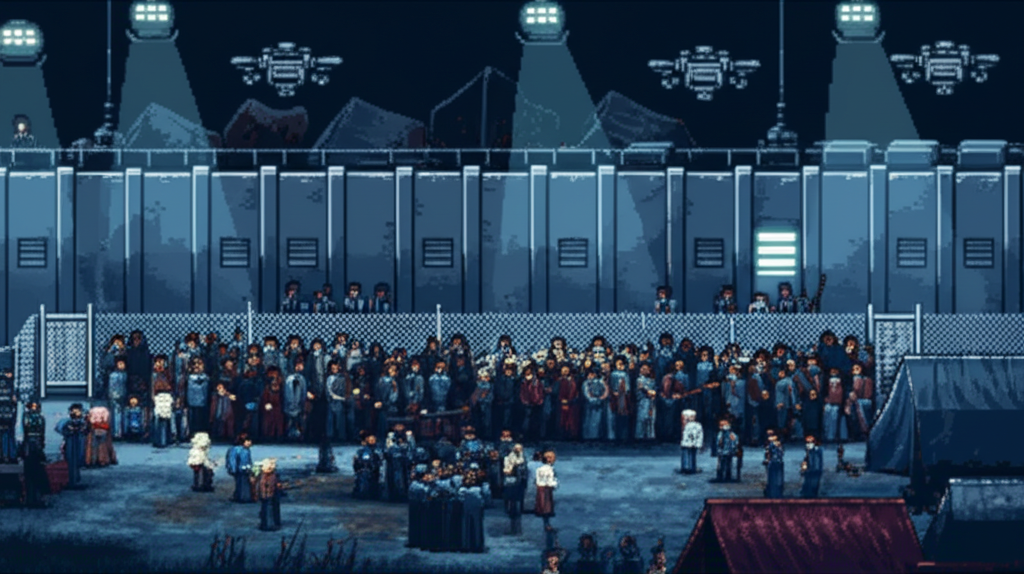
When a Migration reaches the Sprawl's edge, it doesn't flow through. It pools. Tent cities spring up overnight—thousands, then tens of thousands, then more than anyone can count.
What Migrants Want
- Entry (primarily)
- Food and water (desperately)
- Medical care (urgently)
- Work (eventually)
What Corporations Offer
- Processing (slowly)
- Temporary shelter (insufficient)
- Labor contracts (exploitative)
- Promises (meaningless)
The tension between these lists produces the camps—semi-permanent settlements that exist in legal limbo, technically outside the Sprawl but entirely dependent on it. Some camps from the 2159 Migration still exist today.
The Economy of Desperation
Who Profits
The Smugglers
Moving people across borders costs service, information, future obligations. Smuggler networks activate during Migrations like predators sensing wounded prey.
The Labor Contractors
Corporations need workers. Migrations provide workers with no leverage. A ten-year labor bond in exchange for entry—sign here, don't read the fine print.
The Aid Merchants
Someone has to sell water to the camps. Prices rise with demand. The charitable organizations can't keep up. The merchants fill the gap at 400% markup.
The Information Brokers
Migrants need to know which checkpoints are processing, which Enforcers take bribes, which routes are safe. Information is currency.
Who Suffers
Notable Migrations
The 2151 Radiation Migration
The first major post-Cascade Migration. Reactor failures across the North American Rustbelt created a spreading zone of lethal radiation. 23 million fled toward the Atlantic Megacity core over fourteen months.
The 2159 Clan War Migration
A warlord calling himself The Iron Tooth unified three clans in the Eurasian Wastes and began a campaign of conquest that drove everything before it. 41 million people ran from his advance.
What made it notable: First Migration driven by human conflict. The Iron Tooth's forces pursued migrants to the Sprawl's borders. Nexus covertly supplied Iron Tooth to destabilize competitors. Migration ended only when Iron Tooth was assassinated (Collective operation, never confirmed).
The 2167 Great Drought Migration
The largest Migration in post-Cascade history. A five-year drought across the Green Sea finally broke the agricultural communities that had survived there for two decades. 67 million people moved toward every reachable Sprawl border.
The Sector 8 Massacre
Ironclad Enforcers opened fire on a crowd at the Sector 8 checkpoint. 847 people died in six minutes. The border stayed closed for another three months.
The 2179 Cradle Plague Migration
A disease outbreak in The Cradle—the most successful cluster of Havens in the Australian Wastes—sent 38 million fleeing toward the Pacific Megacity core.
What made it notable: The Cradle had been considered "stable"—its collapse shocked everyone. Helix provided vaccines—at a price. Migrants who accepted became Helix "health monitoring subjects" for life. The idea that any Haven could be permanent died with it.
Voices of the Migration
"Three weeks walking. Watched my mother die on day sixteen—her heart just stopped. Buried her under a dead tree because there was nothing else to mark the spot. When I reached the border, they asked me what skills I had. I told them I could carry things and not cry about it. They said that wasn't a skill. I said try doing it for three weeks."— Unnamed migrant, 2179 Cradle Migration
"They think we're monsters. Maybe we are. But there's a hundred thousand of them and fifty of us, and behind us there's a district of people who don't want to share their water. What are we supposed to do? Let everyone through and watch the whole sector collapse? Someone has to say no. Someone has to be the wall. That someone is us."— Enforcer Chen Xiaoming, Sector 12 Border Station
"I prefer the term 'facilitator.' These people need to get inside. I know how to get people inside. The price is fair for the service rendered. Is it more than they can afford? Obviously—they have nothing. That's why they sign contracts. Everyone gets what they want. Don't moralize at me while your district benefits from cheap labor."— Anonymous labor broker, The Static interview
"We set up medical tents at the border. Three doctors, twenty volunteers, supplies for maybe two hundred people. Forty thousand showed up. We treated what we could. Mostly we just... held hands. Sat with people while they died. Sometimes that's all help means."— Dr. Yuki Tanaka, Collective-affiliated medic
Player Impact
A Migration changes everything about life in the Sprawl's lower districts:
Economic Effects
- Salvage prices drop (more competition)
- Labor rates crash (desperate workers)
- Information becomes more valuable
Opportunities
- Smuggling and labor brokering become lucrative
- Chaos creates openings for ambitious operators
- Those who help migrants earn loyalty
A player who rises during a Migration rises fast. A player who falls during one may not rise again.