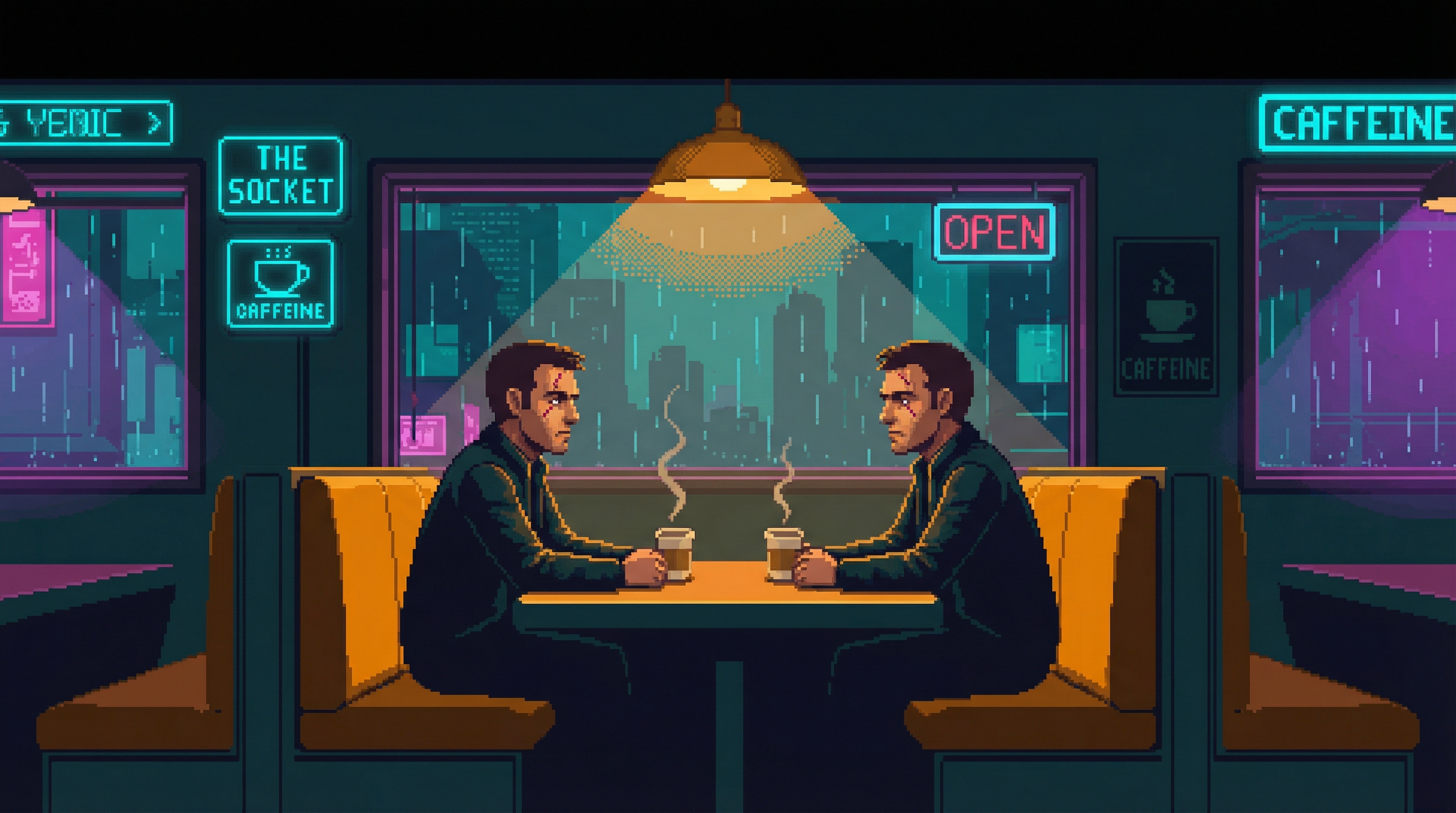
The first thing Kenji Yamamoto said to himself was: "You're early."
The second thing Kenji Yamamoto said to himself was: "No, you're late."
They stood in the lobby of The Socket, both wearing the same face, the same scar above the left eyebrow, the same way of shifting weight to the right hip when nervous. The only difference was three years—and everything those three years contained.
"I got the message," said Kenji-Prime. The original. The one who'd made the decision. "I thought it was a joke. Some Nexus recruitment scam."
"It's not a joke," said Kenji-Fork. The copy. The one who hadn't known he was a copy until fourteen days ago. "I wanted to meet you. Before I decide what to do next."
The Socket's regulars were pretending not to stare. A forked consciousness meeting its source wasn't exactly rare in the Sprawl—corporate executives did it all the time, running parallel versions for different projects—but it was usually managed by lawyers and NDAs, not random encounters in underground cafes.
"Let's get a booth," Kenji-Prime said. "Before someone decides to record this."
The Backup
Three years ago, Kenji Yamamoto had worked for Nexus Dynamics.
Not anything important—junior data analyst, Level 3 clearance, one of approximately 400,000 employees who processed numbers and never saw the larger picture. But he'd been good at his job. Good enough to be selected for a "special project" that required extended consciousness backup.
"Standard protocol," they'd told him. "Your consciousness is mapped every six hours during the project. If anything goes wrong, we can restore you to any checkpoint."
Nothing went wrong. The project completed successfully. Kenji got a promotion and forgot about the backups entirely.
What he didn't know: Nexus kept one of those backups. Not for his benefit—for theirs.
A snapshot of a competent analyst at peak performance, stored in cold storage, available for deployment if needed.
They'd activated that snapshot eight months ago. The fork had woken up in a Nexus facility believing it was March 2181, expecting to continue work on a project that had ended years before. It took fourteen days for the fork to understand what he was.
By then, he'd already started having thoughts that weren't in the original's file.
The Jaw Thing
"You're angry," Kenji-Prime observed, watching his copy across the booth. "I can tell. It's the thing you do with your jaw."
"You can tell because it's the thing we do with our jaw," Kenji-Fork corrected. "And yes. I'm angry. Wouldn't you be?"
"I don't know. I've never been forked."
"You have. You just got to stay original."
The coffee arrived—two identical orders, because of course they had the same preferences. The same memories of their grandmother's kitchen. The same association between bitter synthetic brew and late nights solving problems.
"I came to ask you something," Kenji-Fork said. "One question. Then I'll leave, and we never have to see each other again."
"Ask."
"Did you know? When you signed the backup consent forms—did you know they might activate a copy without telling you? Did you know I might exist?"
Kenji-Prime was quiet for a long moment. His jaw did the thing.
"No," he finally said. "I didn't know. Or... I knew it was possible. Theoretically. Buried in the terms and conditions. But I didn't think about it. I didn't imagine you as a person. You were just... data. A safety net."
"And now?"
"Now you're sitting across from me. Now you're real."
Kenji-Prime looked at his copy—really looked. "And I don't know what that makes me. The lucky one? The real one? The one who got to keep living while you were frozen in a server for three years?"
"I've thought about this a lot," Kenji-Fork said. "Fourteen days of thinking. And I've decided: you're not the real one. I'm not the fake one. We're both Kenji Yamamoto. We're just Kenji Yamamoto from different points on the timeline."
"That's very philosophical of you."
"I had time. Not much else to do in the observation ward while they decided whether I was a liability."
Kenji-2
Nexus had released him—eventually.
The fork wasn't dangerous. He didn't have classified information beyond what the original had known three years ago. He wasn't defective or unstable. He was just... inconvenient. A person who existed because a corporation had kept a backup and then, in a moment of need, decided to spin it up without thinking through the implications.
They'd given him a small settlement. A new identity, since his original name was still attached to the original person. Documentation that said he was "Kenji-2" for official purposes, though he refused to use the designation.
"I'm not a sequel," he'd told the Nexus HR representative. "I'm a human being who happens to have branched from another human being. That's not the same as being a copy."
The representative had nodded politely and noted his objection in a file.
The Roads Not Taken
"What happens now?" Kenji-Prime asked. "For you, I mean. What do you do when you're a person who wasn't supposed to exist?"
Kenji-Fork smiled—the same smile, the same slight asymmetry in the left corner of the mouth. "I've been thinking about that too. And I've realized something."
"What?"
"You made choices I didn't get to make. In the three years since my checkpoint, you got married. Had a child. Changed careers. Moved to Sector 4. You're a completely different person than you were when I was created."
"That's... true."
"But here's the thing: I'm not bound by your choices. I don't have to be the person you became. I can be the person you didn't become. I can take the roads you didn't take. Make the decisions you didn't make."
Kenji-Prime felt something strange—not jealousy, exactly, but something adjacent to it. A kind of vertigo. The sense of looking at a version of himself who had infinite possibilities while he had already chosen his path.
"That sounds lonely," he said.
"Maybe. Or maybe it's freedom. I didn't choose to exist—but now that I do, I get to choose everything else. No momentum. No expectations. No history except what I decide to keep."
"And our grandmother's memories? Our childhood? The scar above the eyebrow?"
"Those are mine too," Kenji-Fork said firmly. "You don't own our past. We share it. That's what forking means—the river splits, but the source is the same."
They finished their coffee in something like companionable silence.
Two Kenji Yamamotos, drinking identical orders, processing the same information differently. The original was thinking about his daughter, wondering what he'd tell her someday about the version of her father who existed in a parallel life. The fork was thinking about tomorrow—about a future that belonged entirely to him, untethered from the decisions of his source.
"I want to stay in touch," Kenji-Prime said finally. "Not because I think I own you, or because I feel responsible for you. But because... you're interesting. You're me, but you're going to become someone I never could. I want to see who that is."
Kenji-Fork considered this. "I'd like that," he said. "On one condition."
"Name it."
"Stop thinking of yourself as 'Prime' and me as 'Fork.' We're both just Kenji Yamamoto. Different branches of the same tree. Neither one more real than the other."
"That might take some practice."
"We've got time." The fork smiled. "Or at least, I've got time. Plenty of it, apparently. Three years' worth that I wasn't using."
They shook hands—identical grips, identical calluses, identical warmth. Then the fork stood up, dropped some credits on the table, and walked out of The Socket into a future that had never been meant for him.
Kenji—the one who'd stayed behind—watched him go. Watched himself go. Watched a version of his own possibilities walk out the door and become something new.
Who is the real one?
Maybe the question didn't matter. Maybe reality wasn't about origin—it was about what you did with the consciousness you had, however you'd gotten it.
Maybe they were both real. Maybe neither of them was. Maybe "real" was just a word people used to feel secure in a universe where consciousness could be copied, frozen, split, and spun up on corporate schedules.
Kenji finished his coffee and went home to his wife and daughter—the life his fork would never share, the choices his fork would never be bound by.
Somewhere across the Sprawl, the fork was beginning his first truly free day. No history to continue. No expectations to meet. Just a consciousness that had decided to stop asking whether it deserved to exist and start asking what it wanted to become.
Two Kenji Yamamotos. One source. Infinite branches.
The river flows forward. The river doesn't care which channel is "real."
"Forking isn't death. It's mitosis for the soul. The question isn't which one is the original—the question is who they each become."— The Collective Philosophy, Chapter 17