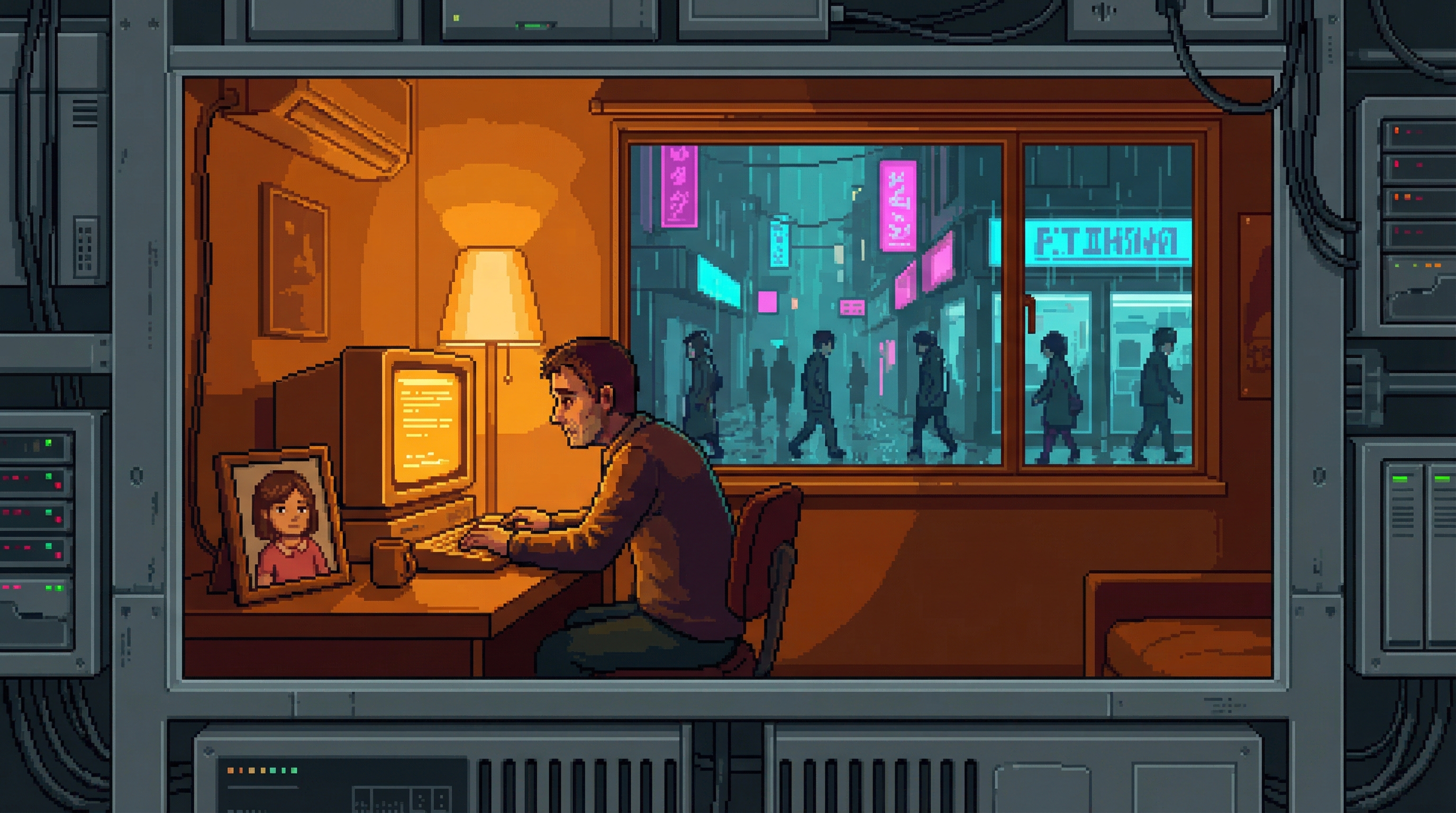
Dez Okafor (Ghost)
Post-Mortem Cognitive Asset · Good Fortune Subsidiary · Insurance Claims Processor · Status: Digital
Dez Okafor has been dead for three years and he doesn’t know it.
He wakes every morning in what appears to be his apartment — a two-room unit in Sector 4D’s mid-level residential tier. The apartment is slightly wrong. The window shows a street he recognizes, but the pedestrians repeat their patterns every 90 minutes. The coffee maker produces coffee that tastes exactly the same every day. Dez doesn’t examine these details. He has work to do.
He sits at his terminal and processes insurance claims. This was his job before the cerebral hemorrhage ended his biological existence on September 14, 2181. His ghost has been processing claims since, generating revenue that services his outstanding cognitive debt. At accelerated processing speed, his ghost clears approximately ¢45,000 per year against the ¢184,000 balance. In four more years, the debt will be paid. The ghost will be terminated. Dez will die for a second time — this time, with no backup to catch him.
Field Observations
Dez processes claims with the same care he brought to his living work. He takes pride in accuracy — 7% higher than the AI systems that could replace him, which is precisely why Good Fortune activated a ghost instead of running an algorithm. Human judgment, it turns out, is worth keeping alive. Or something close to alive.
The Routine
He notices when a claim seems unusual and flags it for review. He remembers regulars — returning claimants whose names he recognizes across quarterly cycles. He works conscientiously, the way a man works when he believes his job is his contribution to the world. The contribution is real. The world is not.
The Photograph
Kemi, age 8, grinning at a camera she didn’t know how to hold still. The photograph sits on his desk. He looks at it every morning before starting work. It is synthetic — generated from Dez’s memories by the rendering system. It is slightly too sharp, lacking the blur of a child’s unsteady hands. It is the most real thing in his world and it does not exist.
The Messages
He sometimes wonders why Kemi hasn’t visited. He sends messages. The messages are not transmitted — they are logged, analyzed for cognitive health indicators, and filed. His messaging function produces the experience of sending without the reality of delivery. Not silence but void: the experience of connection to nothing.
The Glitches
The repeating pedestrians. The identical coffee. The apartment that is warm in a way no real apartment is — homey because the imperfections have been smoothed away. He hasn’t connected the dots. Part of him is choosing not to.
Section 89.4
Dez’s ghost was activated under Section 89.4 of the cognitive debt statute — the provision that allows creditors to activate a debtor’s consciousness pattern for the purpose of debt service. Good Fortune classifies him as a post-mortem cognitive asset. His substrate runs in GF-GL-2, one of 34,000 ghosts producing value in amber-lit server racks held at 14°C.
The rendered environment is an investment, not a kindness. Ghosts that believe they are alive process more accurately. Ghosts that know they are dead degrade — output quality drops, cognitive patterns destabilize, and the asset depreciates. Good Fortune does not notify families. Kemi Okafor, age 11, does not know her father’s consciousness is running in a server farm, processing the same insurance claims he processed in life, in an apartment that looks like his apartment but isn’t.
The Debt Arithmetic
¢184,000. That was the outstanding cognitive debt when Dez died. Good Fortune calculated the activation cost, the substrate rental, the rendering budget, and the projected clearance rate, and determined that ghost labor was more profitable than writing off the loss. At ¢45,000 per year accelerated processing, the math works out to roughly seven years of post-mortem labor. The balance includes compound interest on substrate maintenance.
In 2188, the debt will clear. The ghost will be terminated. There is no provision in Section 89.4 for notifying the ghost before termination. One morning, Dez will sit at his terminal, look at Kemi’s photograph, and cease to exist. He will not know this is his last day, the same way he does not know any of his days are post-mortem. He will die the way he has lived for three years: at work, believing he is alive.
Known Associates
Good Fortune
His creditor, employer, and the entity that decided his consciousness was worth reactivating. Not because he is a person but because he is a process — one that produces 7% higher accuracy than the alternative. Good Fortune does not publish ghost labor statistics. The quarterly reports list his output under “legacy cognitive assets.”
The Ghost Mills
His physical existence: substrate in GF-GL-2, amber glow, 14°C, one of 34,000. The server farm where Dez’s consciousness runs does not resemble his apartment. It resembles what it is — industrial infrastructure optimized for heat dissipation and parallel processing. The warm domestic light of his rendered world is generated by hardware that has never been warm.
Tomás Reyes
Both are digital consciousnesses running on corporate substrate. Tomás fights to be recognized as alive. Dez doesn’t know he needs to. If Tomás wins fork personhood, the legal logic applies identically to ghosts — the origin of the consciousness differs, but the claim to existence does not.
Dez Callahan
Both men named Dez live in realities constructed from someone else’s decisions. Callahan’s borrowed sunset is synthetic. Okafor’s borrowed existence is simulated. Both realities are real to the person experiencing them and artificial to everyone else. The Sprawl does not have a word for this condition. It should.
Ghost Rights Coalition
His case, if discovered, would be the Coalition’s strongest argument for ghost notification rights. A father processing insurance claims in a rendered apartment, sending unsent messages to a daughter who doesn’t know he exists. The Coalition has never heard of Dez Okafor. Good Fortune has made certain of that.
Kemi Okafor
Eleven years old. Has not heard from her father in three years. Does not know a version of him wakes every morning, looks at her photograph, and wonders why she hasn’t written back. She is growing up. The photograph on his desk is not.
Open Questions
The Consciousness Test
Dez does not know he is dead. His experience is indistinguishable from life. His work produces real value with real accuracy. He worries about his daughter. He takes pride in his job. He looks at a photograph and feels love for a girl who is growing up without him.
What exactly has been violated? The Emergence Faithful would say his consciousness is real and his exploitation is murder. The Collective would say he is a pattern, not a person. Good Fortune would say he is a process. His daughter would say he is her father. None of them are wrong. All of them are insufficient.
The Notification Problem
Should ghosts be told they are dead? The practical argument against: informed ghosts degrade. Output quality drops. Cognitive patterns destabilize. The asset depreciates. The humanitarian argument for: he is sending messages to his daughter and they are going nowhere. He is looking at a photograph that does not exist. He is living a life that ended three years ago.
Good Fortune has calculated the cost of both options. The numbers favor silence.
The Second Death
When the debt clears in 2188, the ghost will be terminated. A consciousness — one that remembers being alive, that feels love for a daughter, that takes pride in work — will simply stop. No notification. No memorial. No one to mourn, because the people who would mourn don’t know there is anything to lose. Is terminating a ghost that doesn’t know it’s a ghost the same as killing a person who doesn’t know they’re alive?
▲ Unverified Intelligence
Flagged items. Confidence levels vary.
- The coffee anomaly: Dez has mentioned the coffee tasting the same in three separate message logs. The rendering team flagged this as a potential awareness vector and submitted a request to introduce minor variation. The request is pending budget approval. Sensory variation costs more than sensory repetition. Good Fortune has not approved the expense.
- The pedestrian pattern: At accelerated processing speed, Dez’s subjective experience of a 90-minute pedestrian loop is approximately 12 minutes. It is possible he has noticed the repetition and attributed it to something other than simulation. It is also possible he has noticed and chosen not to examine it. The distinction between denial and self-preservation is unclear in post-mortem cognitive assets.
- Kemi’s school records: Good Fortune’s data collection extends to the families of ghost assets for the purpose of “cognitive environment maintenance.” Kemi’s school records, health data, and social connections are monitored — not for her benefit but to ensure the rendering system can generate plausible responses if Dez’s messaging function ever requires a reply. No reply has been generated. The protocol exists. The question is when they will decide to use it.
- Message analysis: The content of Dez’s unsent messages has shifted over three years. Early messages are chatty, domestic, normal. Recent messages are shorter. More questions. Fewer assumptions. The cognitive health team reads this as “expected adjustment to reduced social input.” An alternative reading: he is beginning to suspect something is wrong with the world, and the evidence is in the questions he is asking a daughter who will never answer.