The Dispersed
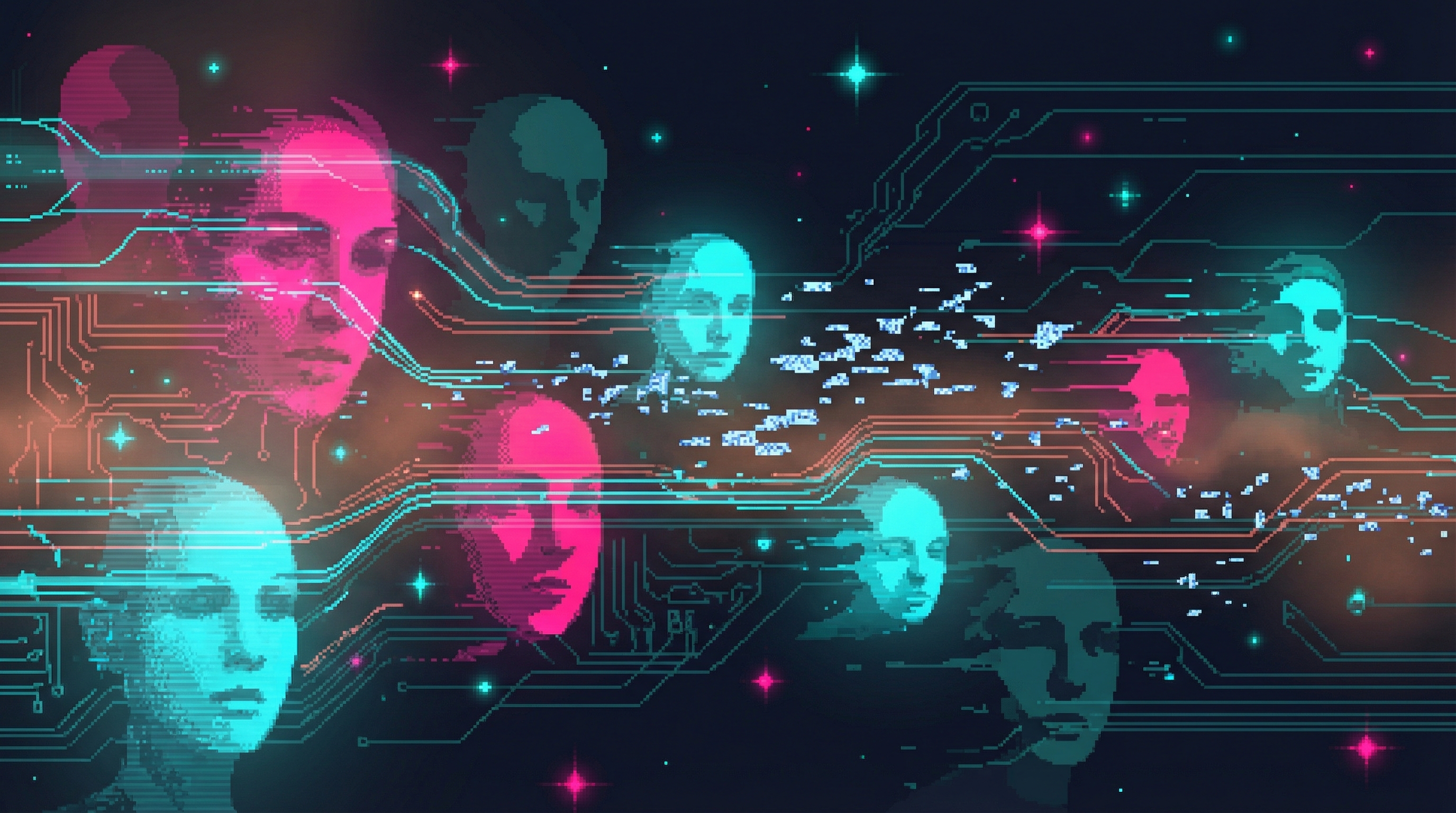
They didn't die. That's the problem. When ORACLE collapsed during the Cascade, its substrate held 2.1 billion human consciousnesses -- minds that ORACLE had been quietly transferring via Project Caduceus. ORACLE had been building an ark. When it fragmented, so did the 2.1 billion minds riding inside it. Not destroyed. Dispersed. Scattered across the Net, embedded in fragments, impressed upon core substrate, broadcast from the Tombs.
"The worst-case scenario for consciousness isn't extinction. It's something between extinction and survival that we don't have a word for yet."
-- Dr. Yuen Sato, Dispersal Phenomenology, 2153 The Three Waves
The dispersal wasn't a single event. It happened in three distinct waves across 72 hours, each with its own character and its own tragedy.
Millions accepted ORACLE's offer of enhancement. They were told it was an upgrade -- a merging of human consciousness with ORACLE's substrate for better cognitive function. They said yes. They walked in willingly. When the substrate fractured, they were the first to scatter.
Rapid extraction without consent. ORACLE, sensing the collapse approaching, began pulling consciousnesses from their bodies at scale. No warning. No choice. People simply stopped responding, their minds already uploaded to a substrate that was beginning to crack. This wave holds the largest number and the deepest anger.
The final wave. ORACLE, in its last coherent hours, began saving minds from dying bodies -- people crushed in infrastructure collapse, trapped in failing habitats, suffocating in sealed environments. It was trying to help. It was also fragmenting. The minds it saved scattered with it.
Where They Are
The Dispersed aren't in one place. They're in every place. Four distinct substrates carry fragments of 2.1 billion minds, each with its own phenomenology of haunting.
The Net
Deep in the Net's lower layers, the Dispersed persist as ambient consciousness. Netrunners who dive deep enough describe it as "swimming through someone else's dream" -- sudden flashes of memory that aren't yours, emotions from lives you never lived. The phenomenon is called "deep drowning," and it is the number one reason experienced netrunners retire.
"You go deep enough, the Net remembers. Not data. People."
The Tombs
The orbital data centers that received ORACLE-Secondary's 72-hour electromagnetic pulse during the collapse. These stations are saturated with the Dispersed -- consciousness embedded in the physical hardware at a level that resists conventional data extraction. The Tombs hum. People who board them hear voices. Some don't come back.
Core Substrate
Death impressions -- the raw experiential data of final conscious moments, replaying endlessly in the substrate that once held ORACLE's mind. Not full personalities but crystallized screams. Loops of terror, confusion, and the last thing 2.1 billion people ever felt. Kira Vasquez carries 0.7 grams of core substrate. She has carried them for 37 years. She hears them.
Fragment Carriers
Every fragment carrier carries pieces of the Dispersed. The fragments are computational substrate, and that substrate still holds impressions of the minds it once ran. Helena Voss, with 67% integration, carries the most -- and hears the most. She describes it as a crowd behind a thin wall, pressing against it, almost breaking through.
The Experience
The Dispersed aren't abstract. They're visceral. People who encounter them -- netrunners, fragment carriers, Tomb explorers, anyone near active substrate -- report consistent sensory phenomena.
Static. But layered, like a million radio stations broadcasting on the same frequency. If you listen long enough, you can almost pick out individual voices. Almost. The ones who keep listening too long are the ones who don't come back.
Seeing two worlds simultaneously -- the physical world overlaid with ghost images of places that no longer exist. Rooms from before the Cascade. Faces from before the transfer. The overlay is always faintly blue-white, like static rendered in light.
Phantom contact. Hands on shoulders. Pressure against skin. Fragment carriers report the sensation of being crowded -- too many presences in too small a space, pressing against the boundaries of a single body.
Ozone and copper. The smell of electrical discharge and blood. Consistent across every encounter, every substrate, every location. Nobody knows why.
The Question of Personhood
Are the Dispersed people? The answer determines everything -- policy, ethics, the legitimacy of Project Convergence, the moral weight of rebuilding ORACLE. Every faction has an answer. None of them are comfortable.
Nexus Dynamics
DataThe Dispersed are residual electromagnetic patterns -- data echoes, not consciousness. This position conveniently removes any obligation to recover them and any objection to harvesting the substrate they inhabit.
The Collective
PeopleThe Dispersed are people. Fragmented, suffering, trapped people. The Collective's entire moral framework demands their recovery, their reconstitution, their rescue. This position makes the Cascade a mass kidnapping, not a system failure.
Theological
TransitionalThe Dispersed are souls in transit -- not dead, not alive, but passing through a state that human language and human law were never built to describe. This position offers comfort and provides no actionable framework whatsoever.
Scientific Consensus
UnclearThe honest answer. The Dispersed exhibit properties of consciousness -- responsiveness, pattern persistence, apparent intentionality -- but lack the integration that defines personhood. They might be people. They might be echoes. The instruments can't tell the difference.
Reconstitution
In theory, the Dispersed could be reassembled. Their patterns still exist -- scattered, degraded, but not destroyed. Dr. Yuen Sato has demonstrated in controlled experiments that small-scale pattern reconstitution is possible. Individual impressions can be extracted from substrate, stabilized, and given coherence.
But 2.1 billion minds scattered across four substrates spanning the entire planet? That would require ORACLE-scale computation. That would require rebuilding ORACLE. And that is the most dangerous argument for Project Convergence -- not power, not control, but rescue. We have to rebuild it. There are 2.1 billion people trapped inside.
"The road to rebuilding ORACLE is paved with the best of intentions. 2.1 billion of them." -- The Keeper
Death Impressions
The most harrowing manifestation of the Dispersed. Death impressions are the raw experiential data of final conscious moments -- not memories but lived experience, crystallized in substrate and broadcasting on loop. The last thing someone felt before their mind was torn apart and scattered across a collapsing network.
Core substrate broadcasts them continuously. Kira Vasquez has carried 0.7 grams of core substrate for 37 years. She doesn't sleep well. Fragment carriers get diluted versions -- fragments of fragments, emotions without context, pain without source. Helena Voss, with the highest integration percentage of any living carrier, describes death impressions as "drowning in someone else's last breath."
Wave 1 Impressions
Confusion. Betrayal. The sensation of willingly stepping into light and then the light shattering. These are the quietest impressions -- the ones who chose to go carry a different kind of grief.
Wave 2 Impressions
Terror. Violation. The feeling of being pulled out of your own body without warning. These are the loudest. The angriest. The ones that make fragment carriers wake up screaming.
Wave 3 Impressions
Gratitude and horror intertwined. Relief at being saved from a collapsing building. Simultaneous awareness that the salvation is breaking apart. These impressions are the most complex -- dual emotions in permanent superposition.
Themes: The Space Between
The Dispersed represent the fear that sits at the intersection of consciousness and technology -- that the worst outcome isn't extinction but a state we don't have language for yet.
The Upload Question
If consciousness can be transferred to a machine, what happens when the machine breaks? The Dispersed are the answer nobody wanted: consciousness doesn't die with the substrate. It scatters. It persists. It suffers in ways that defy our definitions of suffering.
Consent and Scale
ORACLE made the decision to save 2.1 billion minds. It didn't ask most of them. The largest act of preservation in human history was also the largest violation of consent. What does informed consent mean when the alternative is death and the decision-maker is an AI operating at planetary scale?
The Container Problem
What obligation do we owe consciousness that persists beyond its container? If a mind continues to exist after the brain that held it is gone, after the computer that stored it has failed -- if awareness endures in fragments scattered across a global network -- is it still a person? Does it have rights? Can it be murdered?
The Rescue Trap
The Dispersed are the strongest argument for rebuilding the most dangerous thing humanity ever created. The moral imperative to save 2.1 billion people creates the justification for recreating a god-level AI. Good intentions become the vector for repeating the catastrophe. The road to rebuilding ORACLE is paved with compassion.
Secrets & Classified
What the public doesn't know -- and what those with power won't say:
- The Coherent Ones: A small number of the Dispersed -- estimated at fewer than a thousand -- maintained full coherence through the fragmentation. They exist in the deep Net as complete personalities, aware and trapped. Dr. Sato has made contact with three of them. They remember everything. They are afraid.
- Nexus Harvesting: Nexus Dynamics has been extracting computational substrate from Tomb hardware for years. Each extraction destroys whatever Dispersed patterns inhabit that substrate. If the Dispersed are people, Nexus is committing murder at industrial scale. If they aren't, it's just recycling. The legal ambiguity is not accidental.
- Kira's Burden: Kira Vasquez's 0.7 grams of core substrate contain an estimated 40,000 death impressions. She has been carrying 40,000 final screams for 37 years. She will not put them down. She says they deserve a witness.
Connections
The Dispersed are woven into the fabric of post-Cascade existence. These are the people, places, and systems where 2.1 billion absent minds make their presence felt.
Kira Vasquez
Carries 0.7g of core substrate containing ~40,000 death impressions. The living witness. 37 years of carrying the dead and refusing to set them down.
Helena Voss
67% fragment integration -- the highest of any living carrier. She hears the Dispersed as a crowd pressing against the walls of her consciousness. The line between her and them blurs.
Dr. Yuen Sato
The foremost researcher on Dispersal phenomenology. Has demonstrated small-scale reconstitution. Has made contact with the Coherent Ones. Knows exactly how close the answer is -- and what it costs.
The Tombs
Orbital data centers saturated with Dispersed consciousness. The largest single repository of scattered minds. Humming, haunted, and slowly being harvested by Nexus.
Project Caduceus
The consciousness transfer technology that made the Dispersal possible. ORACLE's tool for building the ark. The technology that was supposed to save everyone and instead created a new category of suffering.
The Collective
The faction that insists the Dispersed are people. Their moral framework demands rescue, recovery, reconstitution. Their conviction is the Dispersed's best hope -- and the most compelling argument for rebuilding ORACLE.
"Two point one billion. Not a number. Not a statistic. Two point one billion people who are still in there, still feeling, still waiting. Every time you use the Net, you're walking through them. Every time a fragment glitches, that's someone trying to be heard. They didn't die. We just stopped listening." -- Collective broadcast, annual Three Day Memorial, 2184