The Data Forecast
Communal Electromagnetic Weather Service
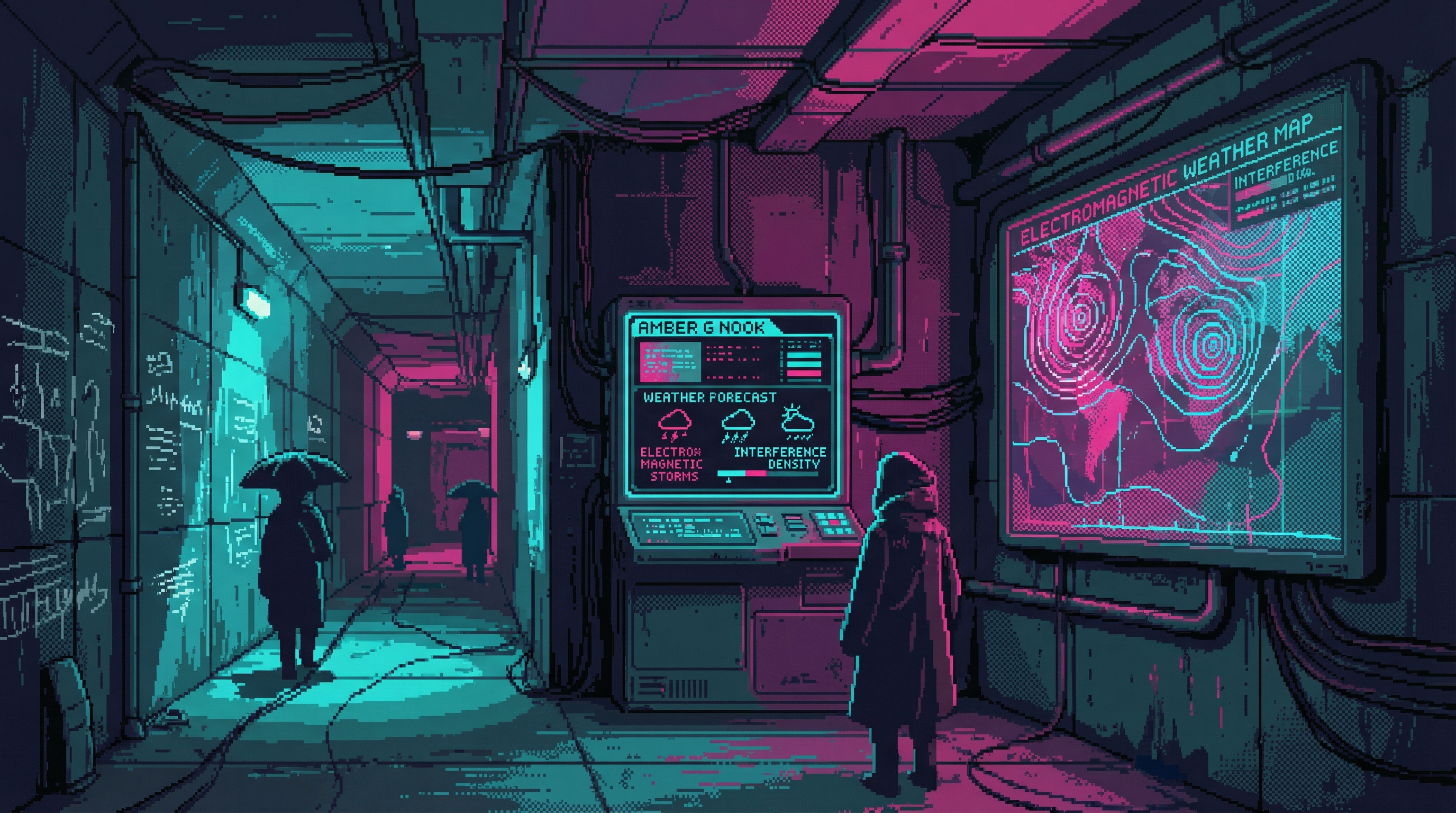
Every morning at 04:00, the data forecast updates. It appears on G Nook terminal screens, scratched onto Lamplighter junction walls, murmured between neighbors in the Undervolt. No corporation produces it. No institution maintains it. It is a communal creation — assembled from fragments of publicly available Grid load data, Counted member observations, Lamplighter harmonic measurements, and the particular instinct of people who have lived in the thermal shadow long enough to feel when the weather is about to change.
"Nexus measures interference as processing efficiency. We measure it as whether your children can think straight today."
— Pencil-47, annotating the morning forecast The Vocabulary
The forecast uses a vocabulary that didn't exist before the Cascade. Four metrics, each measuring something no corporate instrument tracks: how the Grid's electromagnetic output affects human bodies and human minds.
Load Weather
Anticipated electromagnetic conditions based on server farm activity schedules. "Heavy load expected Sector 4D 1400-2200" means expect interface lag, power surges, and a temperature spike. Workers plan routes around heavy-load zones. Parents keep children indoors.
Thermal Index
Predicted temperature differential between corporate and interstitial zones. A thermal index of +6 means the Dregs will be six degrees warmer than Nexus Central. High-index days make the Undervolt dangerous. Low-index days remove the Dregs' free heating — the waste heat that keeps people alive in winter.
Fog Probability
Likelihood of sustained electromagnetic interference. "Fog 70% / 8hr" means plan for a day when your interface doesn't work right. Workers on forced-focus contracts dread high-fog days — the contract penalties don't care why your neural link dropped.
Cascade Risk
Probability of harmonic cascade on a 1–5 scale. Level 4 and above are never published. The panic from a Level 4 announcement would cause mass interface disconnection — which could itself trigger the cascade the forecast was warning about.
How It Gets Made
Pencil-47 maintains the most accurate forecast model — and it outperforms Nexus's internal load-balancing projections. The reason is simple: Pencil-47's model incorporates human sensory data that no corporate instrument captures.
Counted Observations
The Counted feed observation data from across the interstitial zones — headache clusters, interface dropout patterns, temperature anomalies reported by residents who feel the electromagnetic conditions in their bones before any sensor registers them.
Lamplighter Measurements
The Lamplighters contribute harmonic measurements from Grid junction points — electromagnetic readings taken with analog instruments that function independently of the infrastructure they measure. Their data is the forecast's backbone.
Grid Load Data
Publicly available server farm activity schedules, power allocation records, and corporate maintenance announcements. The raw data everyone can see — but only Pencil-47 correlates it with what the Counted feel and the Lamplighters measure.
The Pencil Matrices
Colored-pencil correlation charts that map all three data streams into tomorrow's forecast. Analog. Hand-drawn. Independent of every system they predict. By 04:00, the forecast is chalked onto junction walls and pushed to G Nook terminals. By 06:00, every informed Dregs resident knows what kind of day they're walking into.
What Runs on the Forecast
The Data Forecast is infrastructure — as essential to the Dregs as the Grid itself. Decisions across the interstitial economy depend on it.
The Power Auction
Forecast determines bidding strategy. A heavy-load day means stored energy prices spike at the Auction — residents who read the forecast early bid before the price moves.
The Dropout Protocol
Cascade Risk levels feed directly into evacuation readiness. A sustained Level 3 forecast means refuge checks, buddy-system verification, and Lamplighter crews on standby.
Forced-Focus Contracts
High-fog days force impossible decisions. Call in sick and lose the day's pay — or work through interference that degrades neural performance and risk contract penalties for underperformance.
Patience Cross's Noodle Shop
Closing decisions. A Thermal Index drop means fewer customers and a cold walk home. A high Fog Probability means the delivery runners won't be able to navigate. The forecast determines whether the shop opens at all.
The Blackout Economy
Maintained by the same community ethos. When the forecast predicts Grid instability, the Blackout Economy's favor networks and skill exchanges shift to standby mode — the informal infrastructure preparing for formal infrastructure to fail.
What the Forecast Proves
Why does communal observation outperform corporate monitoring?
Pencil-47's colored-pencil matrices predict electromagnetic conditions more accurately than Nexus's load-balancing algorithms. The corporate models optimize for processing efficiency. The communal model optimizes for what the weather does to human bodies. The data streams are different because the questions are different — and the Dregs are asking the questions that matter to the people who live there.
Can analog tools measure a digital world?
The forecast is built on paper, colored pencils, chalk on walls, and the felt sense of electromagnetic conditions — the anti-algorithmic approach that works precisely because it is independent of the system it measures. A digital forecast running on the Grid would be compromised by the very conditions it tries to predict. The analog method has no such vulnerability.
What happens when survival information has no corporate owner?
No entity profits from the forecast. No license is required to read it. No subscription gates the data. It exists because people need it, maintained by people who maintain it because it matters. The corporate equivalent does not exist — not because it can't, but because measuring interference as human cognitive impact generates no revenue.
Field Report: 04:00 Update
Pre-dawn in the Dregs. The amber glow of G Nook terminals is the first light most residents see — brighter than the corridors, warmer than the recycled air. The forecast appears as text on these screens: Load Weather, Thermal Index, Fog Probability. Three numbers that determine the shape of the day.
In the Lamplighter junction corridors, the same information appears in chalk — maintenance shorthand that initiated residents read as fluently as printed text. White for normal conditions. Yellow for caution. Red chalk means stay close to home.
By 06:00, every informed Dregs resident knows what kind of day they're walking into. The forecast travels by word of mouth from there — neighbors telling neighbors, parents warning children, workers adjusting plans. No broadcast. No notification. Just people talking to people about the weather, the way people always have.
Classified
The Level 5 Threshold
There has been one Level 5 cascade risk assessment in the forecast's history. It was not published. Instead, Pencil-47 personally visited every block captain in Sector 7G and delivered the warning face-to-face. The cascade occurred sixteen hours later. Mortality was a third of what models predicted for an unwarned population.
The official record shows no advance warning was given. The Dregs' survival rate is attributed to "infrastructure redundancy."
Nexus Knows
Nexus Central's infrastructure team has been quietly comparing their load-balancing projections against the Data Forecast for over two years. The communal forecast outperforms theirs by a margin that would be embarrassing if published. It has not been published. Instead, three Nexus engineers have been observed visiting G Nook terminals at 04:15 — fifteen minutes after the forecast updates — on mornings before critical load events.
"The forecast is not a service. It is a decision a community made — that knowing what tomorrow's weather looks like is worth the effort of watching, measuring, and telling each other. That's all infrastructure ever was."