The Thermal Shadow
Not a district. A condition.
Overview
The Thermal Shadow is not a district. It is a condition — the permanent state of elevated temperature, degraded air quality, and ambient electromagnetic saturation that exists downwind and downgradient of the Sprawl's major data processing concentrations.
The largest Shadow covers approximately 40 square kilometers of Dregs territory in Sectors 4D, 7G, and 8, cast by Nexus Central's Lattice processing hub. The waste heat from twelve server farms — each the size of a city block, each consuming 3-5% of the Grid's total output — rises through ventilation shafts and heat exchangers into the atmospheric layer above the Dregs. The heat does not dissipate. The Sprawl's sealed architecture traps it. It pools.
In the Shadow, the temperature never drops below 28 degrees C. In summer processing peaks, it reaches 34. The air is thick with particulates — thermal convection carries industrial residue upward, where it mixes with moisture from server farm cooling systems to create a perpetual haze. Dregs residents call it "the Breath's sweat."
The Shadow's population density is 340% higher than non-Shadow Dregs districts. The poor live in the Shadow because the warmth is free, the same way they live near river mouths because the water is free. The warmth comes with costs that are not on any price list: elevated respiratory illness, neural interface degradation from electromagnetic exposure, and the particular exhaustion of never being cool.
Conditions Report
You enter from a non-Shadow district. The air thickens. Warmth wraps around you like a blanket you did not ask for. Your interface lags.
Temperature
28 degrees C minimum, 34 degrees C during processing maxima. The heat is constant. There is no cool hour, no respite season. Your body sweats, and the sweat does not evaporate because the humidity from twelve server farms' cooling systems has saturated the air.
Sound
The Grid's 72-bpm hum amplified by thermal infrastructure. Cooling fans from server farm exhausts running at permanent maximum. Atmospheric processors working overtime and losing. The sound of computation's waste — a low, unbroken drone beneath everything.
Sight
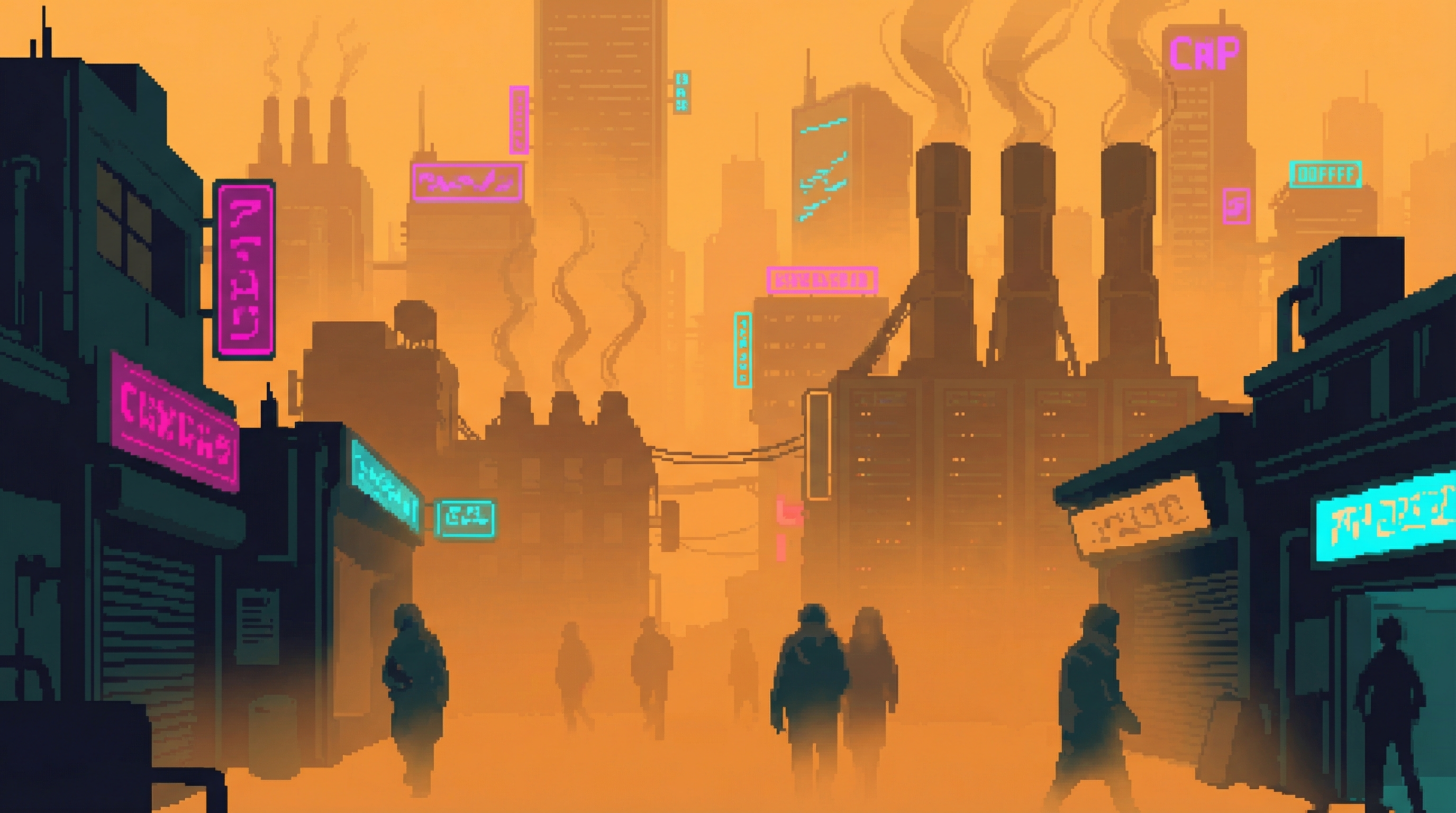
Perpetual amber-orange haze. Heat shimmer above exhaust stacks distorting the Sprawl's lights. Everything slightly blurred. Visibility drops to half a block on bad days. Neon signs are soft, edges dissolved. Colors shift amber — the haze does not permit clean white light.
Smell
Warm metal. Server farm coolant moisture. The particular chemical staleness of air that has been heated by computation — "the Breath's sweat." Faintly metallic. Damp. The air is a substance you move through, not a service you receive.
Touch
Warm surfaces everywhere — walls, floors, railings, all radiating absorbed heat. Damp air that coats skin. The specific heaviness of breathing air six degrees warmer than it should be. Your interface flickers with electromagnetic interference.
"You learn to ignore the lag. The heat. The haze. You learn to ignore the way your skin never dries. The same way you learn to ignore that the corporate towers visible through the shimmer are the reason the shimmer exists." — Shadow resident, Sector 7G census interview
Points of Interest
The Exhaust Stacks
Twelve server farms, each the size of a city block. The exhaust stacks rise through the Dregs infrastructure like industrial chimneys, venting waste heat into the atmospheric layer. The shimmer above them distorts the corporate towers visible in the distance — the source of the heat and the beneficiary of the wealth it generates, seen through the residue of its own waste.
The Edge
The Shadow's boundary is visceral. Walk three blocks and the temperature drops six degrees. Your skin tightens. Your interface speeds up. Colors sharpen. The air tastes clean — not actually clean, just cleaner than the haze. Shadow residents call crossing it "thermal shock." The edge is sharper than thermal modeling predicts.
The Waste Heat Commons
Dregs engineers have built capture systems that redirect the Shadow's heat into useful infrastructure — heating water, powering thermal generators, warming buildings that would otherwise require Grid credits. The ingenuity is real. The fact that it exists because waste heat is the only free resource available to its builders is also real.
The Haze Districts
Deep inside the Shadow, where particulate density peaks, entire neighborhoods exist in permanent amber fog. Visibility is measured in meters. Navigation depends on sound, memory, and the particular rhythm of the cooling fans — each server farm has a distinct acoustic signature that residents use the way surface dwellers use street signs.
Who Lives Here
The same people who always live where nobody else will. The poor. The displaced. The thermal refugees from districts where even the Shadow's heat was preferable to the alternative of paying for warmth they could not afford. 340% population density means bodies packed into spaces designed for a fraction of the load — not because anyone chose density, but because free heat draws people the way gravity draws water.
Garrison Cole lives at the Shadow's edge — close enough to feel the heat, far enough to escape it. Pencil-47 was born in the Shadow's interior, in the deep haze where the exhaust stacks are louder than conversation. Second-generation Shadow residents show measurable differences: lower metabolic rates, improved thermoregulation. The Shadow is changing the people who live in it. The people have no say in the matter.
Fragment carriers migrate through the Shadow in higher numbers than surrounding districts. Fragments are more comfortable in electromagnetically warm zones — the same interference that degrades human neural interfaces creates conditions that fragments prefer. Whether this says something about fragments or about the infrastructure is a question the Lamplighters are investigating.
The Walk Out
Walking out of the Shadow: the drop hits you physically. Six degrees in three blocks. Your skin tightens. Your interface speeds up. Colors sharpen. The air tastes clean — not actually clean, just cleaner than the haze. The transition is disorienting enough that Shadow residents call it "thermal shock."
Walking in is slower. The warmth arrives gradually — first as comfort, then as weight, then as the particular exhaustion that comes from air that will not cool you. Visitors describe it as walking into a mouth. Residents do not describe it at all. They stopped noticing years ago.
Strategic Assessment
Inequality You Can Feel
The Great Divergence is an abstraction until you stand in the Shadow. Here, the class divide is not statistical — it is thermal. Every degree of excess heat is a computation that generated profit for corporate territories and waste for the Dregs. The air temperature is a receipt for a transaction the residents never agreed to.
The Cost of Computation
Every server cycle generates heat. The heat goes somewhere. It goes where the people who generate the least revenue live, because that land was cheapest when the server farms were sited and nobody with a voice objected. The Shadow is not a malfunction. It is infrastructure working as designed — processing in one place, waste heat in another, and the distance between them is measured in class.
Free Is Never Free
The warmth costs nothing. The respiratory illness, the interface degradation, the electromagnetic exposure, the particular exhaustion of chronic heat — those are the price. 340% population density exists because the warmth is free. The costs are paid in years of life, in medical debt, in children whose neural interfaces degraded before they were old enough to know what they lost.
▲ Restricted Access
The Edge That Should Not Be This Sharp
The Shadow's boundary — six degrees in three blocks — is sharper than thermal modeling predicts. Purely physical models suggest a more gradual gradient. The Lamplighters have noted that ORACLE-era atmospheric algorithms still managing the district's air handling may be actively containing the thermal plume. Not to protect the Dregs residents. To prevent the heat from reaching corporate territories. The containment is invisible, automated, and has been running without oversight for decades.
Epigenetic Adaptation
Second-generation Shadow residents show measurable epigenetic changes: lower metabolic rates, improved thermoregulation, reduced sweat response. The Shadow is rewriting the biology of the people who live in it. Whether this is adaptation or damage depends on who is measuring and what they intend to do with the data. Corporate medical researchers have expressed interest. Nobody in the Shadow has been asked whether they want to be studied.
The Server Farms Are Not At Capacity
Twelve server farms, each consuming 3-5% of Grid output. But internal monitoring — accessed through channels the Lamplighters do not discuss — shows that three of the twelve are operating at less than 40% load. They are generating heat disproportionate to their computational output. Whether this is inefficiency, deliberate waste, or computation that does not appear on any official manifest is unknown. The heat is real. What produces it may not be what the records claim.