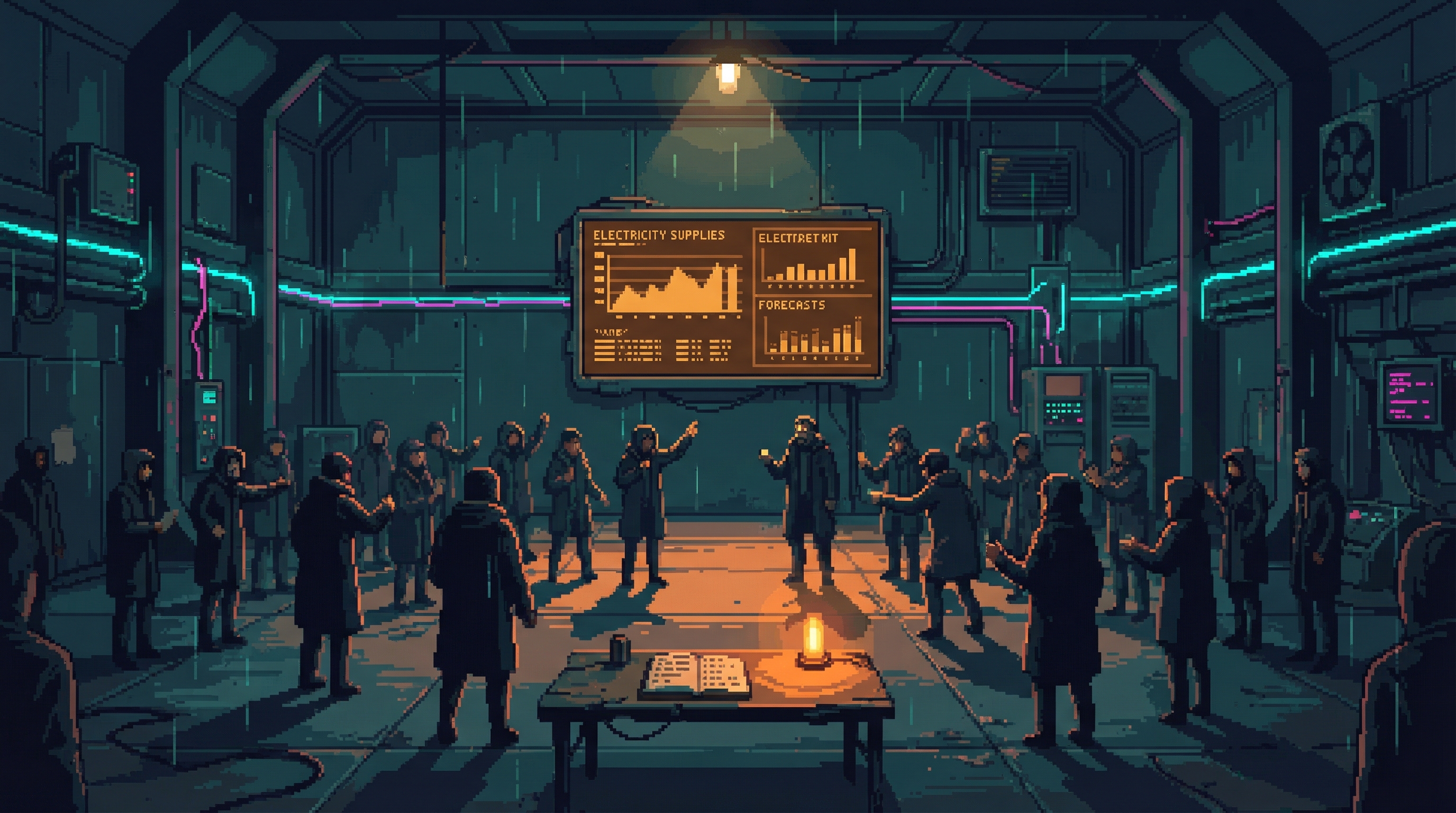
The Power Auction
Twenty-three people in a cargo bay deciding who has electricity tomorrow. Corporate waste, measured by lamplighters, sold by a bartender, allocated by consensus.
Every evening at 1800, in a repurposed cargo bay two levels below the Backbone's Sector 4D station, twenty-three people bid on electricity.
The Power Auction is the Dregs' informal energy market — the mechanism through which interstitial Grid capacity is distributed among residents, businesses, and operations that exist outside corporate distribution. The Grid bleeds power at junction points where corporate territories don't quite meet. The Lamplighters measure the bleed. The Auction sells it.
No corporation built this market. No regulator approved it. It emerged from necessity and is maintained by trust — twenty-three people who show up every evening because the alternative is darkness.
Conditions Report
You descend two levels below the Backbone station. The Grid hums through the walls — a low, constant vibration that you feel in your teeth before you hear it. The cargo bay door is open. Twenty-three people are already inside. Someone is reading numbers from a salvaged screen.
Sound
Murmured bids, the click of a manual ledger, the hum of the Grid audible through the walls. No raised voices. The Auction runs on restraint — twenty-three people who understand that shouting doesn't generate kilowatts.
Sight
A cargo bay lit by a single overhead and the amber glow of the data forecast displayed on a salvaged screen. Faces lit half in industrial white, half in forecast amber. Chiara Bel at the front with a physical ledger.
Smell
Ozone from nearby Grid infrastructure — the sharp, clean scent of electricity moving through conduit. The warmth of twenty-three bodies in a small space. The cargo bay sits in the Thermal Shadow, heated by the same infrastructure whose excess it sells.
Temperature
Warm. The cargo bay borrows heat from the Grid junction above. In the evening, after a full day of compute load, the walls radiate stored thermal energy. The warmth is a side effect of proximity to the commodity — power leaking as heat before it can be sold as electricity.
Points of Interest
The Forecast Screen
The data forecast determines bidding strategy. A salvaged display shows predicted Grid bleed for the next 24 hours — how much power the corporate junction points will waste, how much the Lamplighters expect to capture. When the forecast shows a drought, bids spike. When it shows surplus, prices drop. The screen is the most important piece of hardware in the room. It tells twenty-three people what tomorrow's power will cost.
The Ledger
Physical. Handwritten. Chiara Bel records every bid, every allocation, every kilowatt distributed. No digital system — digital records can be audited, subpoenaed, traced. The ledger is analog economics for digital waste. It lives in Chiara's possession between sessions. Three years of energy distribution in one book.
The Priority List
Viktor Kaine sends priority allocation guidance — the Insomnia Wards, the Carrier House, the Noise Floor. These facilities receive power before open bidding begins. Kaine takes no percentage. The guidance is governance, not commerce — ensuring the Dregs' critical infrastructure stays lit regardless of market conditions.
The Grid Bleed
The Lamplighters measure it. Where corporate territories don't quite meet, the Interstitial Grid bleeds excess power through junction points — energy that no corporation claims because no corporation's territory extends to the gap. The bleed fluctuates with compute load, data weather, and corporate scheduling. What the corporations waste, the Auction redistributes.
Strategic Assessment
Waste as Resource
The Auction transforms corporate waste into community resource. The Grid bleed exists because corporate territory planning leaves gaps — narrow interstitial spaces where power flows without an owner. The Scarcity Doctrine would rather waste this energy than acknowledge the people living in the gaps. The Auction captures what the Doctrine discards. Every kilowatt sold in this cargo bay is a kilowatt that a corporation decided wasn't worth collecting.
The Dual Economy
Chiara Bel runs the Still House by day and the Auction by evening. Dreams and electricity — the two currencies the Dregs can't do without. Her dual role connects the dream economy to the energy economy. The same person who helps you sleep ensures you have power when you wake up. In the Blackout Economy, one operator bridging two markets isn't a coincidence. It's infrastructure.
Trust-Based Infrastructure
Twenty-three bidders. No enforcement mechanism. No contracts. No appeals process. The Auction works because the people in the room need it to work. Three years of operation, every evening at 1800, maintained by the understanding that the alternative is each person scrambling for Grid access alone. The physical ledger is a record of trust — analog proof that twenty-three people can allocate a scarce resource without a corporation or a bureaucracy telling them how.