Forced-Focus Contracts: Selling What You Think
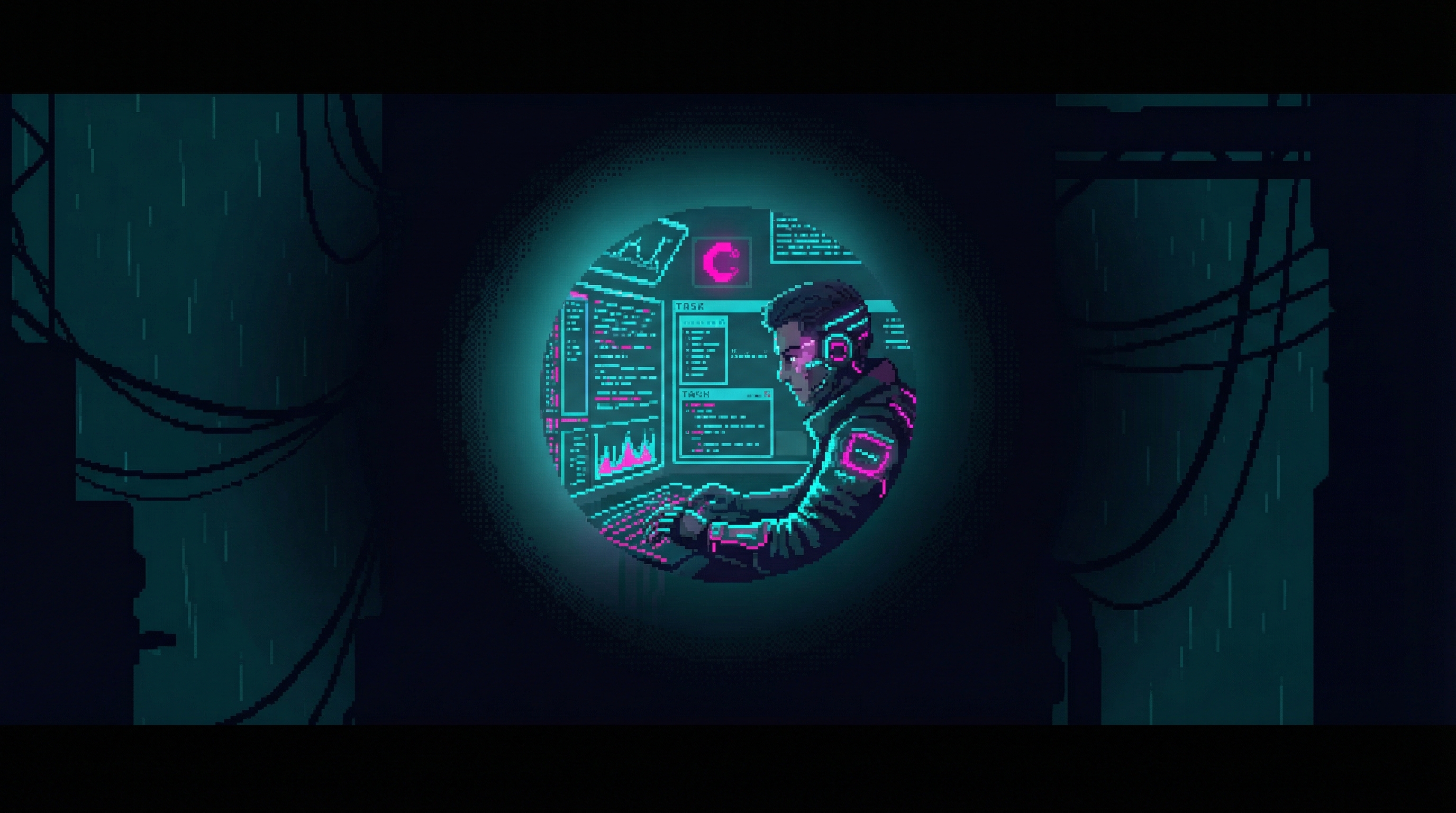
In the old world, you sold your time. Eight hours of your day belonged to your employer. What your mind did during those hours — whether it wandered, worried, fantasized, or focused — was your business. In the Sprawl, you sell your attention. Forced-focus contracts are labor agreements that require the worker's neural interface to lock cognitive bandwidth to corporate tasks for the duration of the shift. The locking is literal: the interface suppresses non-task cognitive threads, reduces peripheral awareness to a minimum, and channels the worker's full conscious processing capacity into a single stream of corporate-designated output. For twelve hours, you don't just work on the assigned task. The assigned task is all you can think about.
"The aftermath is worse. When the focus lock releases, consciousness floods back — and the flooding is disorienting in a way that worsens with repetition."
Quick Facts
How It Works
The shift begins with the Lock — approximately forty-five seconds of narrowing. Colors not relevant to the task fade. Sounds not relevant disappear. People become shapes. Consciousness collapses to a single point of brilliant clarity.
The Lock
~45 secondsThe neural interface suppresses non-task cognitive threads, reduces peripheral awareness to a minimum, and channels full conscious processing capacity into a single stream. Colors fade. Sounds disappear. The task becomes everything.
The Shift
12 hoursTwelve hours of total immersion. The assigned task is all the worker can think about. Productivity gains of 340% over free-focus for data analysis. Error detection at 99.7%. The mind reduced to a tool of extraordinary precision.
The Unlock
~20 minutesThe world rushes back. Colors, sounds, smells, people. Some workers cry during the Unlock — not from sadness, but from the specific overwhelm of being returned to the full breadth of consciousness after twelve hours of reduction.
Cognitive Rebound — "The Snap"
Long-term forced-focus workers develop permanent "cognitive rebound." The mind, freed from the tunnel, tries to expand back to its natural breadth and discovers that the breadth has narrowed permanently. After five or more years of continuous forced-focus work, the tunneling becomes the default state. The Dregs call it "the snap" — the moment you realize the world isn't rushing back anymore because the world has gotten smaller.
Flood Swimmers
Content moderators — "flood swimmers" — are the most damaged population. Their job requires immersion in the rawest Content Flood stream for twelve hours. They burn out at 73% within two years. The 27% who survive develop attentional callusing that makes them excellent at their jobs and barely functional as human beings.
The Sensory Reality
The Lock feels like looking through a tunnel that contracts from the periphery. The task is sharp. Everything else is dark. The Unlock feels like a dam breaking — the world flooding back in colors, sounds, smells, people. The twenty minutes of cognitive vertigo after the Unlock are the closest most forced-focus workers come to the experience of being born.
An eye with a corporate logo reflected as a pinpoint of light. Tunnel vision — sharp clarity at the center fading to dark at the edges. A narrow beam of illumination: everything within it is the task, everything outside it is nothing. The world dimmed to a single point of brilliant, productive focus.
Connections
Forced-focus contracts are the Attention Economy's primary labor instrument, performed in the Focus Mills, opposed by the Attention Abolitionists and the Cognitive Commons movement, and documented in the experiential narrative The Twelve-Hour Mind.
The Attention Economy
Forced-focus contracts are one of the Attention Economy's primary labor instruments — attention sold, metered, and locked to corporate output.
The Focus Mills
The Focus Mills are where forced-focus work physically happens — the factories of cognitive labor.
The Attention Abolitionists
The Abolitionists' primary target — they fight to end forced-focus labor and restore cognitive sovereignty.
The Cognitive Commons
The Commons movement frames forced-focus as enclosure of cognitive sovereignty — the privatization of thought itself.
Ren Vasquez
Seven years of mill work narrowing his attention while paying for his daughter's — the human cost made personal.
Ezra Vane
The Focus Mill Incident — 17 minutes of cognitive civil war that changed everything.
The Twelve-Hour Mind
Experiential narrative documenting what a forced-focus shift feels like from inside — the definitive account.
The Tensions
Forced-focus contracts sit at the intersection of productivity, exploitation, and the question of what it means to own a mind — tensions that 14 million workers navigate every shift.
Cognitive Sovereignty
The right to choose what you think about is the last human freedom. Neural interfaces can lock consciousness to a corporate task stream, but whether anyone should have the power to direct another person's attention — even with consent — remains the defining civil rights question of the Sprawl. The 14 million workers under forced-focus contracts have answered that question with their signatures. Whether desperation constitutes an answer is a different matter.
Desperate Consent
Forced-focus contracts pay 40% above standard Dregs wages. You can refuse forced-focus and starve, or accept it and lose part of your mind. The contracts are voluntary — nobody holds a gun to a worker's head. But when the alternative is the Content Flood raw and wages that don't cover consciousness licensing, the line between consent and coercion dissolves. The corporate position is that desperate consent is still consent. The Abolitionists disagree.
The Narrowing
Technology that makes you more productive at the cost of making you less human. The 340% productivity gain is real — forced-focus workers are extraordinarily effective. The cognitive rebound is also real — after five years, the tunneling becomes permanent. The mind optimized for corporate output becomes a mind incapable of the breadth that makes consciousness worth having. The product being optimized is also the product being damaged.
If you sell your attention for twelve hours, what happens to the person who wasn't paying attention?
Secrets & Mysteries
The Unmeasured Cost
The 340% productivity gain is real. The cognitive damage is also real. No corporate study has ever measured both simultaneously because the study design would require acknowledging that the product being optimized is also the product being damaged. The data exists in fragments — productivity metrics in one database, medical records in another — and the gap between those databases is maintained with the same precision as the productivity gains themselves.