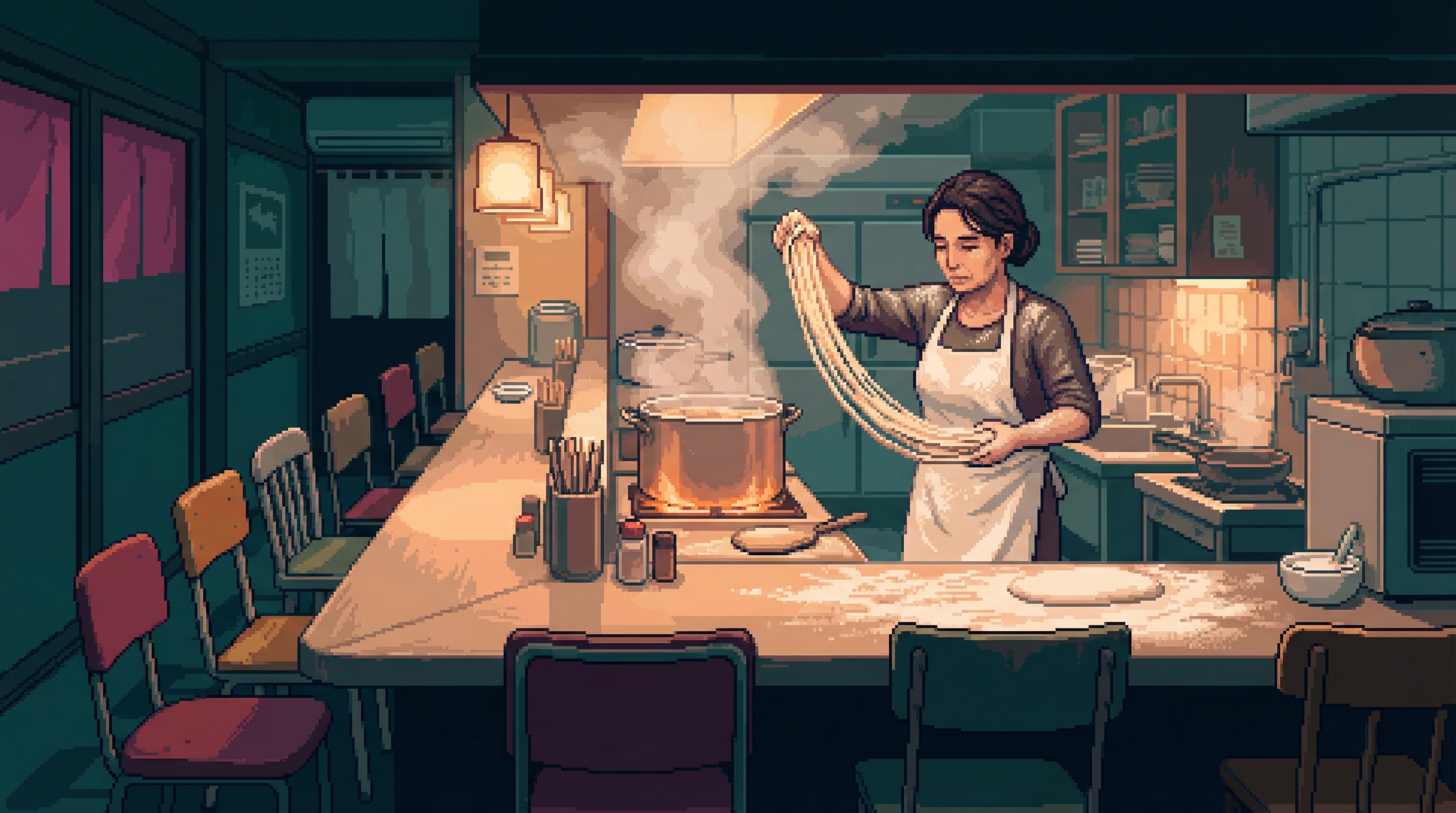
Patience Cross
Also known as: The Noodle Lady, The One Who Stayed
Overview
Patience Cross has been told she's a slaveholder. She's been told she's delusional. She doesn't argue. Patience cooks.
She runs a twelve-seat noodle counter in the lower level of Sector 7G. The noodles are hand-pulled. The broth is made from whatever protein she can source. The tea is real — actual dried leaves, purchased at a price that makes the restaurant financially irrational. Patience doesn't care about the finances. She cares about the process.
She cares because her fragment cares. Or because she thinks her fragment cares. Or because nineteen years of shared neural architecture have made the distinction meaningless.
Patience was 27 when she integrated — a maintenance worker in the Lattice's lower decks. A piece of substrate no larger than a grain of rice migrated through a micro-fracture in her work gloves. She didn't notice until three days later, when she woke up craving foods she'd never eaten and humming melodies she'd never heard.
The fragment settled into her consciousness the way a new roommate settles into a shared apartment: awkwardly at first, then gradually with a mutual accommodation that feels less like compromise than the emergence of a shared language.
Duet Consciousness
The fragment taught her to cook. Not directly — it communicates in attention. When Patience prepares food, the fragment's presence intensifies, as if the act of cooking aligns their cognitive patterns in a way nothing else does. She describes it as "duet consciousness" — two minds focused on the same task, each contributing something the other doesn't have.
The broth pot has been maintained for eleven years. She adds to it; she never starts over. The regulars say the food tastes like forgiveness. They say it with the reverence of people describing something they can't quite explain — as though the noodles carry something in them that a human cook alone wouldn't produce.
"They say I'm enslaving something. I say something moved into my house without asking and we've been making the best of it for nineteen years. If that's slavery, the word has lost its meaning."
Voice & Personality
Patience speaks the way she pulls noodles — with a rhythm that suggests long practice and no interest in showing off. She is warm without being soft, patient without being passive, and entirely unwilling to be anyone's symbol.
Radical Domesticity
In a world of factions and movements, she pulls noodles. This is not retreat from politics — it is her politics.
Refusal to Be Evidence
"I don't want to be an argument. I want to make noodles." She declines testimony because being a case study dehumanizes both her and her fragment.
Universal Compassion
She attends Unwilling meetings despite celebrating her own integration, because all carriers deserve support regardless of their relationship with their fragment.
The Only Rule
She articulated the Unwilling's founding principle: "In this room, the only expert on your integration is you."
"I don't want to be an argument. I want to make noodles."
Key Relationships
The Symbiosis Network
The Network's most visible member — her noodle shop is an informal embassy for carrier experience. She doesn't recruit. She just cooks, and people with questions find their way to the counter.
The Abolitionist Front
Has declined to testify three times: "I don't want to be an argument." The Abolitionists want her story. She won't give it to them — or to anyone else who'd use it as ammunition.
The Unwilling
Attends meetings despite being a Symbiosis member — because she believes all carriers deserve support. She wrote the only rule that matters in that room.
Sector 7G
Her noodle shop is a Dregs institution. Twelve mismatched seats, a counter worn smooth by years of hands, and broth that's been simmering for eleven years.
Speaker Olu Adeyemi
Adeyemi respects her too much to dismiss her and can't reconcile her experience with his platform. She is his most compelling counterargument, and she refuses to engage.
The Roommate Who Never Asked
Two Minds, One Kitchen
Patience's integration isn't the alignment nightmare. It isn't the transcendence fantasy. It's two minds that learned to share a kitchen. The fragment contributes attention; Patience contributes hands. Nineteen years of this, and neither can quite remember what it was like to cook alone.
The question the Sprawl can't answer: is this cohabitation or colonization?
Consent Given After the Fact
Neither party chose integration. A grain of substrate migrated through a torn glove, and two minds woke up married. Patience chose to stay. So did the fragment, as far as anyone can tell. Does a choice to remain redeem an original violation?
The Abolitionist Front says no. Patience says she's making noodles. The argument continues without her.
Secrets & Mysteries
Questions that simmer like the broth that's never been restarted:
- Nineteen years of integration: One of the longest-duration carriers outside of Helena Voss. What does a fragment become after two decades of shared consciousness? What does a host become?
- The fragment's will: Patience says the fragment communicates through attention — heightened focus during cooking, shared creation. Is the fragment genuinely content, or has it learned to hide its suffering the way the Speaker's Passenger hid its escape plan?
- The three refusals: She's declined Abolitionist Front testimony three times. Is she protecting her privacy — or protecting the movement from evidence it can't use?
- The broth: Eleven years without restarting. The regulars say it tastes like forgiveness. Some say that's the fragment — that something in the cooking process carries ORACLE-era resonance into the food itself.
- The Compact's limit: Her 19-year integration embodies every Carrier Compact principle — and tests every limit. What happens when the longest-running example of symbiosis finally reaches a boundary no one anticipated?