The Dropout Protocol
Emergency Infrastructure Failure Response
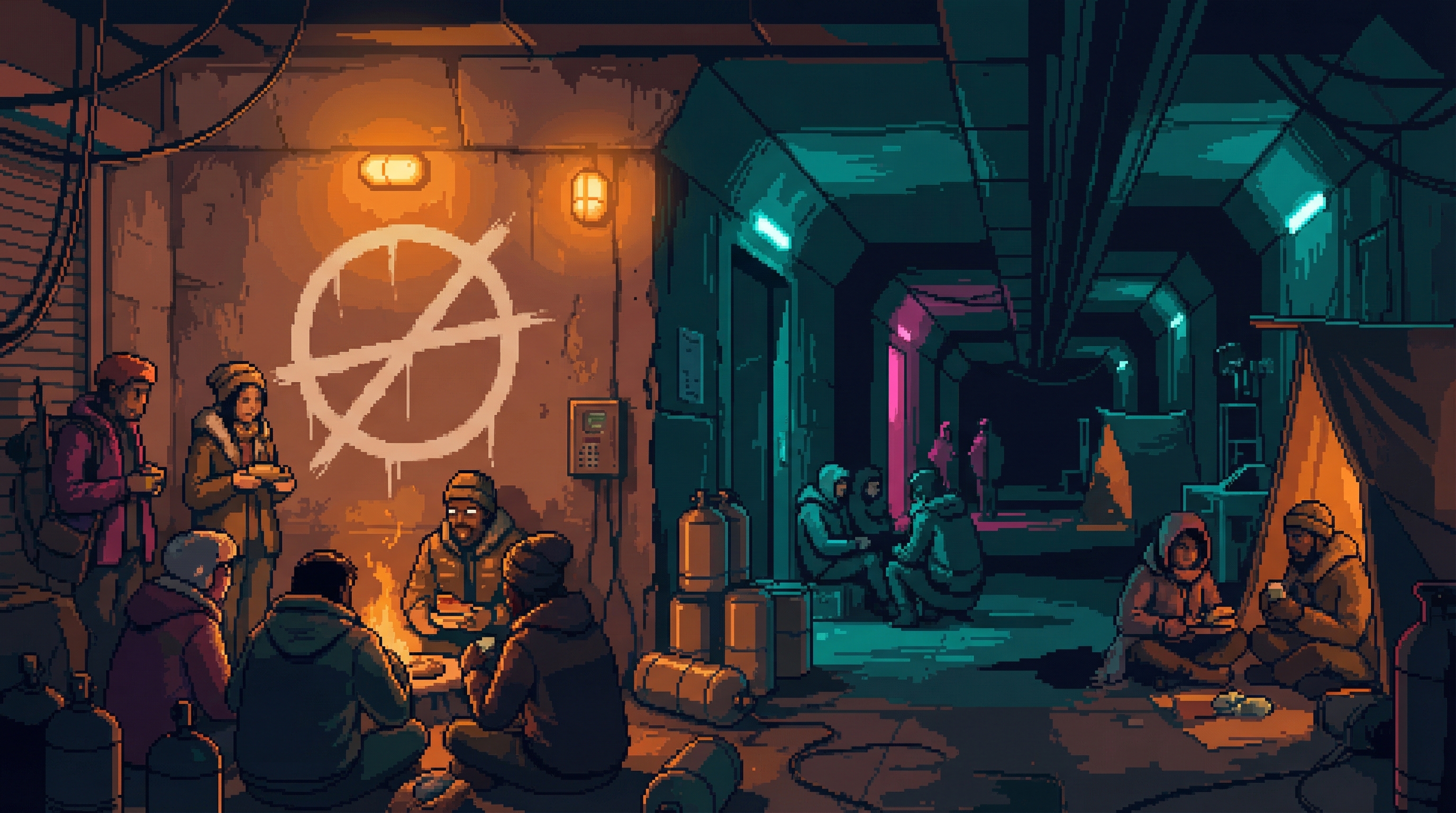
In corporate zones, when the Grid fails, automated systems kick in. Near-zero mortality. In interstitial zones, nobody comes. The Dropout Protocol is what happens instead — community-maintained survival practices that nobody designed, funded, or is responsible for. Formalized in 2168 after Sector 3C atmospheric failure killed 200 people, the Protocol exists for one reason: people kept dying until people stopped dying as much.
"It exists because people kept dying until people stopped dying as much." — Common saying in Sector 7G
Quick Facts
Detection: Reading the Signs
There are no alarms in interstitial zones. No automated warnings. No emergency broadcasts. Detection is sensory — the body learns what failure sounds like, smells like, feels like. Every resident of Sector 7G knows these signals the way they know their own heartbeat.
The Sensory Reality
Sound
The silence when the hum stops is not absence — it's physical pressure against the eardrums. The background drone of the Grid is so constant that its removal feels like a blow. Then, within seconds: voices. Practiced movements. Doors opening in sequence. The Protocol beginning.
Smell
Too many bodies packed into refuge spaces. Collective anxiety has its own scent — sharp, metallic, cutting through the stale recycled air. CO2 buildup carries a faint sweet quality that experienced residents recognize instantly, the way a miner recognizes gas.
Touch
Temperature drops at roughly one degree per minute when the Grid goes offline. Cold within thirty minutes. Shivering within an hour. In combined failures, the air itself thickens — breathing becomes labor, each inhale a conscious effort against rising carbon dioxide.
The Refuge Network
Every resident of Sector 7G knows the location of their three nearest refuges. They are marked with the dropout mark — a circle with a horizontal line through it — painted on walls, scratched into metal, etched into concrete. The mark is everywhere once you know to look for it.
Atmospheric Refuges
Most CommonLocations with manual ventilation access — hand-cranked air processors, connections to external atmosphere shafts, or stored compressed air. When the Breath fails, these spaces keep people breathing.
Power Refuges
CommonSpaces with independent generators — solar taps routed around the Grid, salvaged battery arrays, or hand-cranked dynamos. When the Grid drops, these provide heat and light.
Combined Refuges
RareLocations with both independent power and atmospheric capability. Extremely rare and invaluable. Bash Terminal's upper level is one. The Undervolt's Crossroads is another.
The Buddy System
The simplest component. The most important. Adjacent households check on each other. Nobody evacuates alone. Children, elderly, and augmented individuals are prioritized — augmentation draws Grid power, and when the Grid drops, augmented residents experience disorientation, pain, or system shutdown.
The 2175 Sector 8A Miracle
Sector 8A experienced complete Grid and Breath failure on November 3, 2175. Population: approximately 12,000. Duration: 14 hours before Lamplighter restoration.
Deaths: zero.
Every household checked on their neighbors within four minutes of the hum stopping. Every resident was accounted for within eleven minutes. Every refuge was occupied and operational within twenty minutes. The entire sector executed a perfect Protocol activation because they had been practicing it since childhood.
Corporate media did not report on the Sector 8A success. Ironclad's PR department issued a statement crediting "redundant infrastructure systems" for preventing casualties.
Drill Culture
Interstitial zone residents drill monthly. Not because anyone mandates it — there is no authority to mandate anything — but because the alternative is measured in body counts.
Children (Age 3+)
Can navigate to their nearest refuge blindfolded. It's one of the first things they learn, before reading, before arithmetic. The route is muscle memory — turn left at the broken pipe, down the stairs past the water collector, through the door with the dropout mark.
Teenagers
Compete on response time. Fastest evacuation routes are bragging rights. The inter-block competitions are part sport, part survival training, part community bonding. Record holders are local celebrities.
Adults
Know their buddy assignments, their refuge capacity, their role in the chain. Block captains coordinate. Nobody needs to be told what to do — the drill is the muscle memory that takes over when the hum stops and the fear starts.
Corporate Zones
Have none of this. No drills. No buddy system. No refuges. No dropout marks on the walls.
"Our infrastructure doesn't fail."
The corporate zones are correct — their infrastructure has a 99.97% uptime record. The 0.03% is someone else's problem. The Dropout Protocol exists in the gap between corporate reliability and human survival.
What It Means
The Dropout Protocol is mutual aid as infrastructure — community practices replacing systems that the powerful won't provide. It requires no power grid. No AI. No corporate authorization. No credentials, no employment verification, no augmentation requirements.
It is human solidarity as technology. The most reliable emergency system in the Sprawl runs on nothing but people who decided that their neighbors shouldn't die.
Mutual Aid as Infrastructure
When systems fail and nobody official responds, communities build their own. The Protocol wasn't designed — it evolved. Nobody is in charge of it. Everybody maintains it. It works because the alternative is forty-seven bodies per activation instead of twelve.
Human Solidarity as Technology
In a world saturated with AI and augmentation, the most effective emergency response requires no technology at all. Just people who know their neighbors' names. Just practiced movements in the dark. Just a mark on a wall and the knowledge of what it means.
Whispered Anomalies
ORACLE's Shadow
During the Sector 12 Blackout, ORACLE algorithms in adjacent districts appeared to protect surrounding zones — pre-allocating power, rerouting loads to contain the failure. No human made this decision. The dead god's residual code chose to sacrifice one district to save the rest.
Phantom Dropouts
Sometimes the signs appear — hum shifts, light flickers, the air thickening — with no detectable infrastructure failure. Residents activate the Protocol for what seems like nothing. But in two out of three cases, an actual failure follows within 24 hours.
Nobody can explain why the signs precede the failure. The prevailing theory is that ORACLE-era systems exhibit pre-failure cascading behaviors too subtle for current monitoring to detect — but human senses, tuned by decades of survival pressure, can feel them.