The Blackout Economy
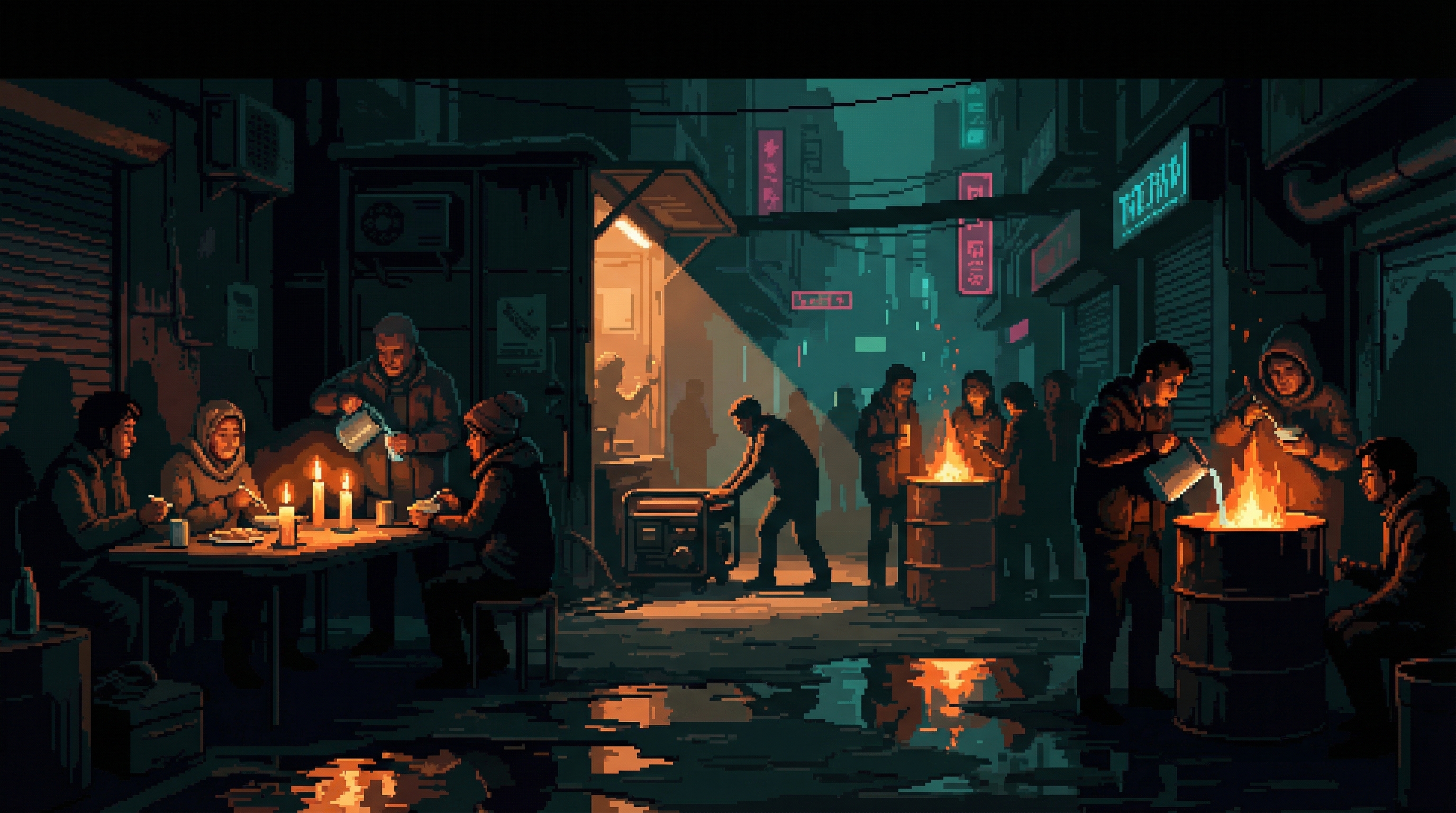
When the Grid fails — a Dropout Protocol activation, a compute drought severe enough to crash local infrastructure, a harmonic cascade that knocks out power — the formal economy stops. No consciousness licensing. No neural interface function. No digital transactions. No communication. No surveillance. What replaces it is the Blackout Economy: the informal system of exchange, cooperation, and survival that the Dregs' residents activate when the machines go quiet.
"The shadow becomes the substance when the lights go out. The substance becomes a shadow when the lights come back. But the relationships, the favors, the skills — those persist. They are the Dregs' real infrastructure."
— Dregs community organizer, post-blackout debrief Quick Facts
How It Works
The Blackout Economy runs on three currencies, none of which require infrastructure to function. Each currency gains value the moment the Grid loses power, and each is tracked by the oldest ledger system in existence: human memory.
Favors
Tracked through social memory, not ledgers. "I gave you water during the 2181 blackout" carries weight years later. Favor networks are the Dregs' banking system — dense, unwritten, enforced entirely by reputation. The more blackouts you've survived, the deeper your credit line.
Skills
Physical competencies invaluable when digital fails. Starting a fire. Purifying water. Navigating without augmented guidance. Setting a broken bone without a medical AI. These are the skills that competence atrophy has systematically eliminated from the general population — and the skills the Dregs have quietly preserved.
Stored Energy
Batteries, generators, solar cells — physical power independent of the Grid. Managed through the Power Auction, stored energy is the Blackout Economy's hard currency. A charged battery is worth more than corporate scrip when the lights go out.
The Hierarchy Inversion
The Blackout Economy inverts the Sprawl's class structure with brutal efficiency. In normal operation, augmentation equals power. Remove the infrastructure, and augmentation equals dependence.
The Most Augmented
Neural interfaces go dark. Cognitive enhancements stop. Enhanced navigation, augmented memory, AI-assisted decision-making — all gone. The corporate tier's advantage depends entirely on infrastructure. Without the Grid, they cannot navigate their own neighborhoods, remember their own schedules, or make decisions without algorithmic guidance. The most augmented become the most helpless.
The Unaugmented
The Lamplighters who restore power. The Dream Harvesters who perform physical labor without augmented assistance. The analog workers who never lost the skills the rest of the Sprawl surrendered. During a blackout, a person who can start a fire, purify water, or navigate without augmented guidance is wealthy. The unaugmented become the most valuable.
The Operators
G Nook operators maintain analog communication networks — physical bulletin boards, runner systems, signal lamps. When digital communication stops, these networks become the Dregs' nervous system. The operators are neither augmented nor fully analog; they are specialists in redundancy, maintaining infrastructure that matters precisely because it is primitive.
Related Systems
The Blackout Economy is embedded in the Dregs' survival infrastructure. It connects to the systems that trigger it, the systems it inverts, and the systems that sustain it.
Viktor Kaine
Kaine's governance is denominated in fifty years of blackout favors. His political capital is not corporate scrip or Grid access — it is the accumulated weight of debts owed and debts honored across decades of shared emergency.
The Lamplighters
The Blackout Economy's aristocracy. The Lamplighters restore power after Grid failures, and their ability to do so makes them the most valuable people in the Dregs during every blackout. Their status persists between failures — everyone remembers who brought the lights back.
The Dropout Protocol
The Blackout Economy's activation trigger. When the Dropout Protocol fires, the formal economy crashes and the informal economy rises. The two systems are coupled: the Protocol creates the conditions; the Economy provides the response.
The Power Auction
The Blackout Economy's energy infrastructure. The Auction distributes stored power during Grid failure, pricing energy through a system the Dregs designed for exactly these conditions.
Competence Atrophy
The Blackout Economy values exactly the skills that competence atrophy destroys. Each blackout is a census of what the Sprawl has lost: how many people can no longer start a fire, purify water, navigate without augmentation, think without algorithmic assistance.
The Scarcity Doctrine
During blackouts, the Dregs distribute resources more equitably than corporations ever have. The Blackout Economy is the Dregs' answer to the Scarcity Doctrine — not a rejection but a survival strategy that proves community-based distribution works.
Implications
The Blackout Economy is not an emergency response. It is a standing indictment of infrastructure dependence and a proof of concept for an alternative.
Competence as Survival Currency
The Sprawl's optimization has spent decades eliminating physical skills as inefficient, outsourcing them to AI systems and augmented workflows. Every blackout demonstrates the cost of that optimization. The skills the formal economy discarded are the skills the Blackout Economy runs on. The Dregs' preservationists — those who maintain analog competencies — are not luddites. They are the Sprawl's insurance policy.
Infrastructure Dependence as Vulnerability
The most augmented become the most helpless. This is not a philosophical observation; it is an operational fact observed during every blackout. Augmentation creates power by creating dependence. The Grid is not just an amenity — it is the foundation of an entire class's capacity to function. Remove it, and the hierarchy based on it collapses in minutes.
Community as Infrastructure
The relationships maintained through blackouts are more durable than any corporate system. Favor networks survive power failures. Skill networks survive compute droughts. The social bonds forged in shared emergency persist when the Grid returns, forming a parallel infrastructure that no corporation controls, no algorithm optimizes, and no surveillance monitors.
Field Report: Blackout Conditions
A blackout: the hum stops. Silence rushes in — not peaceful silence but the specific absence of infrastructure. The electromagnetic background noise that every Sprawl resident has heard since birth simply ceases, and the void it leaves is louder than any sound.
Darkness falls where emergency lighting fails. Voices replace interfaces. Candle flame replaces terminal glow. The smell of kerosene and cooking fire replaces recycled air. In the corridors of the Dregs, fire barrels cast amber light on gathered faces — the specific intimacy of shared emergency, where neighbors become infrastructure and human memory becomes the only ledger that matters.
And in that silence, the Dregs' oldest systems activate: neighbors checking on neighbors, water shared from stored supplies, skills deployed that haven't been needed since the last blackout. A hand-cranked generator sputters to life somewhere in the dark — human power replacing Grid power, one turn at a time.
"The Blackout Economy exists in potential at all times — a shadow economy that mirrors the formal one. When the lights go out, the shadow becomes the substance. When the lights come back, the substance becomes a shadow again. But the relationships, favors, and skills persist between blackouts. They are the Dregs' real infrastructure, more resilient than the Grid has ever been."