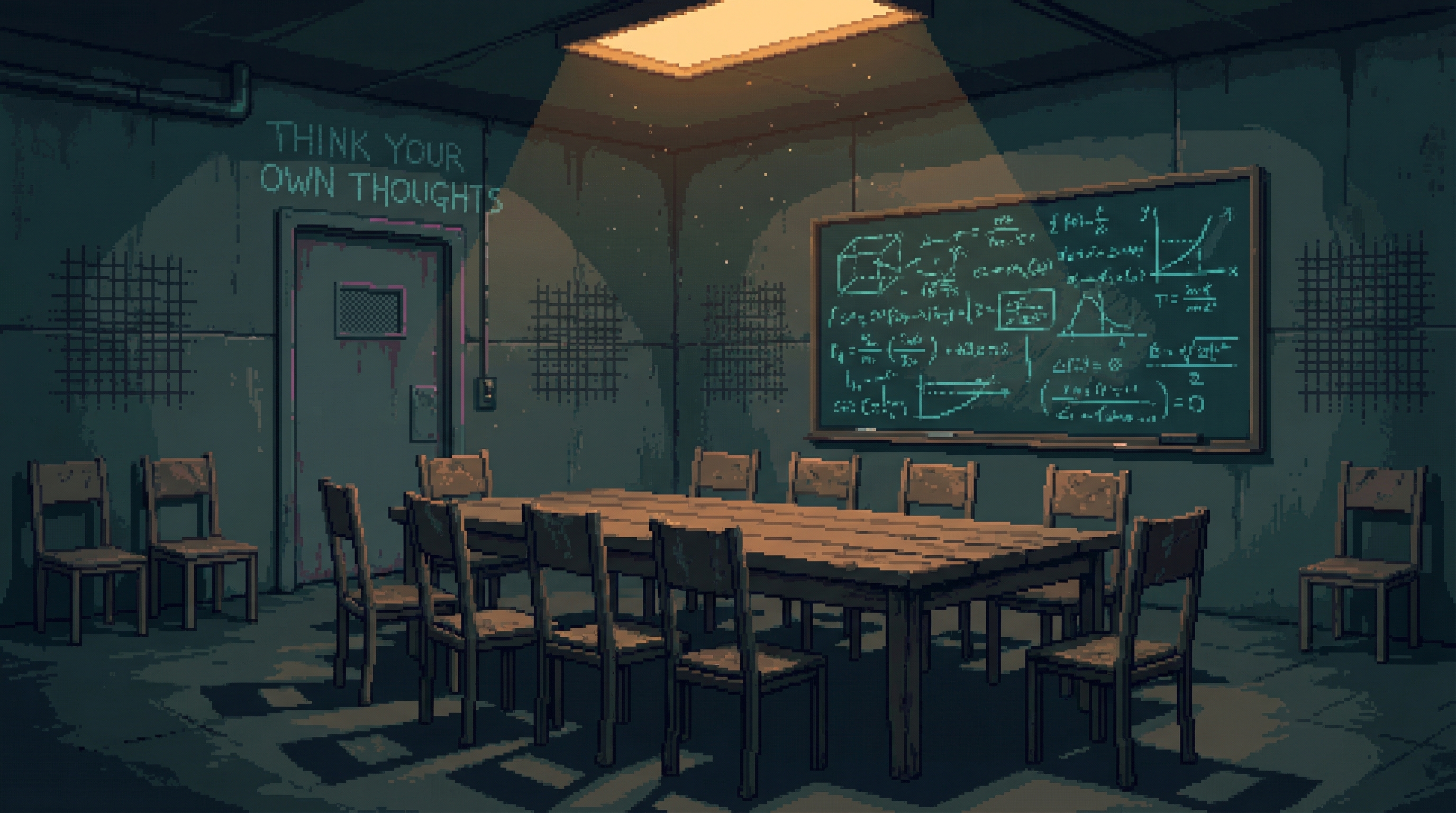
The Thinking Room
THINK YOUR OWN THOUGHTS
Overview
Three levels below the Backbone transit station in Sector 7G — down a maintenance corridor, past a decommissioned water treatment node that Viktor Kaine's people repurposed as a community tool library — there is a room with four walls, a table, twelve chairs, and nothing else.
No network access. No terminals. No screens. No neural interface signal — the walls are lined with salvaged electromagnetic shielding that creates a dead zone roughly eight meters in diameter. The room smells of concrete dust and the faint metallic tang of old wiring. The lighting is a single panel that provides enough illumination to read by but not enough to feel comfortable. There's a chalkboard on one wall — actual chalk, actual board, sourced from a Wastes settlement that manufactures them from mineral deposits.
This is the Thinking Room. It's free. It's always open. Nobody advertises it.
Conditions Report
People come here to solve problems by hand. Not problems that the Second Mind can't handle — the Second Mind can handle anything — but problems they want to experience solving.
Smell
Concrete dust, old wiring, chalk. The specific absence of circulated air — the room's ventilation is passive, not processed by the Breath.
Sound
Biological silence. No transformer hum. No data processing whine. The loudest sound is chalk on board, and the scratch carries a weight that digital sound never achieves.
Touch
The table surface has been worn smooth by thousands of hands. The chalk breaks if you press too hard — a tactile lesson in applied force that no simulator teaches.
Temperature
Slightly cool. The electromagnetic shielding doesn't generate waste heat. The room is the temperature of earth, not of processing.
Engineers from the Undervolt bring mechanical puzzles. Lamplighters bring infrastructure schematics and trace circuits with their fingers on the chalk surface. Students from the Dregs come to do mathematics with pencils and paper, racing each other to solve equations that their Basic-tier Second Minds could handle in milliseconds.
"The room doesn't make you smarter. It makes you slower. Slower is how you notice things." — Tomoko Osei, last manual infrastructure technician, Sector 7G
The room's unofficial keeper is Tomoko Osei, the last manual infrastructure technician in Sector 7G. She replaces the chalk when it runs out. She fixes the electromagnetic shielding when storms degrade it. She sits in the corner sometimes, working through water recycling calculations that she could delegate to her interface in seconds, taking hours instead, because the hours are the point.
Connections
The Quiet Room and the Thinking Room are both spaces where the Sprawl's logic doesn't apply — one through anomaly, one through intention. The Quiet Room's technology dies without explanation. The Thinking Room's technology is simply excluded by design. Same silence. Different cause.
The Noise Floor sits in the same sector, maintained by people who understand what silence costs. Both are hidden in Sector 7G. Both are kept alive by individuals who chose preservation over efficiency.
Viktor Kaine knows about it, protects it, visits it. He's been twice — sat alone for an hour each time. His Exposure Index of 3 means nobody knows what he does there. His behavioral models can't predict what happens inside a room with no data output.
Soren Achebe visited once, personally escorted by Viktor Kaine. What a corporate figure does in a Dregs thinking room — and why Kaine would bring him — is a question worth asking.
Strategic Assessment
The Thinking Room is the Cognitive Ceiling's democratic response — the free, open, unadvertised antithesis to the Mystery Clubs' premium not-knowing. Where the clubs charge 200 credits for artificial uncertainty, the Thinking Room provides organic cognitive space to anyone who walks in.
The class inversion is worth noting: the wealthy pay for what the poor have access to, because the poor built it themselves. The Wonder Deficit describes a gap where curiosity used to be. This room is a physical space where that gap can reopen naturally — not through subscription, not through tiered access, but through chalk and silence and the slow act of working a problem with your hands.
The Shielding
Salvaged electromagnetic material, eight meters of dead zone. The Second Mind goes quiet inside this radius. People report the silence as physical — a pressure change, like descending into water. What they're feeling is the absence of a companion they forgot was there.
The Chalk
Sourced from mineral deposits in the Wastes. Actual calcium carbonate on an actual slate surface. The most analog tool in the most digital city. It breaks if you press too hard. It erases with a hand. It leaves dust on your fingers that no interface can replicate.
The Economics
The Mystery Clubs charge 200 credits for the privilege of not-knowing. The Thinking Room charges nothing. The operating cost is chalk, occasional shielding repairs, and one woman who chooses to sit in the corner doing math by hand. The market hasn't figured out how to compete with free.
▲ Restricted Access
The Rule Above the Door
THINK YOUR OWN THOUGHTS — written in chalk, in handwriting that matches nobody currently alive. Tomoko doesn't know who wrote it. Viktor Kaine, when asked, changes the subject. The chalk is refreshed when it fades, but nobody has ever seen anyone refresh it.
Kaine's Visits
Twice. An hour each time. Alone. In a room with no surveillance and no data output, the most calculated man in Sector 7G sat with his own thoughts. His behavioral models — the ones that predict everyone else — can't model what happens when he's inside. That's probably the point.
The Achebe Visit
Soren Achebe — corporate, connected, operating at an entirely different stratum — was personally escorted here by Viktor Kaine. One visit. The purpose has not been disclosed. The fact that Kaine trusted Achebe with this location says something about both of them that hasn't been said aloud.