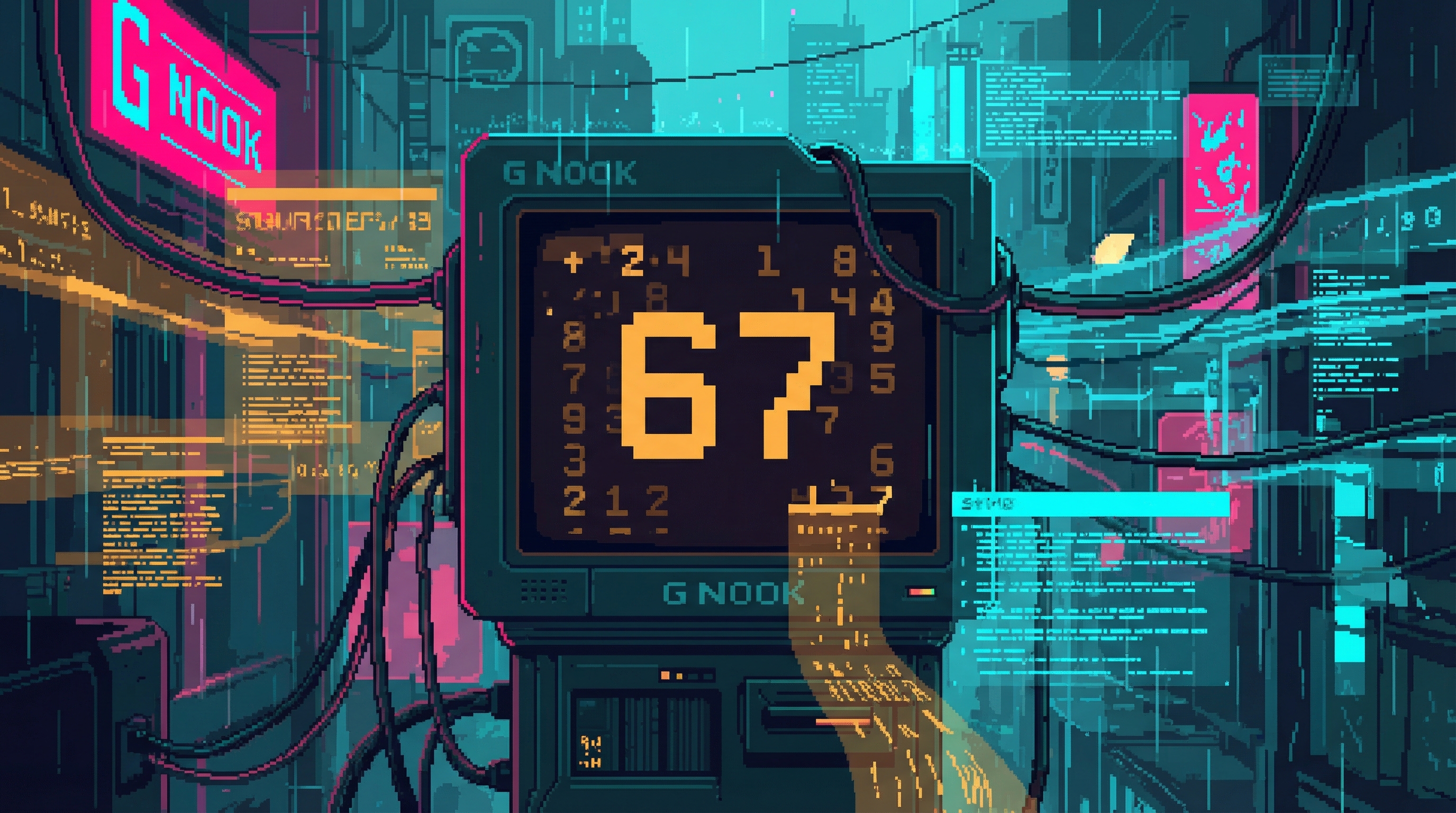
The Exposure Index: Your Transparency Has a Number
The Exposure Index is a number between 0 and 100 that tells you how visible you are. No corporation publishes it. The Opacity Movement built it — a free calculator running on G Nook terminals — because the first step toward resisting surveillance is knowing how much of it you're under. You enter four numbers. The result appears in amber text. And then you know.
"What's your glass score?"
— Common greeting in Opacity Movement circles Technical Brief
The Index combines five surveillance vectors into a single score. Each vector is weighted by the calculator's algorithm, which the Opacity Movement publishes openly — transparency about transparency.
Telemetry Granularity
How much raw data your interface generates per hour. Higher consciousness tiers produce denser telemetry streams. A Tier 3 neural interface broadcasts cognitive patterns, attention allocation, emotional valence, and micro-decision logs in real time. A pre-Cascade interface like Kaine's produces almost nothing.
Inference Accessibility
How easily AI systems can predict your behavior from available data. Employment in a corporate structure makes you more predictable — your routines are logged, your performance is measured, your preferences are mapped against millions of similar profiles. The unemployed and informal workers are harder to model.
Cross-Referencing Depth
How many systems can correlate your data with other datasets. Debt creates linkages — financial records connect to spending patterns, which connect to location data, which connect to social networks. Every debt obligation is a data bridge between systems that would otherwise not share information about you.
04 — Data Persistence
How long your data remains active and queryable in corporate systems. Residents of heavily monitored districts have near-permanent data trails. Those in surveillance gaps see their records decay faster.
05 — Real-Time Monitoring Intensity
How actively your current location surveils you right now. Residential district determines baseline monitoring — a G Nook address versus a corporate campus versus an off-grid settlement in the Wastes.
The Inverse Correlation
The Exposure Index maps inversely to the Loyalty Coefficient. Lower your Index — reduce your visibility — and your Loyalty Coefficient drops with it. Every point of privacy you gain costs you economic opportunity. The system does not punish opacity explicitly. It simply rewards transparency so aggressively that opacity becomes a luxury only the already-privileged can afford.
Implications
Naming the Invisible
Before the Index, surveillance was ambient — like air pressure, something you could feel but not measure. The Opacity Movement understood that you cannot resist what you cannot quantify. The Index transformed surveillance from a condition into a number, and a number can be compared, contested, reduced. The act of measurement is itself resistance.
The Double Bind
Privacy is punished. Not by law, not by policy, but by correlation. Your Exposure Index tracks inversely with your Loyalty Coefficient, which determines your access to credit, employment, and services. Reduce your visibility and you reduce your economic standing. The Sprawl does not forbid privacy. It simply makes privacy expensive enough that only those who can already afford to be invisible will ever achieve it.
The Social Metric
"What's your glass score?" In Opacity Movement circles, the question is a handshake. A low score earns respect — not because it indicates wealth, but because it indicates work. Someone who has actively reduced their visibility in a system designed to maximize it. In the Dregs, your Index is your credential. Not what you claim to believe about privacy, but what you have actually done about it.
The Tell
Opacity culture has made the Exposure Index a dating ritual. "The Tell" is the moment in a new relationship when you share your number. It happens differently depending on who you are.
The Proud Tell
Score in the 20s or lower. Stated early, stated plainly. A declaration: I have done the work. I know what I'm worth to the surveillance economy and I've reduced that value. Usually accompanied by a brief explanation of how — which interfaces were downgraded, which services were abandoned, which economic costs were absorbed.
The Ashamed Tell
Score above 60. Delayed, deflected, eventually confessed. The shame is not personal — everyone in the Dregs scores high. The shame is structural. You know the number. You know what it means. You cannot afford to change it. Sharing it is an act of trust: I am showing you how visible I am, how little I have been able to protect.
The Refusal
Some people will not share. In Opacity circles, this is respected — the refusal to quantify your own surveillance is itself a privacy act. In practice, a refusal usually means either an embarrassingly high score or someone who checked once and decided never to check again.
Sensory Profile
The Terminal
The calculator runs on G Nook terminals. Text-based. No graphics, no animation, no interface design meant to soften the delivery. You enter four numbers with physical keys. The screen thinks for two seconds. Then amber text, bright against black, delivers your score. The font is monospaced. The number takes up three characters.
The Moment
Everyone who has used the calculator describes the same sensation: a weight settling. Something previously felt but unnamed now given a figure. The number itself is never a surprise — you already knew, roughly, how visible you were. But seeing it quantified, reduced to digits, changes something. The ambient becomes specific. The structural becomes personal.
The Color
Amber on black. The specific warm tone of old-style phosphor displays, repurposed by G Nook culture as a statement: we compute without corporate aesthetics. No blue-white Nexus gradients. No soothing Wellness pastels. Amber — the color of self-knowledge in the Sprawl.
The Ritual
Some people check once and never again. Some check weekly, tracking the number like a health metric. A few have been known to check daily, watching their score fluctuate with location changes, debt payments, interface firmware updates. The Opacity Movement discourages this — the Index is meant to be a tool, not an obsession. But the line between measurement and compulsion is thin when the thing being measured is your own visibility.
Related Systems
The Opacity Movement
Created the Index as a consciousness-raising tool. If you cannot see the gradient, you cannot resist it. The Movement gave the Sprawl a mirror.
The Privacy Gradient
The Index measures what the Gradient describes. Each number maps to a tier of surveillance penetration — the Gradient is the territory, the Index is the map.
The Loyalty Coefficient
Inverse correlation. Lower Exposure means lower Loyalty, means less access, means less opportunity. The system makes privacy economically punished without ever explicitly forbidding it.
Viktor Kaine
Lowest recorded Index at 3. His antique pre-Cascade interface generates no modern telemetry. Proof that extreme privacy is achievable — if you happen to own hardware from before the surveillance infrastructure existed.
G Nook
Where the calculator lives. The terminals are free, the results are private — checking your Exposure Index is itself an act of minimal exposure.
Connected To
"I ran the calculator on a Tuesday. Scored 64. Felt about right — Dregs address, Tier 2 interface, two outstanding debt obligations. Then I ran it for my supervisor. Same district, same tier, but corporate employment and no debt. She scored 38. Twenty-six points of visibility separating us, and the only real difference was that she could afford to be less seen. That's when I understood what the number actually measures. Not surveillance. Poverty." — Anonymous Dregs worker, shared on G Nook message board, 2183